


Kaulu : The Hawaiian Kupua and Trickster Demigod
Listen
At a glance
| Description | |
|---|---|
| Origin | Hawaiian Mythology |
| Classification | Demigods |
| Family Members | Kukaohialaka (Father), Hinauluohia (Mother), Kamano, Kaeha (Brothers) |
| Region | Hawaii |
| Associated With | Trickery, Shapeshifting |
The Mythlok Perspective
From the Mythlok perspective, Kaulu represents a distinctly Hawaiian interpretation of power, one rooted in adaptability rather than dominance. He challenges the idea that creation must come through order alone, showing instead that disruption can restore balance. Comparable figures appear across cultures, from Māui in Polynesia to Loki in Norse tradition, yet Kaulu remains uniquely tied to landscape and ecology. His legend reminds us that intelligence and resilience often leave deeper marks on the world than brute strength ever could.
Kaulu
Introduction
Kaulu stands as one of the most enigmatic figures in Hawaiian oral tradition, a kupua whose stories sit at the intersection of trickster lore, divine rebellion, and cosmic reordering. Often translated as “the breadfruit sprout,” his name itself evokes youth, growth, and unexpected resilience. Kaulu’s legends describe a being who defied death even before birth, outwitted gods and spirits, and reshaped the physical and metaphysical landscape of the Hawaiian Islands. Unlike more widely exported Polynesian heroes, Kaulu’s narratives remain deeply rooted in local cosmology, preserving a worldview where cleverness rivals raw power and where even the gods can be challenged. His deeds explain why the ocean is salty, why dogs are small, and why waves no longer tower as they once did, placing him firmly among those mythic figures whose actions leave permanent marks on the world.
Physical Traits
Kaulu’s physical appearance is deliberately understated in most traditions, reinforcing the idea that his true strength lies beyond visible form. He is frequently described as a small boy or youthful figure, an image that contrasts sharply with his immense supernatural capabilities. This apparent fragility allows him to move unnoticed among humans and spirits alike, a vital aspect of his trickster nature. His body is said to be invulnerable, capable of withstanding lightning strikes and divine weapons without harm. Shapeshifting defines his physicality more than any fixed traits. Before birth, he famously transformed himself into a rope to escape death, and throughout his adventures he hides within leaves, shrinks his body, or alters his form to deceive akua and monsters. In Kaulu’s stories, the body is not a limitation but a tool, constantly reshaped to suit survival and strategy.
Family
Kaulu’s family background anchors his myths within the social and spiritual fabric of ancient Hawaii. He was born on Oahu to Kukaohialaka and Hinauluohia, figures associated with forest growth and plant life, linking him symbolically to fertility and regeneration. As the youngest of three brothers, Kaulu’s life is marked by conflict from the outset. His elder brother Kamano seeks to kill him before he is even born, embodying destructive and chaotic forces that threaten balance. Another brother, Kaeha, acts as his protector, hiding the rope-form infant and ensuring his survival. This tension between siblings reflects a broader mythological theme in Hawaiian lore, where creation and destruction emerge from the same familial source. Kaulu is not associated with a long lineage of descendants, and his brief marriage traditions do not emphasize progeny, reinforcing his role as a wandering force rather than a dynastic ancestor.
Other names
Kaulu’s name appears in several variations across chants and regional tellings, each highlighting a different aspect of his identity. The form “Ka-ulu” emphasizes youth and growth, while compound names connect him to groves, navigation, or specific exploits. Some traditions associate him with plant imagery, reflecting his parents’ woodland connections and his pre-pubertal identity. Other epithets emerge in famine stories or trickster episodes, where he adopts alternate names to deceive spirits and chiefs. This fluid naming tradition is typical of Hawaiian oral culture, where identity shifts according to role and circumstance. Rather than diminishing his character, these variations expand it, presenting Kaulu as a figure who resists singular definition.
Powers and Abilities
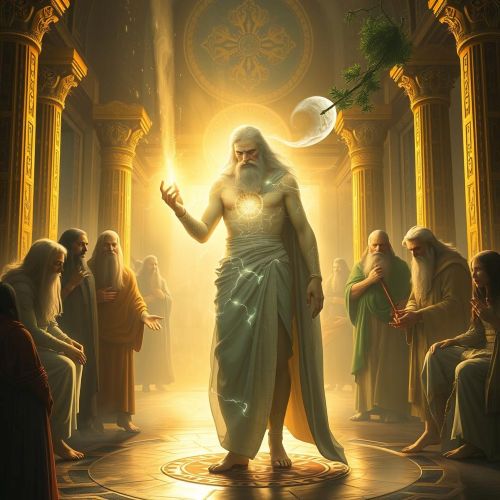
Kaulu’s powers are vast, but they are rarely expressed through straightforward domination. His strength is concentrated in his hands, enabling feats such as tearing apart divine sharks, crushing colossal waves, and defeating monstrous beings without weapons. One of his most famous acts involves drinking the ocean itself, permanently salting its waters and reducing its former immensity. He demonstrates absolute immunity to divine punishment, casually catching thunderbolts hurled by storm spirits. Shapeshifting allows him to infiltrate the realms of gods, where he steals sacred resources to end famine among humans. Kaulu also wields ritual knowledge, using chants and incantations to defeat powerful opponents. Even acts of apparent destruction carry creative consequences, as his battles reorder the natural world into a more habitable state. His abilities reveal a worldview where intelligence, adaptability, and courage redefine what power truly means.
Modern Day Influence
In contemporary Hawaii, Kaulu survives primarily through storytelling, scholarship, and cultural revival rather than mass media. His tales are preserved in folklore collections, academic studies, and traditional performances, where he is often compared to Māui yet recognized as distinctly local in character. Cultural practitioners view Kaulu as a symbol of resistance and ingenuity, embodying the survival of indigenous knowledge in the face of erasure. While he has not entered global popular culture on the scale of other Polynesian figures, his presence remains strong within Hawaiian identity, especially in discussions of land, balance, and the right to challenge authority. Kaulu’s relevance today lies not in spectacle but in meaning, offering a reminder that transformation often comes from subtle, clever defiance rather than overwhelming force.
Related Images



Source
Beckwith, M. (1970). Hawaiian mythology. University of Hawaii Press.
Fornander, A. (1880). An account of the Polynesian race (Vol. 2). Trübner & Co.
Kaulu. (2006, September 28). In Wikipedia. https://en.wikipedia.org/wiki/Kaulu
Pukui, M. K., & Elbert, S. H. (1986). Hawaiian dictionary. University of Hawaii Press.
Sterling, E. C., & Summers, C. C. (1978). Sites of Oahu. Bishop Museum Press.
Thrum, E. S. (1907). Hawaiian folk tales: A collection of native legends. A. C. McClurg & Co.
https://www.gutenberg.org/files/18450/18450-h/18450-h.htm
Thompson, V. L. (1969). Hawaiian legends of tricksters and riddlers. Rand McNally.
Westervelt, W. D. (1915). Hawaiian legends of ghosts and ghost-gods. George H. Ellis Press.
Wikipedia contributors. (2025). Kaulu. In Wikipedia. Retrieved January 19, 2026, from https://en.wikipedia.org/wiki/Kaulu
The Enlightenment Journey. (2023). Kaulu: Heroic figure in Hawaiian folktales. Retrieved January 19, 2026, from https://theenlightenmentjourney.com/kaulu-heroic-figure-in-hawaiian-folktales/
Hardy, J. (2024). The Hawaiian gods: Māui and 9 other deities. History Cooperative. Retrieved January 19, 2026, from https://historycooperative.org/hawaiian-gods/
Frequently Asked Questions
Who is Kaulu in Hawaiian tradition?
Kaulu is a kupua or demigod-like figure known for trickery, immense strength, and reshaping the natural world through his exploits.
Is Kaulu a god or a demigod?
How is Kaulu different from Māui?
What is Kaulu famous for?
He is known for shrinking the ocean, defeating divine monsters, outwitting gods, and surviving attempts on his life before birth.
Does Kaulu appear in modern popular culture?
Kaulu appears mainly in Hawaiian folklore studies and cultural storytelling rather than mainstream global media.


