Battle of Lanka : Rama’s Final War Against Ravana
| Description | |
|---|---|
| Origin | Indian Mythology |
| Epics/Texts | Valmiki Ramayana, Ramcharitmanas, Kamba Ramayanam |
| Key Characters | Rama, Sita, Lakshmana, Hanuman, Ravana, Vibhishana |
| Type of Event | Mythical War |
| Symbolism | Dharma vs. Adharma, Triumph of virtue, Fall of pride |
Mythlok Perspective
In Mythlok’s Perspective, the Battle of Lanka is not simply a war between heroes and villains but a layered conflict about power, ego, and moral responsibility. Ravana’s tragedy lies in the fact that he possesses wisdom, devotion, and strength, yet fails to master his own pride. Rama’s victory therefore represents more than military triumph; it reflects the victory of restraint over unchecked ambition. The battle also stands apart from many global war myths because of its spiritual dimension. Unlike the glory-driven conflicts of the Trojan War or the apocalyptic destruction of Ragnarok, the Ramayana frames war as a painful but necessary act to restore cosmic balance. Hanuman’s unwavering devotion further transforms the story from a royal conflict into a narrative about loyalty, faith, and service. Across cultures, the Battle of Lanka continues to endure because it speaks to a universal human struggle between higher ideals and destructive desire.
Battle of Lanka
Introduction
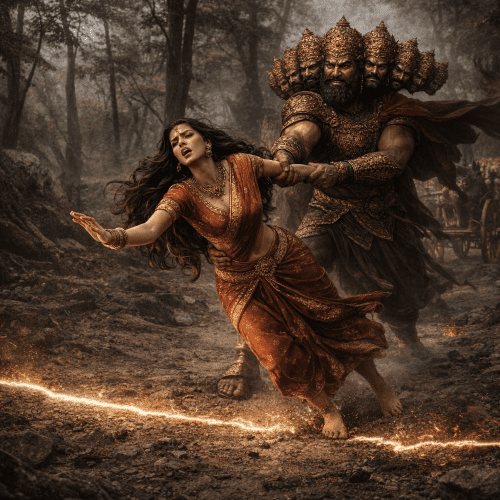
The Battle of Lanka is one of the most iconic wars in Indian epic literature and forms the climax of the Ramayana. The conflict begins after Ravana, the powerful king of Lanka, abducts Sita, the wife of Rama. Determined to rescue her and restore justice, Rama gathers allies including Hanuman, Sugriva, and the Vanara army before launching an invasion of Lanka. The battle is remembered not only for its scale and heroic duels but also for its deeper spiritual meaning.
In the epic, the war is portrayed as a struggle between dharma and adharma, or righteousness and chaos. Rama stands as the ideal ruler and protector of moral order, while Ravana’s pride and unchecked ambition ultimately lead to destruction. Across centuries, the Battle of Lanka has remained a powerful symbol of courage, loyalty, sacrifice, and the triumph of virtue over evil.
Source Texts
The primary source for the Battle of Lanka is the Valmiki Ramayana, especially the Yuddha Kanda, also known as the Lanka Kanda. Scholars generally place the composition of the text between roughly the 7th and 4th centuries BCE, although parts may have evolved over time through oral traditions. The Yuddha Kanda gives a detailed account of the siege of Lanka, the major duels, military strategies, and the final confrontation between Rama and Ravana.
Over the centuries, the story was retold in many regional traditions. Ramcharitmanas by Tulsidas transformed the narrative into a devotional masterpiece, emphasizing bhakti and Rama’s divine nature. In South India, Kambaramayanam by Kamban added poetic grandeur and emotional depth. Other versions, including the Adhyatma Ramayana and Jain retellings, reinterpret the battle according to different philosophical and religious viewpoints. Despite variations, the core conflict between Rama and Ravana remains central across all traditions.
Key Characters
At the heart of the Battle of Lanka is Rama, the seventh avatar of Vishnu and the embodiment of dharma. Calm, disciplined, and compassionate, Rama enters the war not for conquest but to restore justice and rescue Sita. His younger brother Lakshmana fights beside him throughout the campaign and plays a crucial role in defeating some of Lanka’s greatest warriors.
Hanuman emerges as one of the most beloved figures in the epic. His devotion to Rama defines his character, and his actions become decisive to the war effort. Before the battle even begins, Hanuman infiltrates Lanka, discovers Sita’s location, and later burns sections of the city during his escape. Sugriva, the Vanara king, provides Rama with the massive army needed to challenge Ravana’s forces, while Angada serves as a fearless warrior and envoy.
On the opposing side stands Ravana, the ten-headed ruler of Lanka. Ravana is not portrayed as merely evil; he is also described as a brilliant scholar, a devotee of Shiva, and a formidable warrior. However, his arrogance and obsession with power lead to his downfall. His son Indrajit, also called Meghanada, becomes one of the deadliest fighters in the war due to his mastery of celestial weapons and illusionary warfare. Ravana’s giant brother Kumbhakarna represents raw destructive power, while Vibhishana, Ravana’s righteous brother, defects to Rama’s side after failing to convince Ravana to return Sita peacefully.
Narrative Summary
The Battle of Lanka begins after Rama’s forces construct the legendary Rama Setu bridge across the sea to reach Lanka. According to the epic, the bridge was built by the Vanara army under the guidance of Nala and allowed the invading forces to cross into Ravana’s island kingdom. Before the fighting starts, Rama offers Ravana one final chance to avoid war by returning Sita, but Ravana refuses.
Once the siege begins, fierce clashes erupt between the Vanara warriors and the Rakshasa armies. Unlike conventional armies, the Vanaras rely heavily on physical strength, uprooted trees, rocks, and sheer numbers to overwhelm Lanka’s defenses. Several powerful generals from Ravana’s side fall during the early stages of the war, but the conflict escalates dramatically when Indrajit enters the battlefield.
Indrajit uses celestial weapons to incapacitate both Rama and Lakshmana, creating panic among the Vanara forces. Later, Lakshmana is gravely wounded during another encounter, forcing Hanuman to undertake his famous journey to retrieve the Sanjeevani herb from the Himalayas. Unable to identify the exact herb, Hanuman carries the entire mountain back to Lanka, saving Lakshmana’s life.
Ravana eventually awakens Kumbhakarna, whose massive size and strength devastate Rama’s army. Despite his terrifying presence, Kumbhakarna is ultimately slain by Rama. Soon after, Lakshmana defeats Indrajit, weakening Ravana’s morale and military strength.
The war concludes with the legendary duel between Rama and Ravana. Guided by Sage Agastya’s Aditya Hridayam hymn and armed with divine astras, Rama finally kills Ravana using the Brahmastra. Following the victory, Vibhishana is crowned king of Lanka, and Sita reunites with Rama. Some versions of the Ramayana also include the Agni Pariksha episode, where Sita proves her purity through a trial by fire.
Symbolism
The Battle of Lanka carries layers of symbolic meaning that extend far beyond warfare. Rama represents self-control, justice, and moral order, while Ravana symbolizes ego, pride, and uncontrolled desire. The war itself reflects the eternal struggle between higher ideals and destructive impulses within human nature.
Ravana’s ten heads are commonly interpreted as representations of negative human qualities such as anger, greed, arrogance, attachment, and lust. His immense knowledge and power show that wisdom alone is not enough without humility and ethical restraint. In contrast, Rama demonstrates balance, discipline, and devotion to duty even during moments of grief and conflict.
Hanuman’s role symbolizes the strength that comes from faith and selfless service. The construction of Rama Setu is often seen as a metaphorical bridge between the human and divine realms, representing how determination and devotion can overcome impossible obstacles. The Sanjeevani episode further reinforces themes of hope, resilience, and renewal in times of despair.
Comparative Mythology
The Battle of Lanka is frequently compared to other great mythological wars from around the world. One of the strongest parallels appears in the Iliad, where the abduction of Helen triggers the Trojan War. Both epics involve large-scale invasions, heroic champions, divine intervention, and the destruction of a powerful city.
Unlike the Trojan War, however, the Ramayana places a much stronger emphasis on moral duty and spiritual order. Rama fights not for personal glory but to uphold dharma and rescue Sita. This ethical dimension gives the Battle of Lanka a distinct philosophical foundation compared to many Western war epics.
Some scholars also compare the conflict to Ragnarok from Norse tradition because both narratives depict cosmic struggles between opposing forces. In Southeast Asia, localized adaptations such as Thailand’s Ramakien and Indonesian shadow-play traditions reshape the story according to regional cultures while preserving the central themes of loyalty, heroism, and justice.
Cultural Impact
The Battle of Lanka has deeply influenced religious practices, festivals, theater, and visual art throughout South and Southeast Asia. In India, the victory of Rama over Ravana is celebrated during Dussehra, where giant effigies of Ravana are burned to symbolize the destruction of evil. Diwali is also linked to Rama’s return to Ayodhya after the war.
Traditional Ramlila performances dramatize scenes from the Ramayana and remain an important part of cultural life in many regions. Temple carvings, murals, and miniature paintings frequently depict major moments from the battle, including Hanuman carrying the mountain and Rama’s duel with Ravana.
The story has also shaped cultural memory in Sri Lanka, where several locations are associated with Ravana and the events of the Ramayana. These traditions continue to attract pilgrims, historians, and travelers interested in the epic’s enduring legacy.
Modern Influence
The Battle of Lanka continues to inspire modern literature, cinema, television, and digital media. Ramayan by Ramanand Sagar introduced the epic to millions of viewers and became one of the most influential television productions in Indian history. Animated films such as Ramayana: The Legend of Prince Rama brought the story to international audiences.
Modern authors including Amish Tripathi
and Ashok Banker
have reimagined the war from new perspectives, often exploring Ravana’s motivations in greater psychological depth. Graphic novels, video games, YouTube adaptations, and online storytelling platforms continue to reinterpret the conflict for younger generations.
In Southeast Asia, performances such as Indonesia’s wayang kulit shadow plays and Bali’s kecak dance preserve the story as a living cultural tradition. Even in modern discussions about leadership, morality, and justice, the Battle of Lanka remains a timeless reference point that continues to resonate across cultures.
Sources
Wisdom Library. (2024). Battle of Lanka: Significance and symbolism. https://www.wisdomlib.org/concept/battle-of-lanka
Britannica. (2026). Ramayana | Summary, characters, themes, & facts. https://www.britannica.com/topic/Ramayana-Indian-epic
Wikipedia. (2026). Ramayana. https://en.wikipedia.org/wiki/Ramayana
Hindu Culture Hub. (2025). The divine conflict: Significance of the War of Lanka in Ramayana. https://hinduculturehub.com/texts-scriptures/ramayana/war-of-lanka/
Valmiki. (1984). The Ramayana of Valmiki: An epic of ancient India: Vol. 6. Yuddhakanda (R. P. Goldman, Trans.). Princeton University Press. (Original work ~500 BCE)
Pollock, S. (1991). The Ramayana of Valmiki: Vol. 3. Aranyakanda. Princeton University Press.
Tulsidas. (1576). Ramcharitmanas. (Bhaktivedanta Book Trust edition, 2010).
Goldman, R. P. (1984). Resisted readings: The Ramayana of Valmiki. Journal of the American Oriental Society, 104(3), 565-570.
Frequently Asked Questions
What was the Battle of Lanka?
The Battle of Lanka was the final war in the Ramayana where Rama and his allies fought Ravana to rescue Sita and restore dharma.
Who killed Ravana in the Battle of Lanka?
Rama killed Ravana using the divine Brahmastra after a long and devastating duel in Lanka.
Why did the Battle of Lanka happen?
The war began after Ravana abducted Sita and refused Rama’s repeated demands to return her peacefully.
What is the significance of Rama Setu?
Rama Setu symbolizes devotion, determination, and the bridge between human effort and divine support.
Which text describes the Battle of Lanka?
The most detailed account appears in the Yuddha Kanda of the Valmiki Ramayana.