


Gonggong : The Cataclysmic Water Deity of Chinese Mythology
At a glance
| Description | |
|---|---|
| Origin | Chinese Mythology |
| Classification | Gods |
| Family Members | N/A |
| Region | China |
| Associated With | Water |
Mythlok Perspective
In Mythlok’s Perspective, Gonggong stands apart from many water deities because his mythology is less about mastery of water than the consequences of forces that cannot be contained. His clash with Zhuanxu or, in later traditions, Zhurong, resembles other elemental figures such as Mesopotamian Tiamat, where disorder threatens cosmic stability. Yet Gonggong remains distinctly Chinese in the way his destruction becomes an explanation for the shape and movement of the natural world.
Gonggong
Introduction
Gonggong is one of the most striking figures in Chinese mythology, remembered primarily as a powerful figure associated with water, floods, rebellion, and cosmic disorder. His mythology survives in several ancient Chinese texts, including the Huainanzi and Shan Hai Jing, although these sources do not always present the same story or genealogy. This is important because there is no single, standardized biography of Gonggong in Chinese mythology.
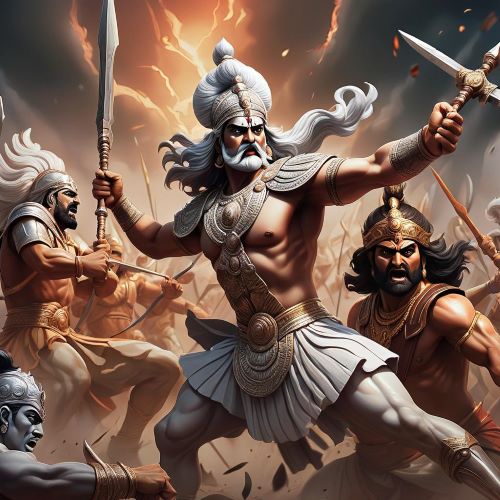
Gonggong is best known for the catastrophe that followed his defeat in a struggle for supremacy. In the account preserved in the Huainanzi, he fought Zhuanxu and, after losing, struck Mount Buzhou, one of the supports of the heavens. The resulting damage caused heaven and earth to become misaligned, providing a mythological explanation for the movement of celestial bodies and the direction of rivers. Later traditions associate Gonggong’s defeat with Zhurong, the god of fire, creating one of Chinese mythology’s most memorable conflicts between water and fire.
Rather than simply representing evil, Gonggong can be understood as a figure of overwhelming natural and political disruption. His story reflects an ancient concern with maintaining order in a world where floods, unstable landscapes, and other natural forces could threaten human life.
Physical Traits
Gonggong’s appearance varies considerably between textual traditions, later folklore, and artistic representations. Traditional descriptions commonly give him a human-like head combined with a serpentine body, emphasizing his connection with the elemental world. Some accounts and later descriptions associate him with a copper-coloured face, an iron forehead, and red hair, giving him an imposing and distinctly supernatural appearance.
Artists have subsequently interpreted Gonggong in more dragon-like or aquatic forms, sometimes giving him dark scales, horns, or other monstrous characteristics. These features are especially common in modern visual adaptations and should not be treated as a single fixed appearance from ancient Chinese literature.
The serpent-like form is particularly appropriate to Gonggong’s mythology because serpents and dragons occupy an important place in Chinese traditions surrounding water, rivers, rain, and aquatic forces. His unusual body therefore functions less as a literal portrait and more as a visual expression of his association with dangerous and uncontrollable waters.
Family
Gonggong’s family relationships are difficult to establish because different ancient sources preserve different genealogical traditions. Rather than providing one consistent family tree, Chinese mythology places Gonggong within several overlapping accounts of primordial rulers, deities, and elemental powers.
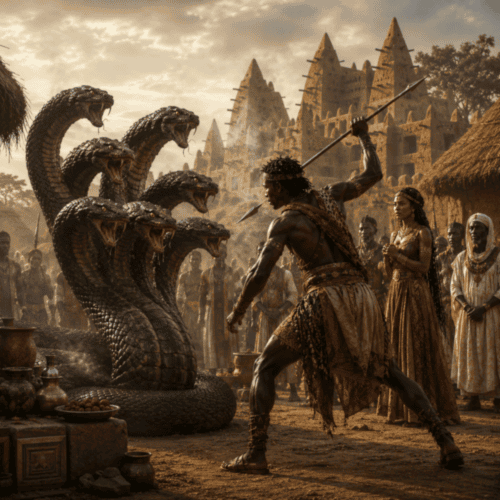
His relationship with Xiangliu is clearer. In the Shan Hai Jing, Xiangliu is described as a minister of Gonggong. Xiangliu has nine heads and a serpent-like body and is associated with destruction and poisonous, waterlogged landscapes. After Xiangliu’s death, the places affected by him remained unsuitable for habitation until they were dealt with by Yu, the legendary flood controller.
Gonggong is also linked with major figures involved in the ordering of the cosmos. His best-known conflict is with Zhuanxu in the Huainanzi, while other traditions make Zhurong, the fire deity, his principal opponent. These differing relationships demonstrate how Gonggong’s mythology developed across separate textual traditions rather than from a single unified family narrative.
Other names
The name Gonggong (共工) is commonly written as two characters in Chinese and is also rendered as Gong Gong in English-language works. Kung-Kung is an older romanization that appears in some Western translations and scholarship.
Gonggong is also associated with the name Kanghui (康回) in traditional and scholarly interpretations. However, the textual relationship between Kanghui and Gonggong is not as straightforward as simply treating Kanghui as an interchangeable name. For this reason, the name Gonggong remains the clearest and most widely recognized designation for the mythological figure.
His descriptions and roles also vary according to the source. In some contexts Gonggong appears as a powerful water-associated deity or ruler, while in others he functions primarily as a rebellious figure whose actions contribute to a cosmic catastrophe.
Powers and Abilities
Gonggong is strongly associated with water and destructive floods, although ancient Chinese mythology does not provide him with a fixed catalogue of supernatural abilities. His power is instead revealed through the scale of the disasters connected with his actions.
His most important myth is the destruction of Mount Buzhou. In the Huainanzi, Gonggong engages Zhuanxu in a struggle for supremacy. After being defeated, he becomes enraged and strikes Mount Buzhou with his head. The mountain was regarded as one of the supports connecting heaven and earth, and its destruction throws the cosmos out of balance.
The consequences are enormous. Heaven is said to incline toward the northwest while the earth slopes toward the southeast. This cosmological imbalance provides a mythical explanation for why celestial bodies follow their observed paths and why rivers ultimately run toward the lower eastern or southeastern regions. The story transforms a physical feature of the natural world into a consequence of a primordial struggle.
Other traditions replace Zhuanxu with Zhurong, creating a battle between the forces of water and fire. This version has become particularly influential in later retellings. Gonggong’s defeat by Zhurong is followed by his furious attack on Mount Buzhou, preserving the same essential catastrophe even though the identity of his opponent differs.
Gonggong’s significance therefore extends beyond flooding. He represents a force powerful enough to disturb the fundamental relationship between heaven and earth. His story places destruction within a larger cycle in which disorder threatens the cosmos and must ultimately be corrected.
Modern Day Influence
Gonggong remains an influential figure in modern interpretations of Chinese mythology. His story continues to appear in literature, illustrated retellings, animation, games, fantasy fiction, and contemporary discussions of ancient Chinese cosmology. Modern artists frequently emphasize his connection with floods, dragons, and catastrophic natural forces, giving visual form to a character whose ancient descriptions are far less uniform.
His astronomical legacy is particularly notable. In 2020, the International Astronomical Union approved the name Gonggong for the distant trans-Neptunian object 225088, formerly known by its provisional designation 2007 OR10. The object is commonly described as a dwarf planet or possible dwarf planet. Its moon was officially named Xiangliu, creating a direct connection between the modern astronomical naming system and the relationship between Gonggong and his minister in Chinese mythology.
The survival of these names illustrates how Gonggong has moved beyond ancient storytelling into modern science and popular culture. His mythology also continues to offer a useful symbol for thinking about environmental destruction, political rebellion, and the fragile boundary between order and disorder.
At the heart of the Gonggong tradition is not simply a tale about a destructive water deity. It is a story about what happens when a powerful force breaks the structures that hold the world together. Mount Buzhou’s collapse turns personal defeat into a cosmic catastrophe, while the subsequent restoration of order reflects a recurring theme in Chinese mythology: the world may be disrupted, but harmony must eventually be rebuilt.
Related Images




Source
Gonggong. (n.d.). In Wikipedia. https://en.wikipedia.org/wiki/Gonggong_(mythology)[1]
Gonggong: The Titan Whose Fury Shook the Ancient Chinese World. (2025, June 27). Vocal Media. https://vocal.media/futurism/gonggong-the-titan-whose-fury-shook-the-ancient-chinese-world
Water War (Chinese myth). (2018). EBSCOhost Research Starters. https://www.ebsco.com/water-war-chinese-myth
GONGGONG – the Chinese Demon of Water. (2023, June 15). Godchecker. https://www.godchecker.com/chinese-mythology/GONGGONG/
Fate Lines. (2024). The Mythology of Gonggong: Power, Chaos, and Balance. https://fatelines.com/mythology/the-mythology-of-gonggong-power-chaos-and-balance/
Birrell, A. (1993). Chinese Mythology: An Introduction. Johns Hopkins University Press.
Yang, L. (2005). Handbook of Chinese Mythology. Oxford University Press.
Christie, A. (2010). Water and Fire in Chinese Cosmology. Journal of Asian Studies, 69(2), 345–368. https://doi.org/10.1017/S0021911810001234
Wu, K. C. (1982). The Chinese Heritage. Crown Publishers.
Ferrebeekeeper. (2011, May 19). Gong Gong, Nüwa, and the Fragile Nature of Life. Retrieved from https://ferrebeekeeper.wordpress.com/2011/05/19/gong-gong-nuwa-and-the-fragile-nature-of-life/
Fandom. (n.d.). Gong Gong. Myth and Folklore Wiki. Retrieved from https://mythus.fandom.com/wiki/Gong_Gong
Chinaknowledge.de. (2012, January 23). Gong Gong. Retrieved from http://www.chinaknowledge.de/History/Myth/personsgonggong.html
Frequently Asked Questions
Who is Gonggong in Chinese mythology?
Gonggong is a powerful water deity known for causing great floods and cosmic imbalance, particularly after his battle with the fire god Zhurong.
Why did Gonggong destroy Mount Buzhou?
After losing a celestial battle, Gonggong struck Mount Buzhou in rage, causing the sky to tilt and reshaping the natural world.
What does Gonggong look like?
He is typically depicted with a human head, vivid red hair, and a long serpentine or dragon-like body.
What is Gonggong known for?
Gonggong is best known for controlling destructive waters and for the myth explaining the earth’s tilt and directional flow of rivers.
Why is a dwarf planet named Gonggong?
The dwarf planet 225088 Gonggong was named after the deity due to his mythological association with cosmic disruption and celestial imbalance.


