
Boon of Iron : Ogun’s Sacred Gift to Humanity
At a glance
| Description | |
|---|---|
| Mythology | Yoruba Mythology |
| Bestowed Upon | Humanity |
| Granted By | Ogun |
| Primary Effect | Agricultural tools, Weapons, Craftsmanship |
| Conditions Attached | Ritual respect, Offerings, Moral use of iron |
Mythlok Perspective
In Mythlok’s Perspective, Ogun’s Iron is one of the clearest examples of a myth explaining the arrival of transformative technology. Rather than portraying progress as purely beneficial, Yoruba tradition presents iron as a force that carries both creative and destructive potential. This balanced view feels remarkably modern, reflecting ongoing debates about how humanity uses powerful innovations. Similar themes appear across cultures. The Greek Titan Prometheus gifted fire to humanity, while the Norse dwarves forged magical weapons that shaped the fate of gods and heroes. Ogun’s Iron stands apart because it focuses on craftsmanship, labor, and civilization itself. It reminds us that true progress is not defined by technology alone, but by the wisdom and responsibility with which that technology is used.
Boon of Iron
Introduction
Among the many divine gifts found in world traditions, few have had a greater impact on human civilization than Ogun’s Iron. In Yoruba tradition, Ogun is the powerful orisha associated with iron, metalworking, warfare, hunting, and technological advancement. His gift of iron is not simply the discovery of a useful metal. It represents the beginning of a new era in which humans gained the ability to shape their environment, create lasting tools, cultivate land more efficiently, and build increasingly complex societies.
Ogun’s Iron occupies a unique place in Yoruba belief because it combines practical knowledge with spiritual significance. Iron became the material through which humanity could overcome natural obstacles and transform the world around them. At the same time, it served as a reminder that power must be used responsibly. The same metal that could produce farming tools could also create weapons of war. This dual nature makes Ogun’s Iron one of the most important and enduring symbols in Yoruba culture and spirituality.
Mythological Background
Ogun is one of the most revered orishas in the Yoruba religious tradition. He is commonly associated with iron, blacksmithing, hunting, warfare, and all forms of skilled labor involving metal. In many Yoruba narratives, Ogun is remembered as the first orisha to descend from the spiritual realm to the earthly world.
According to traditional accounts, the newly formed earth was covered by dense forests and untamed wilderness. The other divine beings found it difficult to navigate this challenging environment. Ogun used his iron implements to cut through the vegetation and open pathways where none previously existed. Because of this achievement, he became known as the divine pathfinder who made human settlement and civilization possible.
This role elevated Ogun beyond the status of a simple god of metal. He became the force that connected the spiritual and physical worlds. Every road cleared, every tool forged, and every act of productive labor reflected his presence. His association with iron emerged naturally from this role because iron was the material that enabled transformation on both a practical and symbolic level.
Granting of the Boon/Blessing
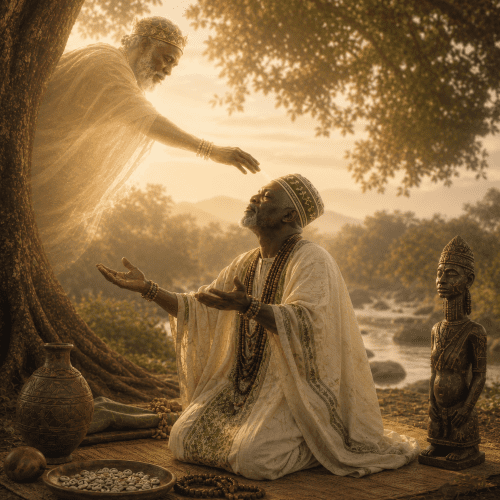
The story of Ogun’s Iron centers on the moment when the secrets of ironworking were shared with humanity. Various Yoruba traditions describe Ogun possessing special knowledge of iron and metalworking that distinguished him from other divine beings. Some accounts state that this knowledge originated from divine wisdom passed down through higher spiritual powers.
After using iron tools to clear pathways through the wilderness, Ogun revealed the potential of the metal to both gods and humans. He demonstrated how iron ore could be transformed through fire and skill into durable implements. This knowledge allowed people to move beyond the limitations of stone, wood, and softer metals.
The gift was not presented as an unrestricted blessing. Ogun expected respect, honesty, and proper conduct from those who benefited from his knowledge. Devotees believed that misuse of iron for unjust purposes could attract his displeasure. In this way, the blessing carried both privilege and responsibility, emphasizing that technological advancement must be accompanied by moral accountability.
Nature of the Boon/Blessing
Ogun’s Iron is far more than a physical resource. It encompasses the complete knowledge and power associated with ironworking and its applications. At its most basic level, the boon provided humanity with stronger and more reliable tools. Farmers could clear land more effectively and cultivate larger areas. Builders gained implements capable of shaping wood and other materials with greater precision. Hunters obtained stronger weapons and equipment that improved their chances of survival.
The blessing also included the knowledge of smelting, forging, and metalworking. Blacksmiths learned how to transform raw ore into useful objects through fire and craftsmanship. This ability became one of the foundations of technological development within Yoruba society.
Spiritually, Ogun’s Iron symbolizes determination, discipline, and the ability to transform raw potential into meaningful achievement. The process of forging iron itself became a metaphor for personal growth, where challenges and hardship shape individuals into stronger versions of themselves.
Recipients and Key Figures
Although all of humanity benefited from Ogun’s gift, certain groups developed particularly close relationships with the orisha and his sacred metal. Blacksmiths are perhaps the most direct inheritors of Ogun’s power. Their ability to transform iron through fire mirrors Ogun’s own divine mastery of the metal. As a result, blacksmiths traditionally occupied respected positions within many Yoruba communities.
Hunters also maintained a special connection with Ogun. Their tools and weapons depended upon iron, and many sought his protection before entering forests or embarking on dangerous expeditions. Warriors likewise honored Ogun as a source of strength, courage, and protection during conflict.
Kings and political leaders frequently invoked Ogun’s authority as a symbol of justice and legitimate power. Because iron represented truth and accountability, rulers often associated themselves with Ogun when enforcing laws and maintaining social order. Priests and spiritual practitioners served as intermediaries between devotees and the orisha, conducting rituals and offerings designed to maintain harmony with Ogun’s powerful energy.
Effects and Consequences
The impact of Ogun’s Iron was transformative. The introduction of iron tools significantly improved agricultural productivity, allowing communities to cultivate more land and support larger populations. This contributed to the growth of settlements, trade networks, and increasingly sophisticated social structures.
Iron technology also altered military capabilities. Stronger weapons and defensive tools enhanced the ability of communities to protect themselves and expand their influence. Throughout history, societies with advanced ironworking often enjoyed strategic advantages over their rivals.
However, Yoruba tradition never presents iron as an entirely positive force. The same technology that enables prosperity can also cause suffering when used recklessly. Ogun himself embodies this duality. He is celebrated as a creator and protector, yet he is also known for his fierce temper and destructive potential. This balance serves as an enduring lesson. Progress without wisdom can lead to conflict, while technological advancement guided by justice and integrity can benefit entire communities.
Symbolism and Spiritual Meaning
Iron remains one of the most powerful symbols within Yoruba spirituality. It represents strength, endurance, resilience, and the ability to overcome obstacles. Just as iron survives pressures that would destroy weaker materials, devotees view Ogun’s energy as a source of perseverance during difficult times.
The concept of path-clearing is equally important. Ogun’s iron machete symbolizes the removal of barriers, whether physical, social, or spiritual. People often invoke Ogun when facing challenges that require determination and decisive action.
Iron also serves as a symbol of truth and justice. In traditional Yoruba culture, sacred oaths were sometimes sworn upon iron objects associated with Ogun. The belief was that dishonesty would invite divine punishment, while truthfulness would earn protection.
Perhaps most importantly, Ogun’s Iron represents transformation. Raw ore hidden within the earth becomes a useful tool through fire, skill, and effort. This process mirrors the human journey of growth, discipline, and self-improvement.
Cultural Impact and Legacy
The influence of Ogun extends far beyond the Yoruba homeland. Through the African diaspora, his worship spread across the Atlantic and became an important part of traditions such as Santería, Candomblé, and Haitian Vodou. Although local interpretations vary, Ogun consistently remains associated with iron, labor, protection, and progress.
Annual festivals dedicated to Ogun continue to be celebrated in parts of Nigeria and throughout the Yoruba diaspora. Offerings of palm wine, food, and iron objects honor his enduring role as a guardian of workers, artisans, and communities.
In the modern world, Ogun’s symbolism remains remarkably relevant. Mechanics, engineers, construction workers, metalworkers, and others whose professions depend on technology often view him as a patron figure. His story speaks to the ongoing relationship between human innovation and ethical responsibility.
Ogun’s Iron is ultimately more than a mythological gift. It is a symbol of humanity’s capacity to transform the world through knowledge, labor, and perseverance. Its legacy continues to remind people that every technological breakthrough carries both opportunity and responsibility.


Source
Barnes, S. T. (Ed.). (1997). Africa’s Ogun: Old world and new (2nd ed.). Indiana University Press.
Encyclopedia.com. (n.d.). Ogun. Myths and Legends of the World. https://www.encyclopedia.com/humanities/news-wires-white-papers-and-books/ogun
Mythopedia. (2023). Ogun. https://mythopedia.com/topics/ogun
Ogunnaike, A., & Ogunnaike, O. (2026). Yoruba mythology. Black Dog & Leventhal.
Sandra Barnes, T. (Ed.). (1997). Africa’s Ogun: Old world and new. Indiana University Press. https://www.grafiati.com/en/literature-selections/ogu-african-people/book/
The Archaeologist. (2025, November 25). The worship of Ogun: The Iron God of the Yoruba. https://www.thearchaeologist.org/blog/the-worship-of-ogun-the-iron-god-of-the-yoruba
Yoruba Library. (2025, September 16). Ògún – Uncovering the full myth about Yoruba god of Iron. https://www.yorubalibrary.com/culture/oriki_yoruba/oriki_for_orisha/orisha_ogun.html
Zack-Orilis, T. (2018). Re-imagining Ogun in selected Nigerian plays: A decolonial reading. University of South Africa. http://hdl.handle.net/10500/25490
Frequently Asked Questions
Who is Ogun in Yoruba tradition?
Ogun is the Yoruba orisha of iron, metalworking, warfare, hunting, labor, and technological advancement.
What is Ogun's Iron?
Ogun’s Iron refers to the sacred gift of iron and metalworking knowledge that enabled humanity to create tools, weapons, and advanced technologies.
Why is iron sacred to Ogun?
Iron is sacred because it represents Ogun’s divine power, path-clearing ability, strength, transformation, and connection to civilization.
How did Ogun help humanity?
Ogun taught humans how to forge iron and create tools that improved agriculture, construction, hunting, and social development.
Is Ogun's Iron a symbol of creation or destruction?
It symbolizes both. Iron can build societies and support life, but it can also be used for warfare and destruction depending on human intent.