Twilight of the Gods : A Dark Reimagining of Norse Mythology
| Description | |
|---|---|
| Origin | Norse Mythology |
| Language | English |
| Type | Reimagination / Dark Retelling |
| Seasons | 1 (Canceled after Season 1 in 2025) |
| Cast | Sylvia Hoeks, Stuart Martin, Pilou Asbæk, Paterson Joseph, Rahul Kohli |
| OTT Platform / TV Channel | Netflix |
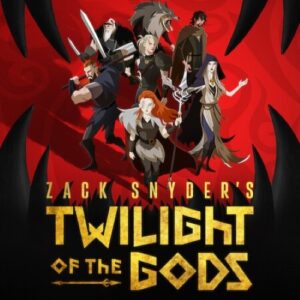
Twilight of the Gods
Introduction
Twilight of the Gods is an adult animated series that gives Norse mythology a distinctly violent, tragic and personal interpretation. Created by Zack Snyder, Jay Oliva and Eric Carrasco, the Netflix series premiered on September 19, 2024, with eight episodes. It was produced by Stone Quarry Animation, with French studio Xilam Animation providing the animation. The series also features music by Hans Zimmer, Omer Benyamin and Steven Doar.
Rather than retelling a single Norse myth, Twilight of the Gods builds an original revenge story around familiar gods, realms and mythological ideas. At its center is Sigrid, a warrior of mixed human and Jötunn heritage, and Leif, a mortal king. Their wedding becomes the beginning of a war when Thor attacks the ceremony, leaving Sigrid determined to take revenge against the gods. Netflix describes the series as a story of love, loss and revenge that carries its characters through fantastical lands and battles against gods and supernatural forces.
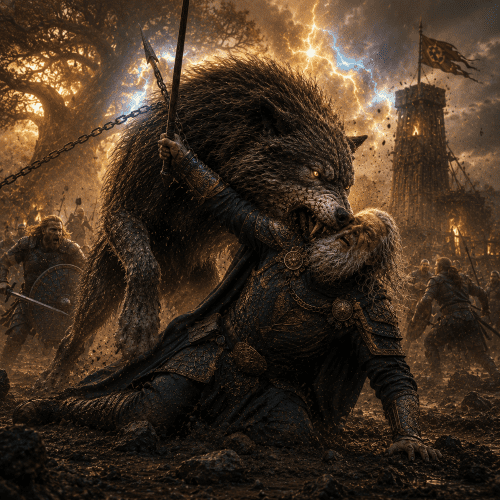
The title itself evokes Ragnarök, traditionally understood as the catastrophic fate of the gods and the world in Old Norse tradition. Yet the series approaches that idea from an unusual direction. Instead of beginning with prophecy and ending with inevitable destruction, it places a mortal woman’s grief and anger at the center of the story. The result is less a direct adaptation of Norse mythology than a modern mythic narrative assembled from its gods, creatures, conflicts and themes.
Plot
The story begins when Sigrid and Leif fall in love after meeting on the battlefield. Leif, a mortal king, is drawn to Sigrid, a formidable warrior with Jötunn ancestry. They eventually travel to Jötunheim for their wedding, hoping to celebrate their union among Sigrid’s people.
The ceremony is destroyed when Thor arrives while pursuing Loki. His anger turns the wedding into a massacre, leaving Sigrid and Leif alive and giving Sigrid a reason to challenge the divine order itself. Netflix identifies this event as the central catalyst for Sigrid’s vow of vengeance.
Sigrid and Leif then assemble a group of warriors and supernatural allies for a seemingly impossible mission: kill the gods responsible for the destruction of her family. Loki becomes an important participant in the plan, while the group travels through different realms in search of weapons capable of harming divine beings.
Their journey takes them toward Vanaheim and other mythological locations, bringing them into conflict with gods, giants, monsters and supernatural forces. The fourth episode, for example, revolves around the search for enchanted apples associated with the Vanir, while later episodes build toward an enormous confrontation between mortals, giants, Vanir forces and Thor’s Aesir warriors.
The eight-episode season ultimately transforms Sigrid’s private revenge into a conflict with consequences for the wider Norse cosmos. Her struggle becomes intertwined with the ambitions of Loki and Odin and the larger catastrophe associated with Ragnarök.
Mythological Basis
Twilight of the Gods draws its mythological vocabulary primarily from the Norse traditions preserved in medieval Icelandic texts, especially the Poetic Edda and Prose Edda. However, the series should not be treated as a literal adaptation of either source. It combines characters and motifs from different myths and places them within a new storyline.
Ragnarök provides the broadest mythological framework. In Old Norse tradition, Ragnarök describes a sequence of catastrophic events involving the gods, giants and monstrous beings, culminating in the deaths of major figures and the destruction and renewal of the world. The phrase Twilight of the Gods is therefore strongly associated with this final cosmic crisis, although the Old Norse term Ragnarök has meanings more closely related to the fate or doom of the gods than simply a literal “twilight.”
The series also draws on the distinction between the Æsir and Vanir, two groups of gods in Norse tradition. Odin and Thor belong to the Æsir, while Freyja is one of the best-known Vanir deities. The show expands the relationship between these groups into a major political and military conflict.
Other recognizable figures include Loki, Hel, Baldr, Freyja, Heimdall and Thor, alongside beings such as Jörmungandr and the Jötnar. Several episodes also incorporate motifs associated with famous Norse stories, including enchanted apples, dwarven craftsmanship and cursed treasures. These elements make the series recognizably Norse even when the surrounding narrative is entirely its own.
Characters & Archetypes
Sigrid is the defining character of Twilight of the Gods and represents the archetype of the avenger. Her story begins with love and family but quickly becomes dominated by grief and the desire for retribution. Her half-human, half-Jötunn identity is an original creation for the series, allowing her to occupy a position between the mortal and supernatural worlds. Rather than being a traditional Norse goddess or legendary heroine taken directly from the Eddas, Sigrid is the series’ original gateway into the mythic world.
Leif represents the mortal hero whose loyalty draws him deeper into a conflict far larger than himself. His relationship with Sigrid gives the story an emotional foundation, while his status as a human king emphasizes the vulnerability of mortals when confronted by divine power.
Thor is deliberately presented as one of the most frightening figures in the series. Pilou Asbæk’s Thor is violent, arrogant and capable of devastating destruction. This is very different from the heroic Thor familiar from Marvel adaptations, although it is important to remember that the medieval sources themselves do not present Thor as a modern superhero. He is a powerful defender of the gods and humans, but also a figure associated with violence, force and relentless confrontation with the Jötnar.
Loki occupies a more ambiguous position. His traditional association with deception, transformation and disruption remains central, but the series gives his actions a more sympathetic emotional motivation. He is neither simply a hero nor a straightforward villain, making him one of the story’s most recognizably mythological characters.
Odin represents authority, knowledge and manipulation. As the ruler of the Æsir, he embodies the larger divine system against which Sigrid rebels. The supporting cast, including Freyja, Hel, Andvari, Egill, Hervor and the Seid-Kona, further expands the series’ mixture of recognizable mythological figures and original interpretations.
Creative Liberties
The greatest strength of Twilight of the Gods is also the reason it should not be confused with a traditional retelling of Norse mythology. Much of its central narrative is original. Sigrid is not a character from the surviving Eddic poems, and her wedding to Leif, the massacre of her Jötunn family and her campaign against Thor are inventions created for the series.
The romantic relationship between Sigrid and Leif similarly provides an emotional structure that is specific to this adaptation. Instead of presenting the gods as the unquestioned center of the narrative, the series asks what happens when mortals become victims of divine conflict and decide to fight back.
The treatment of Thor is another major departure. Traditional Norse sources give Thor an important protective role, particularly in his battles against giants and other threats. Twilight of the Gods emphasizes his brutality and destructive impulses, making him the immediate antagonist of Sigrid’s story. This is a creative interpretation rather than a straightforward representation of the mythological Thor.
The series also expands familiar ideas into new lore. God-killing weapons, the political relationship between the Æsir and Vanir, Sigrid’s ancestry and the personal motivations of Loki are all reshaped to serve the revenge narrative. The traditional Ragnarök cycle is therefore not reproduced in its original sequence. Instead, the show uses Ragnarök as a mythic destination toward which its original characters and conflicts move.
This approach makes Twilight of the Gods best understood as a mythological adaptation rather than a mythological retelling. It preserves names, archetypes, cosmological concepts and legendary motifs while giving them new relationships and motivations.
The series was ultimately a one-season production. Netflix did not renew it for a second season, with its cancellation reported in November 2025. Its eight-episode first season therefore stands as a complete, though open-ended, interpretation of Snyder’s Norse-inspired world.
What makes Twilight of the Gods distinctive is not its accuracy to every detail of Norse mythology, but the way it uses ancient myth to explore modern ideas of trauma, revenge, power and resistance. Its gods may be ancient, but the question at its heart is remarkably human: what happens when those with power destroy the lives of those beneath them, and the victims decide to fight back?