


Curse of Endless Greed : Andvari’s Condemnation of the Nibelung Ring
At a glance
| Description | |
|---|---|
| Mythology | Germanic Mythology |
| Cursed Individual(s) | Hreidmar, Fafnir, Sigurd, Brynhildr & Gudrun |
| Cursed By | Andvari |
| Primary Consequence | Greed induced death |
| Symbolism | Greed transforms into monstrosity |
Mythlok Perspective
From the Mythlok perspective, the Nibelung Ring represents a deeper curse than death: the inability to possess power without becoming possessed by it. Its gold promises control, yet every hand that closes around it inherits fear, suspicion, and violence. Across cultures, this pattern recurs. The Greek Golden Fleece and the Irish Lia Fáil similarly transform objects of extraordinary value into sources of political desire and conflict, though neither carries the same explicit curse. The Nibelung Ring’s tragedy lies in the belief that possession creates freedom, when in reality, the desire to possess becomes the chain.
Curse of Endless Greed
Introduction
The Nibelung Ring is one of the most famous cursed treasures in Germanic legend, representing the destructive relationship between wealth, power, greed, and ambition. Its story appears in several related traditions rather than one single ancient account. Old Norse sources such as the Völsunga saga and Poetic Edda tell of the dwarf Andvari and his magical ring, while the medieval Nibelungenlied develops a related heroic tradition surrounding Siegfried and the Nibelung treasure.
The ring became even more famous through Richard Wagner’s Der Ring des Nibelungen, a four-part music drama inspired by several Germanic and Norse sources. Wagner transformed the older stories into a vast mythic drama in which a golden ring becomes the focus of a struggle between gods, dwarfs, giants, and mortals. Although the details differ between traditions, the central theme remains consistent: the pursuit of extraordinary wealth and power can ultimately destroy those who seek to possess it.
Mythological Background
The Nibelung Ring belongs to the wider Germanic heroic tradition shared by medieval Scandinavia and continental Europe. The stories developed over centuries and survive in different literary forms, meaning that there is no single original version of the Nibelung Ring myth. In Old Norse tradition, the story is connected to the dwarf Andvari, whose treasure includes a magical ring called Andvaranaut. The Völsunga saga connects the treasure to Loki, Odin, Hreidmar, Fafnir, and eventually the hero Sigurd.
The story begins when Loki kills Ótr, the son of Hreidmar, who has taken the form of an otter. Hreidmar demands compensation for his son’s death. Loki is therefore forced to find enough gold to cover Ótr’s hide. He obtains the treasure from Andvari, including the ring. Andvari curses the treasure after it is taken from him, declaring that it will bring death to whoever possesses it. The later German Nibelungenlied preserves related characters and themes but changes the narrative considerably. Sigurd becomes Siegfried, and the story focuses more heavily on heroic honour, political alliances, revenge, and the downfall of the Burgundians.
Origin of the Curse
The origin of the Nibelung Ring’s curse differs significantly between the Norse tradition and Wagner’s interpretation. In the Völsunga saga, Andvaranaut is originally Andvari’s ring. Loki takes it from him along with his hoard to satisfy Hreidmar’s demand for compensation. Andvari responds by placing a curse upon the treasure.
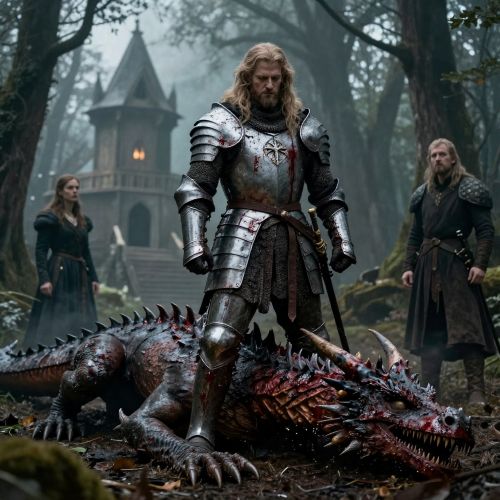
The curse then follows the gold through a chain of violent events. Hreidmar receives the treasure but refuses to share it with his sons. His son Fafnir kills him and takes the hoard for himself. Fafnir subsequently becomes a dragon, guarding the treasure from anyone who might attempt to take it. The hero Sigurd eventually kills Fafnir and claims the treasure.
Wagner’s version is different. In Der Ring des Nibelungen, the ring is created by Alberich, a Nibelung dwarf who steals the Rhinegold and renounces love so that he can obtain its power. He forges the gold into a ring that gives its possessor immense authority and then curses it. Wagner therefore transforms the earlier curse into a larger philosophical idea: power gained through the rejection of love and moral responsibility ultimately destroys its possessor.
Nature of the Curse
The Nibelung Ring’s curse operates both as a supernatural punishment and as a symbol of human greed. In the Old Norse tradition, Andvari’s curse explicitly connects the treasure with death. Yet the tragedy is not caused by magic alone. The people who possess the treasure repeatedly make choices driven by greed, suspicion, jealousy, and revenge.
Hreidmar’s refusal to share the gold contributes to his death. Fafnir’s greed transforms him into a dragon. Sigurd’s possession of the treasure places him within a wider chain of betrayal and revenge. The ring therefore functions almost like a magnet for conflict. Its enormous value gives everyone a reason to desire it, fear losing it, or kill for it.
Wagner develops this idea further. The ring becomes a symbol of absolute power. Its owner does not become secure by possessing it. Instead, possession creates fear because others want the same power. This creates the central paradox of the Nibelung Ring: the object that promises freedom through power ultimately makes its owners prisoners of their own ambition.
Victims and Key Figures
Andvari is the dwarf at the centre of the original Norse ring story. His treasure is taken from him, and his curse establishes the destructive path followed by the gold. Hreidmar becomes one of the first victims. After receiving the treasure as compensation for Ótr’s death, he refuses to share it with his sons and is eventually killed by Fafnir.
Fafnir represents greed in its most extreme form. After murdering his father, he takes possession of the hoard and becomes a dragon who guards it obsessively. His transformation makes his inner corruption physically visible. Sigurd is the heroic figure who defeats Fafnir. After killing the dragon, he takes possession of the treasure and becomes entangled in the tragedy surrounding Brynhildr and Gudrun. Brynhildr and Gudrun become central to the later cycle of betrayal and revenge surrounding Sigurd. Their stories demonstrate how the consequences of the treasure extend beyond its immediate owners.
In Wagner’s version, Alberich becomes the creator of the ring, while Wotan, Siegfried, and Brünnhilde occupy central roles in the struggle over its possession. These figures belong to different versions of the tradition, but each contributes to the same larger theme: the pursuit of the ring destabilizes families, kingdoms, and entire systems of power.
Consequences and Resolution
The consequences of the Nibelung Ring extend across generations. In the Norse heroic tradition, the cursed treasure becomes connected with the deaths of Hreidmar, Fafnir, and Sigurd and with the eventual destruction surrounding the Volsung family. The treasure does not simply cause individual tragedy; it becomes part of a much larger cycle of vengeance.
The Nibelungenlied develops a related story around Siegfried, Kriemhild, the Burgundians, and the Nibelung treasure. Its narrative ultimately leads to the catastrophic downfall of the Burgundian court. Wagner expands the consequences to the entire cosmic order. His Ring cycle ends with Götterdämmerung, in which the established order of the gods collapses.
The ring is ultimately returned to the Rhine, but Wagner deliberately avoids a simple explanation of what this means. The ending has been interpreted as destruction, redemption, renewal, or the end of a corrupt system. What remains clear is that the world created around the ring cannot continue unchanged.
Symbolism and Moral Lessons
The Nibelung Ring is ultimately a symbol of power without responsibility. Its extraordinary value represents wealth, but the story repeatedly demonstrates that possession does not produce happiness or security. Instead, the ring creates anxiety, suspicion, competition, and violence. Greed is central to the myth, but so is the desire for control. The characters do not simply want gold because it is beautiful or valuable. They want what the gold allows them to command.
Wagner makes this especially explicit by connecting the ring with the ability to dominate others. Alberich’s decision to reject love in exchange for power establishes the moral foundation for the tragedy that follows. The story also contrasts love and possession. Again and again, characters must choose between human relationships and the pursuit of wealth or authority.
The Nibelung Ring therefore asks a timeless question: how much are people willing to sacrifice to possess something that gives them power over others? Its answer is bleak. Wealth can become a curse when possession matters more than loyalty, love, justice, or responsibility.
Cultural Impact and Legacy
The Nibelung Ring has had a remarkable influence on European literature, music, theatre, and modern fantasy. The medieval Nibelungenlied became one of the most important works of German heroic literature. Its characters and themes continued to influence writers and artists long after the poem was composed.
Richard Wagner later transformed the material into Der Ring des Nibelungen, consisting of Das Rheingold, Die Walküre, Siegfried, and Götterdämmerung. His interpretation combined elements from Norse mythology, German heroic legend, and medieval literature into a new mythic narrative. Wagner’s version also transformed the ring itself into a powerful cultural symbol. Rather than being merely a magical object, it becomes an embodiment of political authority, greed, corruption, and the destructive desire to control.
The Nibelung Ring is also frequently discussed alongside J. R. R. Tolkien’s One Ring. Both involve magical rings associated with power, possession, corruption, and destruction, and Tolkien was familiar with Germanic and Norse heroic literature. However, Tolkien’s ring belongs to his own fictional mythology and should not be treated as simply a retelling of the Nibelung legend. The enduring power of the Nibelung Ring lies in its ability to turn something desirable into something terrifying. Gold promises security. Power promises freedom. Yet once either becomes an obsession, the possession itself can become the source of destruction.


Source
Byock, J. L. (Trans.). (1990). The saga of the Volsungs: The Norse epic of Sigurd the Dragon Slayer. University of California Press.
Kennedy Center. (2011, December 1). The Ring of the Nibelung. https://www.kennedy-center.org/education/resources-for-educators/classroom-resources/media-and-interactives/media/opera/rep/late-romantic/the-ring-of-the-nibelung/
Morris, W., & Magnússon, E. (Trans.). (1870). The story of the Volsungs (Volsunga saga), with excerpts from the Poetic Edda. https://www.marxists.org/archive/morris/works/1870/volsungs/chapters/chapter14.htm
Needler, G. H. (Trans.). (1905). The Nibelungenlied. Project Gutenberg. https://www.gutenberg.org/files/7321/7321-h/7321-h.htm
Naxos. (n.d.). About this recording: Der Ring des Nibelungen.
https://www.naxos.com/MainSite/BlurbsReviews/?itemcode=NBD0049&catnum=NBD0049&filetype=AboutThisRecording&language=English
Shumway, D. B. (Trans.). (1909). The Nibelungenlied. Project Gutenberg. https://www.gutenberg.org/files/1151/1151-h/1151-h.htm
World History Encyclopedia. (2022, March 1). Magic rings in Norse mythology. https://www.worldhistory.org/article/1950/magic-rings-in-norse-mythology/
University of Pittsburgh. (n.d.). The Nibelungenlied: A summary in English prose.
https://sites.pitt.edu/~dash/nibelungenlied.html
Frequently Asked Questions
What is the Nibelung Ring?
The Nibelung Ring is a magical and cursed ring associated with the Nibelung treasure in Germanic heroic tradition. In Old Norse sources, the related ring is called Andvaranaut, while Wagner’s version is forged by Alberich from the Rhinegold.
Who cursed the Nibelung Ring?
In the Old Norse tradition, Andvari curses his treasure and ring after Loki forces him to surrender them. In Wagner’s Der Ring des Nibelungen, Alberich places the curse on the ring he forges.
Who possessed the Nibelung Ring?
The ring passes through several hands depending on the tradition. In the Norse story, its history involves Andvari, Hreidmar, Fafnir, and eventually Sigurd. Wagner’s version involves Alberich, Wotan, Siegfried, and Brünnhilde among others.
What does the Nibelung Ring symbolize?
The Nibelung Ring symbolizes greed, absolute power, corruption, possession, and the destructive consequences of ambition. Wagner particularly uses it to explore the conflict between power and love.
Is the Nibelung Ring the same as Tolkien's One Ring?
No. Tolkien’s One Ring shares some themes with the Nibelung Ring, particularly the corrupting nature of power and the significance of a magical ring, but it belongs to Tolkien’s original fictional mythology.


