


Brynhildr : The Norse Valkyrie of Fate and Tragic Love
At a glance
| Description | |
|---|---|
| Origin | Norse Mythology |
| Classification | Demigods |
| Family Members | Odin (Father) |
| Region | Iceland, Denmark, |
| Associated With | Valkyries, Fate, Fire, War, Honor |
The Mythlok Perspective
In Mythlok’s Perspective, Brynhildr represents controlled divinity—power that exists within rules, not outside them. Unlike figures such as the Greek Athena or the Indian Durga, who act with divine authority, Brynhildr operates within a system she cannot escape. Her defiance does not free her; it binds her further to fate. Similar to figures like the Japanese Tomoe Gozen or the Celtic Scáthach, she exists at the edge of human and divine worlds, where strength is both a gift and a burden shaped by forces beyond control.
Brynhildr
Introduction
Brynhildr is one of the most powerful and tragic figures in Norse tradition, remembered as a valkyrie whose defiance of Odin set into motion a story of fate, love, and destruction. Unlike the Germanic Brunhilde, Brynhildr belongs firmly to the mythic world of gods and warriors, where destiny is not shaped by politics but by cosmic order and divine will.
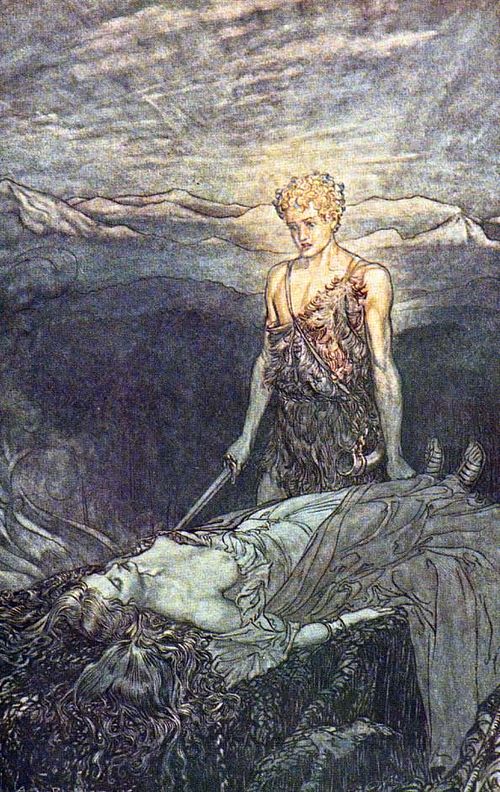
Her legend is preserved in the Völsunga saga and Eddic poems, where she is both a chooser of the slain and a woman bound by oath and honor. Her awakening by Sigurd marks the beginning of one of the most tragic romances in Norse lore—one driven not by choice alone, but by fate itself.
Brynhildr’s story is not simply about love or revenge. It is about what happens when divine duty and human emotion collide, and neither can survive unchanged.
Physical Traits
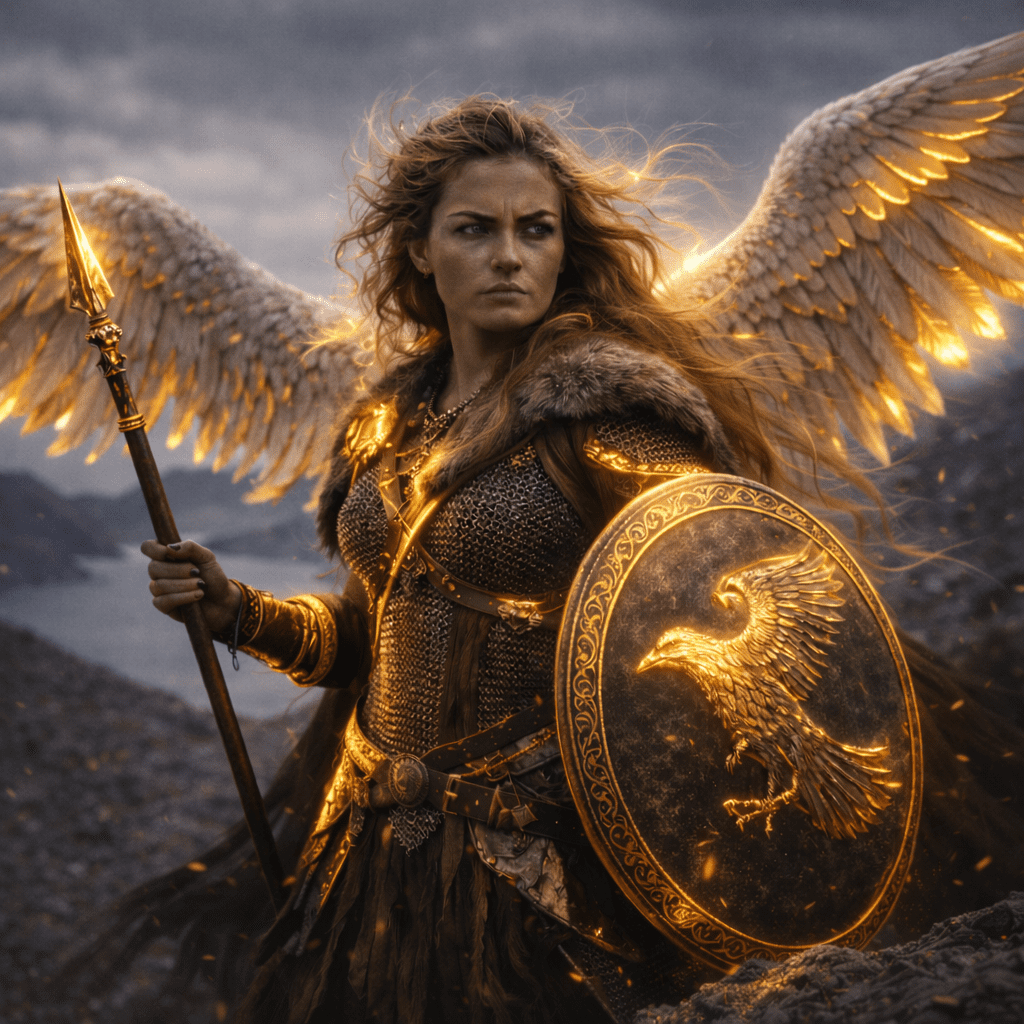
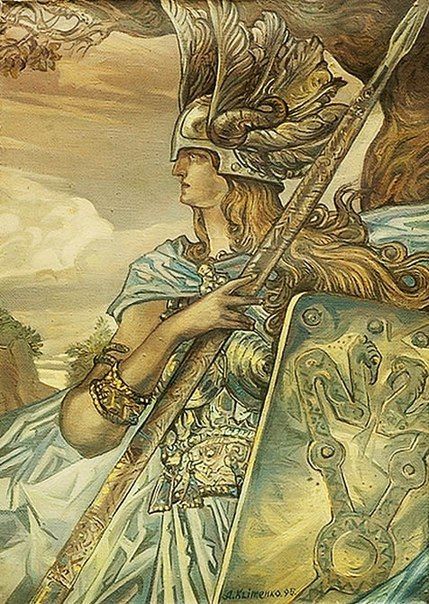
Brynhildr is described as strikingly beautiful, but her appearance is always tied to her identity as a warrior. She is often depicted with golden hair, sharp features, and a commanding presence that reflects both discipline and strength.
She wears armor not as decoration, but as an extension of her role as a valkyrie. Her shield, helm, and spear are functional and battle-worn, reinforcing her purpose as a chooser of warriors rather than a ceremonial figure.
Unlike mortal queens, Brynhildr’s presence carries a quiet intensity. She does not dominate through spectacle but through composure. Her posture is upright, her gaze unwavering, and her expression often restrained, reflecting the internal conflict between duty and desire.
Family
Brynhildr’s lineage varies across sources, but she is most often associated directly with Odin, either as his daughter or as one of his valkyries bound to his command. This connection places her firmly within the divine hierarchy of Norse cosmology.
In the Völsunga saga, she is also linked to King Budli and is described as the sister of Atli, connecting her to the legendary Volsung cycle. However, these familial ties are secondary to her role as a valkyrie. Her most important relationship is with Sigurd. Their bond is not merely romantic—it is symbolic of the intersection between divine will and mortal action.
Other names
Brynhildr appears under several names and identities across Norse texts. The most prominent variation is Sigrdrífa, meaning “driver to victory,” a valkyrie awakened by Sigurd in certain Eddic poems.
She is also referred to as “Hild under the helmet,” reflecting her upbringing as a warrior maiden. These variations suggest that Brynhildr may have originally been part of a broader valkyrie tradition, later consolidated into a single narrative figure. Unlike her Germanic counterpart Brunhilde, these names retain strong mythological meaning, emphasizing her divine role rather than her royal status.
Powers and Abilities
As a valkyrie, Brynhildr possesses abilities that extend beyond human limits. She has the power to determine the fate of warriors in battle, choosing who lives and who dies, and guiding the fallen to Valhalla.
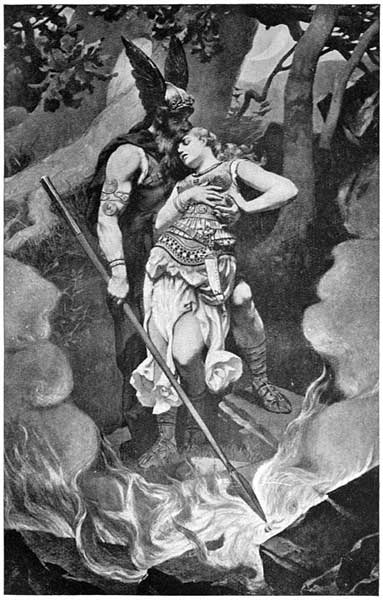
Her defiance of Odin—choosing the wrong king in battle—demonstrates that her power is not merely functional but autonomous. This act leads to her punishment: a magical sleep encircled by fire, a barrier that only a fearless hero can cross.
She also displays exceptional combat skill, mastery of weapons, and deep knowledge of runes and wisdom. In some accounts, she imparts sacred knowledge to Sigurd, further emphasizing her role as both warrior and teacher. Her abilities are not expressed through spectacle but through control—over fate, over knowledge, and over herself.
Modern Day Influence
Brynhildr’s story has shaped countless interpretations of Norse mythology in modern culture. The most influential adaptation remains Der Ring of the Nibelung by Richard Wagner, which blends Norse and Germanic elements but draws heavily from her valkyrie identity.
She appears in modern anime such as Record of Ragnarok, often portrayed as a strategist or leader among valkyries, and in games like Fate/Grand Order, where her abilities reflect her mythological roots.
Beyond media, Brynhildr has become a symbol of tragic strength—a figure who embodies both power and vulnerability. Her story continues to influence literature, art, and reinterpretations of warrior women across cultures.
Related Images



Source
Anonymous. (ca. 1270). Völsunga saga [Saga]. https://en.wikipedia.org/wiki/V%C3%B6lsunga_saga
Byock, J. L. (1990). Saga of the Volsungs: The Norse epic of Sigurd the dragon slayer. University of California Press.
Byock, J. L. (2012). Viking language 2: The Old Norse reader. Jules William Press.
Larrington, C. (Trans.). (2014). The Poetic Edda. Oxford University Press. https://mythus.fandom.com/wiki/Brynhildr
Orchard, A. (1997). Dictionary of Norse myth and legend. Cassell. https://religion.fandom.com/wiki/Brynhildr
Snorri Sturluson. (ca. 1220). Edda (Prose Edda). In The Prose Edda (A. Faulkes, Trans., 1995). Everyman. https://kids.britannica.com/students/article/Brynhild/310415
Sturluson, S. (1997). Eddas and sagas: Icelanders’ books. In The complete sagas of the Icelanders (Vol. 1, pp. 1–12). Leifur Eiríksson Publishing. https://thenorsegods.com/brunhilde/
Wikipedia contributors. (2026). Brynhildr. In Wikipedia, The Free Encyclopedia. Retrieved April 14, 2026, from https://mythus.fandom.com/wiki/Brynhildr
Frequently Asked Questions
Who is Brynhildr in Norse legend?
Brynhildr is a valkyrie who defied Odin and became central to a tragic love story with Sigurd.
Is Brynhildr the same as Brunhilde?
No, Brynhildr is the Norse valkyrie, while Brunhilde is a Germanic queen from a separate tradition.
Why was Brynhildr punished by Odin?
She disobeyed Odin’s command in battle, leading to her magical imprisonment in a ring of fire.
What are Brynhildr’s powers?
She controls battle fate, guides warriors to Valhalla, and possesses great combat skill and wisdom.
What does Brynhildr symbolize?
She represents fate, honor, and the conflict between divine duty and personal emotion.
