

Jötnar : Primordial Beings of Norse Tradition
| Description | |
|---|---|
| Origin | Norse Mythology |
| Nature | Neutral |
| Notable Members | Ymir, Surtr, Skadi, Ægir, Angrboda, Þjazi, Mimir |
| Symbolism | Chaos, Nature, Duality, Wisdom, Inevitability of fate |
| Epics | Prose Edda, Poetic Edda, Ragnarök narratives, |
Mythlok Perspective
From the Mythlok perspective, the Jötnar are not villains but elemental truths. They resemble the Titans of Greece and the Fomorians of Celtic tradition, both representing forces that precede divine order. Where Olympians and Tuatha Dé Danann impose structure, these elder beings remind cultures that order is temporary. Across traditions, such figures express a shared mythic insight: civilization exists by negotiating with chaos, not by erasing it.
Jötnar
Introduction
The Jötnar occupy a foundational yet often misunderstood place in Norse cosmology. Commonly translated as “giants,” the term obscures their true nature, which is not defined by size but by cosmic function. The Jötnar represent primordial forces that predate the gods and continue to shape the universe from its creation to its inevitable destruction at Ragnarök. They are not a single species or race but a broad category of beings bound by ancestry, worldview, and opposition to divine order. While conflict with the gods defines many myths, the survival of the Norse cosmos itself depends on the Jötnar, as both matter and meaning emerge from them. Understanding the Jötnar reveals Norse mythology not as a simple struggle between good and evil, but as a tense balance between structure and raw existence.
Physical Description
Descriptions of the Jötnar vary widely across sources, reflecting their symbolic rather than biological nature. Some are described as enormous, capable of standing against the Æsir in physical combat, while others are indistinguishable from humans in size and form. Beauty and monstrosity coexist among them. Figures such as Gerðr are portrayed as radiant and desirable, while others manifest with multiple heads, animal traits, or terrifying deformities. The children born of Jötnar often exaggerate these traits, as seen in the monstrous lineage of Loki. Shape-shifting is common, reinforcing the idea that Jötnar are not bound by fixed forms. Their bodies reflect the landscapes they inhabit: ice-bound, fire-scorched, mountainous, or oceanic. Physicality among the Jötnar is therefore expressive rather than anatomical, embodying elemental and environmental forces.
Mythological Context
Within Norse cosmology, the Jötnar primarily inhabit Jötunheimr, one of the Nine Worlds connected by Yggdrasil. This realm exists beyond the cultivated order of Asgard and Midgard, marked instead by wilderness, danger, and ancient power. Mythic narratives frequently depict confrontations between the Jötnar and the Æsir, especially Thor’s journeys into giant territory. Yet these encounters are not merely battles of strength. Many myths revolve around contests of wisdom, deception, or endurance, underscoring the intellectual parity between gods and giants. The Jötnar are indispensable to the prophecy of Ragnarök, where they emerge not as invaders but as agents of cosmic correction. Their opposition ensures that the universe remains cyclical rather than static.
Origins
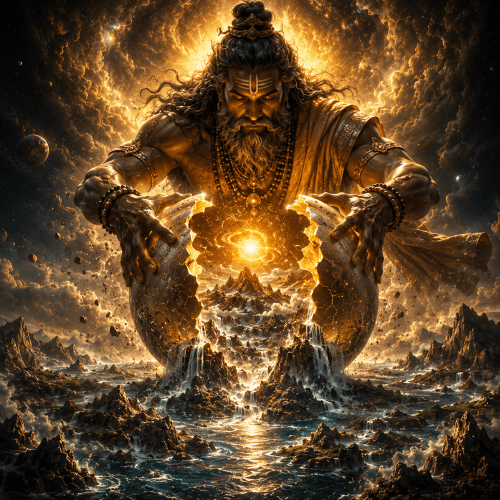
The lineage of the Jötnar begins with Ymir, also known as Aurgelmir, the first living entity to arise from the meeting of fire and ice in Ginnungagap. From Ymir’s body emerged the earliest generations of Jötnar, born without union or design. When Odin and his brothers slew Ymir, his body became the material foundation of the world. Earth, sea, mountains, and sky were all fashioned from his remains. Only Bergelmir and his kin survived the flood of blood that followed, preserving the Jötnar line. This origin establishes a profound paradox: the gods’ ordered cosmos is literally built from the body of a Jötunn, making the giants both ancestors and existential threats.
Notable Members
Among the most significant Jötnar is Surtr, ruler of Muspelheim, whose flaming sword will ignite the world at Ragnarök. Skaði embodies the fusion of Jötunn and divine identities, becoming associated with skiing, mountains, and winter after marrying Njörðr. Ægir, also known as Hlér or Gymir, occupies a liminal role as both host and threat to the gods. Angrboða, consort of Loki, gives birth to Fenrir, Jörmungandr, and Hel, beings central to Ragnarök. Figures such as Vafþrúðnir and Þjazi emphasize the Jötnar as keepers of wisdom and catalysts of crisis. Collectively, these figures demonstrate the diversity and narrative necessity of the Jötnar.
Relationship with Other Beings
The relationship between the Jötnar and the Æsir is marked by hostility, kinship, and interdependence. Odin himself descends from the Jötunn Bestla, while Thor’s mother Jörð is often identified as a giantess. Marriages between gods and Jötnar are common, producing alliances that temporarily stabilize cosmic tensions. Loki, born of a Jötunn father, embodies this ambiguity most clearly. The Jötnar also serve as sources of forbidden or ancient knowledge, prompting gods to seek them out despite the risks. Rather than a simple enemy class, the Jötnar function as an essential counterweight to divine authority.
Similar Beings
In Old Norse sources, terms such as þurs, risi, and troll are sometimes used interchangeably with Jötnar, suggesting overlapping or evolving categories. Over time, these distinctions blurred, especially as folklore replaced myth. Across Northern Europe, cognates such as the English ettin, the Swedish jätte, and the Finnish jätti reflect a shared cultural memory of primordial beings dwelling beyond human society. These figures often appear as builders of ancient stoneworks or inhabitants of remote landscapes. Their shared traits emphasize isolation, antiquity, and resistance to imposed order, reinforcing the Jötnar’s role as embodiments of the untamed world.
Symbolism and Interpretations
Symbolically, the Jötnar represent chaos, nature, and the ungovernable aspects of existence. They are not evil but necessary, ensuring that creation remains dynamic rather than stagnant. Their frequent association with borders, mountains, oceans, and cosmic thresholds marks them as liminal beings. As Christianity spread, later texts increasingly portrayed Jötnar as brutish or foolish, reflecting ideological shifts rather than original mythic intent. Earlier sources, however, depict them as intelligent, powerful, and morally complex. The Jötnar ultimately affirm a worldview in which destruction is not failure, but renewal.
Modern Influence
Modern media has significantly reshaped perceptions of the Jötnar. Popular franchises often simplify them into frost giants or monstrous invaders, stripping away their philosophical depth. While this is evident in superhero adaptations, darker interpretations in games and horror films have restored aspects of their ancient terror. Contemporary pagan movements and ecological readings increasingly view the Jötnar as symbols of environmental power and resistance to human domination. Their continued presence in literature, games, and scholarship confirms their enduring relevance as archetypes of primordial reality.
Sources
Groeneveld, E. (2017, November 2). Norse mythology. World History Encyclopedia. https://www.worldhistory.org/Norse_Mythology/
Jötunn. (2002, September 20). In Wikipedia. https://en.wikipedia.org/wiki/J%C3%B6tunn
Kolesnyk, O. (2023). Jötnar as “supernatural beings”: A cognitive matrix of the Old Norse verbal representations. Academia.edu. https://www.academia.edu/123145671/
Lindow, J. (n.d.). Jotnar in Norse mythology: Origins, characteristics & examples. Study.com.
https://study.com/academy/lesson/jotun-norse-mythology-overview-description-giants.html
Vikingr. (2024, March 16). Jötnar (Jötunn) | The giants of Norse mythology.
https://vikingr.org/other-beings/jotnar-giants-norse-mythology
Lindow, J. (2002). Norse mythology: A guide to the gods, heroes, rituals, and beliefs. Oxford University Press.
Hermann, P., Mitchell, S., Schjødt, J. P., & Rose, A. J. (Eds.). (2017). Old Norse mythology: Comparative perspectives. Harvard University Press.
Sturluson, S. (c. 1220). Prose Edda (A. Faulkes, Trans.). Everyman. (Original work published ca. 1220).
Kolesnyk, O. (2023). Jötnar as “supernatural beings”: A cognitive matrix of the Old Norse verbal representations. Studia Philologica, 20, 78-102. https://studiap.kubg.edu.ua/index.php/journal/article/view/443
Frequently Asked Questions
Who are the Jötnar in Norse tradition?
The Jötnar are primordial beings representing chaos and nature, predating and opposing the gods while remaining essential to cosmic balance.
How are Jötnar portrayed in modern media?
Modern portrayals vary, often simplifying them as monsters, though some interpretations restore their mythic complexity.
Are Jötnar always giants in size?
No, the term refers to their nature, not their stature. Many Jötnar are human-sized or capable of changing form.
Did Norse gods descend from Jötnar?
Why do Jötnar oppose the gods?
They represent forces beyond order and civilization, ensuring the universe remains cyclical rather than static.
