


Krong Reap : Demon King of the Cambodian Reamker
At a glance
| Description | |
|---|---|
| Origin | Cambodian Mythology |
| Classification | Demigods |
| Family Members | Mandodari (WIfe) |
| Region | Cambodia |
| Associated With | Royalty, Strength, Magic, Shapeshifting |
Mythlok Perspective
In Mythlok’s Perspective, Krong Reap is fascinating because he is more than a conventional embodiment of evil; he represents the danger of power when desire overwhelms judgment. Compared with Preah Ream, whose authority is defined by restraint and duty, Krong Reap possesses immense power but repeatedly allows personal desire to dictate his choices. Compared with Ravana, his Indian counterpart, Krong Reap is even more interesting as an example of how a shared epic can be reshaped by another culture, becoming a distinctly Khmer figure through the Reamker’s storytelling, dance, theatre and visual traditions.
Krong Reap
Introduction
Krong Reap is the principal antagonist of the Reamker, Cambodia’s Khmer adaptation of the ancient Ramayana. He corresponds to Ravana in the wider Ramayana tradition, but Krong Reap should not be understood simply as Ravana under another name. Over centuries, the story was absorbed into Khmer culture and developed its own characters, episodes, artistic traditions and moral emphases. In the Reamker, Krong Reap is the powerful king of Lanka whose abduction of Neang Seda, the counterpart of Sita, brings him into conflict with Preah Ream, the Khmer form of Rama. His defeat forms the dramatic climax of a story concerned with loyalty, desire, power, courage and the consequences of destructive choices. Krong Reap therefore occupies an important place not only in Cambodian mythology but also in the artistic traditions through which the Reamker continues to be performed and remembered.
Physical Traits
Krong Reap is traditionally represented as a formidable supernatural ruler whose appearance communicates both royal authority and terrifying power. His most recognizable feature is his multiple-headed form, generally associated with the ten heads and twenty arms of Ravana in the broader Ramayana tradition. Khmer artistic and performance traditions translate these extraordinary attributes into elaborate crowns, masks, costumes and gestures rather than treating them simply as physical anatomy.
His appearance combines the visual language of a king with that of a supernatural being. Ornate clothing and elaborate regalia emphasize his position as ruler of Lanka, while the features associated with the yeak, or giant, distinguish him from the heroic human and divine characters of Khmer classical performance. In Cambodian theatre, the supernatural characters of the Reamker are therefore recognizable not only through their stories but also through carefully codified costume, masks, movement and colour. The result is a Krong Reap who appears simultaneously magnificent and threatening: a ruler whose grandeur cannot conceal the destructive choices that ultimately bring about his downfall.
Family
Krong Reap’s family connections are important to the wider conflict of the Reamker, although the Khmer tradition does not always reproduce every relationship or episode of the Sanskrit Ramayana in exactly the same form. He belongs to the supernatural ruling world of Lanka and is associated with several powerful figures who participate in the struggle against Preah Ream.
His sister is associated with the character corresponding to Surpanakha in the Ramayana tradition, whose encounter with Preah Ream contributes to the chain of events leading toward the conflict with Lanka. The wider tradition also associates Krong Reap with a royal household and warrior sons, including the figure corresponding to Indrajit, who becomes an important adversary of Preah Ream’s forces.
These relationships give Krong Reap a dimension beyond that of a conventional villain. The war is not simply a confrontation between two isolated individuals; it involves families, kingdoms, armies and supernatural alliances. Krong Reap’s position as king makes his personal decisions matters of consequence for everyone under his authority. His determination to pursue his own desires despite opposition from others ultimately turns a personal conflict into a devastating war.
Other Names
Krong Reap is the Khmer name most closely associated with the demon king of the Reamker. He is the Cambodian counterpart of Ravana, the antagonist of the Sanskrit Ramayana, and the two characters share the central narrative role of the powerful ruler of Lanka who abducts the hero’s wife.
The spelling of the Khmer name can vary in English-language sources because Khmer names have been transliterated in different ways. Forms such as Krong Reap, Krong Riep and Reap can therefore be encountered in older or modern writing. These variations should not be confused with separate mythological characters. They reflect differences in romanization and the transmission of Khmer names into other languages.
The relationship between Krong Reap and Ravana is therefore best understood as one of cultural adaptation. The Reamker preserves the broad narrative framework of the Ramayana while giving it a distinctly Khmer identity through its language, performance traditions, visual culture and storytelling conventions.
Powers and Abilities
Krong Reap’s power comes from his status as a supernatural king as much as from his abilities as a warrior. The traditions surrounding his Ramayana counterpart portray him as exceptionally strong, magically capable and difficult to defeat. His extraordinary physical form, supernatural abilities and command over the forces of Lanka make him one of the most formidable opponents faced by Preah Ream.
Magic and transformation are recurring elements in the wider Ramayana tradition, and the Reamker likewise contains supernatural encounters, deception and extraordinary feats. Krong Reap is not merely a warrior who relies on physical strength; he operates within a world in which gods, demons, magical beings and humans interact, making strategy and supernatural power equally important to the conflict.
Yet his greatest weakness is not a lack of power. It is his inability to control his own desires and recognize the consequences of his decisions. His abduction of Neang Seda places him directly against Preah Ream and ultimately brings Lanka into a war that he cannot win. The contrast between Krong Reap’s immense power and his inability to master his own impulses gives his story much of its moral force. His downfall demonstrates that supernatural strength and political authority cannot protect a ruler who allows pride and desire to override judgment.
Modern Day Influence
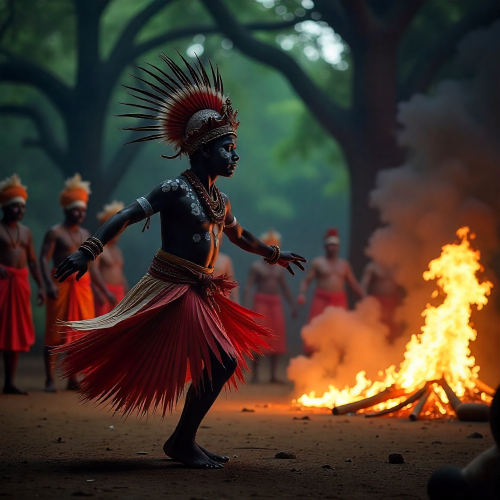
Krong Reap remains visible in Cambodian culture because the Reamker has never been confined to written storytelling. Its characters continue to live through performance, dance, theatre and visual art. The Royal Ballet of Cambodia preserves a classical repertoire in which the characters of the Reamker are represented through highly codified movement, costumes and masks. UNESCO recognizes the Royal Ballet as an important expression of Cambodian cultural heritage, noting its long association with Khmer court culture and its symbolic character types, including the Yeak, or giant.
Krong Reap is particularly important to Lkhon Khol, Cambodia’s masked male theatre tradition. UNESCO identifies Lkhon Khol of Wat Svay Andet as an important Cambodian heritage tradition and notes that the performance repertoire specifically includes the Reamker.
The character also appears through Sbek Thom, the traditional Khmer shadow theatre. Its large leather puppets represent figures from the Reamker, and performances can involve dozens or even more than a hundred puppets to stage episodes of the epic. UNESCO inscribed Sbek Thom on the Representative List of the Intangible Cultural Heritage of Humanity in 2008.
The connection between Krong Reap and Cambodia’s ancient monuments also requires an important historical distinction. The famous bas-reliefs of Angkor Wat depict scenes from the Ramayana, including the Battle of Lanka and Ravana, but they should not automatically be described as illustrations of the later Khmer Reamker. The Reamker belongs to a later development of the story within Khmer literary and performance culture. This distinction shows how the Ramayana tradition evolved in Cambodia across different historical periods.
Today, Krong Reap therefore survives not simply as a mythological villain but as part of a living cultural tradition. His image continues to be reproduced through masks, dance, theatre and visual storytelling, while his conflict with Preah Ream remains one of the most recognizable narratives in Cambodian epic tradition. His enduring appeal comes from the contradiction at the heart of his character: he possesses extraordinary power and royal authority, yet ultimately destroys himself through the choices he makes. In the Reamker, Krong Reap becomes a powerful reminder that strength without restraint can become the very force that leads to downfall.
Related Images





Source
Cambodian Community Day. (2015, September 4). The Khmer Reamker overview. Retrieved November 15, 2025, from https://cambodiancommunityday.org/the-khmer-reamker-overview
Wonders of Cambodia. (2025, September 21). The Reamker: Cambodia’s Epic of Good and Evil. Retrieved November 15, 2025, from https://wondersofcambodia.com/the-reamker-cambodias-epic-of-good-and-evil
CID-DS. Reamker: Version of Ramayana in Cambodia. Retrieved November 15, 2025, from https://cid-ds.org/reamker-version-of-ramayana-in-cambodia
MOWCAP. Summary of restored files on Cambodian mythology. Retrieved November 15, 2025, from https://mowcapunesco.org/restored-files-cambodian-mythology
Academia.edu. (2020, December 31). Supernatural Ancestors of the Cambodian People. Retrieved November 15, 2025, from https://www.academia.edu/12345678/supernatural-ancestors-cambodian-people
Horizon Journal of Humanities and Social Sciences Research. Retrieved November 15, 2025, from https://horizon-jhssr.com/article/reamker-cultural-impact
Bizot, F. (1994). Le figuier à cinq branches: Réflexion sur le bouddhisme khmer. Éditions du Seuil.
Pou, S. (1982). Reamker: L’épopée khmère. École française d’Extrême-Orient.
Frequently Asked Questions
Who is Krong Reap in Cambodian mythology?
Krong Reap is the demon king and main antagonist of the Reamker, Cambodia’s adaptation of the Ramayana.
Is Krong Reap the same as Ravana?
Yes, Krong Reap is the Khmer interpretation of Ravana, though adapted with unique local cultural and spiritual elements.
Why did Krong Reap abduct Neang Seda?
His abduction of Neang Seda stems from desire and vengeance, triggering the epic war with Preah Ream.
What powers does Krong Reap possess?
He wields immense strength, dark magic, shape-shifting, and near-invulnerability granted by divine boons.
How is Krong Reap represented in Khmer culture today?
He appears prominently in classical dance, temple murals, shadow puppetry, literature, and modern reinterpretations.


