Shrimad Ramayan : A Modern Epic Rooted in Ancient Dharma
| Description | |
|---|---|
| Origin | Indian Mythology |
| Language | Hindi |
| Type | Retelling with creative reimagination |
| Seasons | 1 season (2024–2025), ~341 episodes |
| Cast | Sujay Reu (Ram), Prachi Bansal (Sita), Basant Bhatt (Lakshman), Nirbhay Wadhwa (Ravana), Nikitin Dheer (Hanuman) |
| OTT Platform / TV Channel | Sony Entertainment Television, SonyLIV, Airtel Xstream |
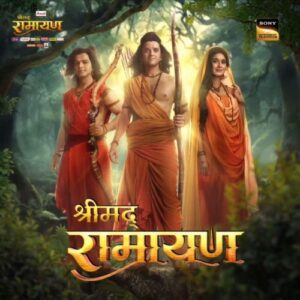
Shrimad Ramayan
Introduction
Shrimad Ramayan reintroduces one of India’s most enduring epics to a contemporary audience through a visually rich and emotionally grounded television format. Premiering on January 1, 2024, the series focuses on the life and journey of Rama, widely revered as the seventh incarnation of Vishnu, and presents his story as a living embodiment of dharma.
Unlike earlier adaptations such as Ramayan, the show places strong emphasis on cinematic scale, detailed production design, and visual effects that bring divine moments to life. Grand recreations of Ayodhya and Lanka, combined with devotional music and carefully staged sequences, aim to immerse viewers in both the spiritual and narrative dimensions of the epic.
At the same time, the series strives for closer alignment with traditional texts like the Ramayana while making the storytelling accessible for modern audiences. While widely appreciated for its performances and philosophical undertones, it has also received mixed responses regarding pacing and occasional overreliance on visual effects. Ultimately, Shrimad Ramayan positions itself as both a devotional experience and a narrative revival, bridging ancient storytelling with present-day expectations.
Plot
The narrative unfolds with the birth of Rama in Ayodhya, the son of King Dasharatha and Queen Kaushalya, alongside his brothers Bharata, Lakshmana, and Shatrughna. Each brother carries symbolic significance tied to cosmic order, reinforcing the divine framework of the story.
Rama’s early life leads to a defining moment at the court of King Janaka, where he wins Sita’s hand by lifting and stringing the mighty bow of Shiva. This event not only establishes his strength but also marks the beginning of a sacred union between Rama and Sita. The marriages of the four brothers soon follow, strengthening familial and political bonds.
The turning point arrives when Kaikeyi, influenced by palace intrigue, invokes her long-promised boons and demands Rama’s exile. Accepting this without resistance, Rama leaves Ayodhya for fourteen years, accompanied by Sita and Lakshmana. Their journey into the forest introduces a series of encounters that test endurance, morality, and faith.
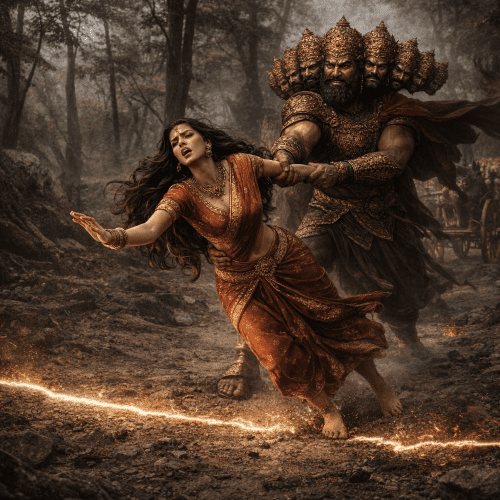
Conflict escalates when Surpanakha’s rejection leads to a chain of events culminating in Sita’s abduction by Ravana, the powerful ruler of Lanka. This act transforms the narrative from exile to quest. Rama forms alliances, most notably with Sugriva and the devoted Hanuman, leading to the construction of the legendary Ram Setu and the march toward Lanka.
The climactic war between Rama and Ravana represents the ultimate confrontation between righteousness and ego. Ravana’s defeat restores cosmic balance, but the story does not end there. Sita undergoes a trial by fire to affirm her purity, reflecting the societal and moral complexities embedded in the epic.
The return to Ayodhya marks Rama’s coronation and the establishment of Ram Rajya, an idealized kingdom built on justice and harmony. Later traditions extend the story to include the final departures of key figures, symbolizing the transition into a new cosmic age.
Mythological Basis
Shrimad Ramayan draws primarily from the classical Sanskrit epic attributed to Valmiki, which remains the foundational narrative of Rama’s life and purpose. In this tradition, Rama is not merely a king but a divine incarnation sent to restore balance by defeating forces of adharma, represented by Ravana.
The series also incorporates devotional elements from Tulsidas’ Ramcharitmanas, which presents Rama as the ideal human—Maryada Purushottama—whose life exemplifies perfect conduct. This dual influence allows the show to balance philosophical depth with emotional devotion.
Structurally, the narrative follows the traditional division into kandas, or books, covering Rama’s childhood, exile, alliances, war, and eventual reign. Each segment highlights a different aspect of human and cosmic duty, reinforcing the central idea that dharma must be upheld regardless of personal cost.
The characters themselves are rooted in symbolic identities. Rama represents divine order, Sita embodies grace and resilience, Lakshmana reflects unwavering loyalty, and Hanuman symbolizes devotion in its purest form. Ravana, despite his knowledge and power, represents the consequences of unchecked ego.
While the series remains largely aligned with orthodox interpretations, it acknowledges the existence of multiple traditions and retellings across regions. However, its core focus remains on presenting a spiritually consistent and culturally grounded version of the epic.
Characters & Archetypes
The strength of Shrimad Ramayan lies in its portrayal of timeless archetypes through its central characters. Each figure represents a moral principle, making the story both narrative and instructional. Rama, portrayed by Sujay Reu, stands as the embodiment of righteousness. His choices consistently prioritize duty over personal desire, reinforcing his role as the ideal king and individual. His journey is not about power but about responsibility.
Sita, played by Prachi Bansal, represents strength through grace. Her resilience during exile and captivity highlights inner courage rather than physical force. She remains one of the most enduring representations of devotion and dignity. Lakshmana, portrayed by Basant Bhatt, symbolizes absolute loyalty. His unwavering support for Rama, even at great personal cost, reflects the depth of brotherhood and sacrifice.
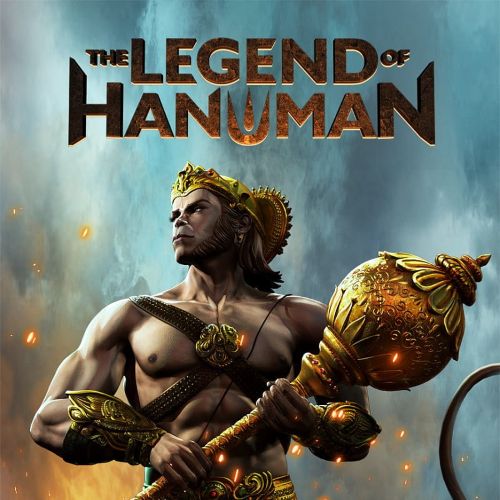
Hanuman, brought to life by Nirbhay Wadhwa, stands as the ultimate devotee. His strength, intelligence, and humility combine to create one of the most beloved figures in the narrative. His actions are driven entirely by faith and service.
Ravana, often portrayed as both brilliant and flawed, serves as a complex antagonist. His knowledge and devotion contrast sharply with his arrogance, making him a cautionary figure rather than a purely evil one.
Supporting characters such as Dasharatha, Kaikeyi, Bharata, and Vibhishana further enrich the narrative by representing different human dilemmas. Together, these archetypes create a layered story where every relationship mirrors real-life values and conflicts.
Creative Liberties
Although Shrimad Ramayan aims to remain faithful to its textual roots, it inevitably adopts certain creative liberties to suit the demands of modern storytelling. Under the vision of Siddharth Tewary, the series expands on emotional and psychological dimensions that are only briefly touched upon in traditional texts.
For instance, characters like Kaikeyi and Manthara receive more detailed backstories, offering viewers a deeper understanding of their motivations. Similarly, Hanuman’s early life and transformation into a devoted follower are explored with greater emphasis to build emotional connection.
Visual storytelling plays a major role in these adaptations. The use of VFX enhances divine events such as celestial weapons, miraculous feats, and the construction of the Ram Setu. While these elements add spectacle, they sometimes extend beyond the simplicity of the original texts.
Dialogue is another area where the series modernizes the narrative. Philosophical discussions are framed in a way that resonates with contemporary audiences, making ancient concepts more relatable without altering their essence.
However, these liberties have sparked debate. Some viewers appreciate the added depth and accessibility, while others feel that certain expansions affect the gravity of the original narrative. Despite this, the series largely succeeds in maintaining the integrity of its core message while adapting to a new medium.