


Huxian : The Mysterious Fox Deity of Chinese Folklore
At a glance
| Description | |
|---|---|
| Origin | Chinese Mythology |
| Classification | Spirits |
| Family Members | N/A |
| Region | China |
| Associated With | Foxes, Mischief |
Mythlok Perspective
In Mythlok’s Perspective, Huxian stands out because the fox is not merely a trickster but a supernatural being capable of earning spiritual status through longevity and cultivation. Unlike Japan’s kitsune, which became closely tied to Inari worship, Huxian developed a distinct place in Chinese folk religion as a figure of protection, prosperity, and spiritual influence. Its enduring appeal lies in how it transforms the humble fox into a bridge between the human and supernatural worlds.
Huxian
Introduction
Huxian, meaning “Fox Immortal,” is a supernatural figure rooted in the traditional religious and folkloric culture of northern China. Rather than representing a single fixed mythological character, Huxian belongs to a broader tradition in which foxes are believed to acquire extraordinary powers through age, spiritual cultivation, and supernatural transformation. The tradition became particularly prominent in northern and northeastern China, where fox spirits could be regarded not merely as mysterious creatures but as powerful beings capable of offering protection, prosperity, healing, or spiritual guidance. Huxian is therefore best understood as a fox deity or immortal within Chinese popular religion, rather than simply another name for the nine-tailed fox.
Chinese folklore contains many stories about fox spirits, often known as huli jing, that portray them as intelligent and highly supernatural beings. Some are benevolent and cultivate relationships with humans, while others are deceptive or dangerous. Huxian occupies an especially important position within traditions of fox worship, where fox deities could receive offerings and, in some communities, become associated with spirit-medium practices. The tradition demonstrates how Chinese mythology could transform an animal associated with mystery and the wilderness into a supernatural figure capable of occupying a place within popular religious life.
Physical Traits
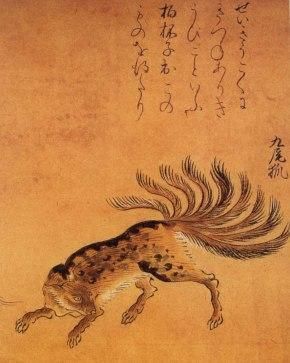
Huxian is fundamentally associated with the fox, although descriptions vary according to the particular tradition or story. In its animal manifestation, the figure may appear as an ordinary fox or as a supernatural fox displaying characteristics that distinguish it from a natural animal. The nine-tailed fox, or jiuweihu, is one of the most famous supernatural forms associated with Chinese fox mythology and can appear in representations of powerful or highly cultivated fox spirits.
The nine tails should not, however, be regarded as an essential feature of every Huxian. The broader tradition contains fox spirits with different appearances and varying degrees of supernatural development. Similarly, the idea that every tail represents a fixed period of time or a specific number of centuries is a modern simplification rather than a universal rule of Chinese mythology.
Like other fox spirits, Huxian may also assume human form. Stories frequently describe fox spirits appearing as attractive men or women and interacting directly with humans while concealing their supernatural identity. Their ability to cross between animal and human forms reflects one of the central characteristics of Chinese fox folklore: the fox occupies a boundary between the natural world and the supernatural realm.
Family
Huxian does not possess a standardized family genealogy comparable to the divine families associated with figures such as the Jade Emperor or other major Chinese deities. Instead, Huxian belongs to a much broader supernatural tradition involving fox spirits and fox deities.
In northern and northeastern Chinese popular religion, fox deities could form part of wider communities of animal-associated immortals. One important tradition is the Wudaxian, or “Five Great Immortals,” whose membership varies regionally but commonly includes supernatural beings associated with animals such as foxes, weasels, snakes, hedgehogs, and rats. Within these traditions, animal spirits could be regarded as powerful supernatural entities capable of interacting with humans.
Fox spirits could also develop relationships with individual people. Folklore contains stories of foxes assisting humans, entering into relationships with them, causing misfortune, or acting as spiritual intermediaries. These stories do not establish a single Huxian family but instead demonstrate the diverse social relationships attributed to fox spirits in Chinese mythology and popular religion.
Other Names
Huxian is written as 狐仙 and literally means “Fox Immortal.” Other titles associated with fox deities include Hushen (狐神), meaning “Fox God,” and Huwang (狐王), meaning “Fox King” or “Fox Ruler.” A particularly important feminine title is Huxian Niangniang (狐仙娘娘), generally translated as “Lady Fox Immortal” or “Fox Immortal Lady.”
Huxian should be distinguished from huli jing (狐狸精), the broader term for fox spirits found throughout Chinese folklore. Likewise, jiuweihu (九尾狐), meaning “nine-tailed fox,” refers specifically to the nine-tailed supernatural fox tradition and is not simply a universal alternative name for Huxian. The Japanese kitsune and Korean kumiho are related fox-spirit traditions from neighboring cultures, but they are not alternative names for Huxian. Each developed its own mythology, religious associations, and cultural characteristics.
Powers and Abilities
The supernatural abilities attributed to Huxian derive largely from the wider Chinese tradition of cultivated fox spirits. Shape-shifting is among the most important. Fox spirits are frequently said to acquire the ability to transform into human beings, allowing them to enter human communities and interact with people while concealing their true identities.
Fox spirits are also associated with longevity and spiritual cultivation. Traditional stories often portray supernatural foxes as beings that become increasingly powerful as they grow older and accumulate spiritual knowledge. This process distinguishes them from ordinary animals and allows them to approach the status of immortals or other supernatural beings in some traditions.
Another important characteristic is illusion and supernatural influence. Fox spirits may deceive humans through transformations, appearances, dreams, or other supernatural means. Their intelligence and ability to manipulate perception contribute to their ambiguous reputation as both helpful and dangerous beings.
Huxian can also be connected with healing, protection, prosperity, and spiritual intervention, particularly within traditions of fox worship. In northeastern China, fox deities became associated with spirit-medium practices in which supernatural beings were believed to communicate through human intermediaries. These religious traditions give Huxian a significance beyond the literary image of the seductive or mischievous fox spirit.
The powers of Huxian therefore vary considerably between traditions. Rather than possessing a fixed list of abilities, the figure reflects a flexible body of Chinese beliefs concerning the supernatural potential of animals, spiritual cultivation, and communication between humans and otherworldly beings.
Modern Day Influence
Huxian’s influence survives today through the continuing fascination with Chinese fox spirits, supernatural animals, and the nine-tailed fox. Although Huxian itself is less familiar internationally than the generalized image of the nine-tailed fox, its broader tradition has had a significant influence on East Asian popular culture.
The nine-tailed fox has become particularly prominent in modern anime, manga, television, literature, and video games. One famous example is Kurama, the Nine-Tails in Naruto, which draws upon the wider East Asian mythology surrounding supernatural foxes. Such modern characters are adaptations rather than direct representations of Huxian, but they demonstrate how the ancient image of the powerful fox continues to evolve.
Within China, the religious dimension of fox mythology is equally important. Fox deities have historically been worshipped in domestic and local religious settings, particularly in northern and northeastern regions. Stories of fox spirits also continue to appear in popular literature, television, film, fantasy fiction, and online culture.
The enduring appeal of Huxian comes from the unusual position occupied by the fox in Chinese mythology. Neither wholly benevolent nor inherently evil, the supernatural fox can become a protector, benefactor, trickster, lover, healer, or dangerous spirit depending on the story and tradition. Huxian therefore represents more than the familiar image of a magical nine-tailed fox. The figure reflects a much deeper Chinese belief that animals, through longevity and spiritual cultivation, could cross the boundary between the natural and supernatural worlds and become powerful spiritual beings.
Related Images




Sources
Kang, X. (2006). The cult of the fox: Power, gender, and popular religion in late imperial and modern China. Columbia University Press.
Huntington, R. (2003). Alien kind: Foxes and late imperial Chinese narrative. Harvard University Asia Center.
Strassberg, R. E. (2002). A Chinese bestiary: Strange creatures from the Guideways through mountains and seas. University of California Press.
Li, W.-T. (1948). On the cult of the Four Sacred Animals (Szu Ta Men 四大門) in the neighbourhood of Peking. Folklore Studies, 7, 1–94. https://asianethnology.org/article/147967-on-the-cult-of-the-four-sacred-animals-szu-ta-men-in-the-neighbourhood-of-peking
Chinese Text Project. (n.d.). Yiwen Leiju: Volume 99—Auspicious omens: Fox. Chinese Text Project. https://ctext.org/text.pl?if=gb&node=551974
Mirsky, A. (n.d.). Fox spirits. In China’s magical creatures. Muhlenberg College. https://open.muhlenberg.pub/chinasmagicalcreatures/chapter/fox-spirits/
Hong Kong Metropolitan University. (2025, February 7). Chinese mythical beasts go digital. School of Arts and Social Sciences, Research Institute for Digital Culture and Humanities. https://www.hkmu.edu.hk/as/research/ridch/chinese-mythical-beasts-go-digital/
Wikipedia contributors. (2026). Huxian. Wikipedia. https://en.wikipedia.org/wiki/Huxian
Frequently Asked Questions
Who is Huxian in Chinese mythology?
Huxian is a supernatural fox spirit revered as a deity in Chinese folk religion, particularly in northern China. It is associated with shapeshifting, spiritual power, protection, and prosperity.
What does Huxian mean?
Huxian (狐仙) means “Fox Immortal” and refers to supernatural fox spirits believed to gain spiritual power through age and cultivation. Huxian can be worshipped as a fox deity.
Is Huxian a nine-tailed fox?
Huxian is associated with the nine-tailed fox, but the two are not identical. Huxian refers to fox spirits or deities, while Jiuweihu specifically means “nine-tailed fox.”
What powers does Huxian have?
Huxian is associated with shapeshifting, longevity, spiritual cultivation, illusion, supernatural influence, protection, healing, and prosperity. Its abilities vary across Chinese folklore and religious traditions.
Is Huxian a god or a spirit?
Huxian is best understood as a fox spirit that can be revered as a deity. Unlike the Eight Immortals, Huxian belongs primarily to Chinese fox-spirit and popular religious traditions.
