


Nishi Daak : The Night-Calling Ghost of Bengal
| Description | |
|---|---|
| Origin | India |
| Classification | Ghost |
| Demeanour | Evil |
| Habitat | Towns and Villages |
| Status | Not Proved |
Mythlok Perspective
In Mythlok’s Perspective, Nishi Daak represents the fear of misplaced trust. The terror does not come from physical monstrosity but from emotional familiarity. It is the idea that something you love or recognize can become a gateway to danger. Cross-culturally, Nishi parallels the Slavic Rusalka, who lures victims near water, and the Irish banshee, whose call signals death. Yet unlike these figures, Nishi does not wail or reveal herself openly. She whispers. That subtlety makes her uniquely psychological. Where the banshee announces fate loudly, Nishi tests awareness quietly.
Nishi Daak
Introduction
Indian folklore has long been a tapestry of chilling stories passed down through generations, and among its most spine-tingling legends is the tale of Nishi Daak. Predominantly rooted in the regions of West Bengal, Bihar, and Jharkhand, this entity is dreaded not for its visible terror but for its deceptive whispers. Translating to “Call of the Night,” the Nishi Daak is said to lure unsuspecting victims into the darkness by mimicking voices of their loved ones. These eerie calls are more than just illusions—they often lead to disappearances that feed the myth, reinforcing its hold on the imagination of those who dare to walk alone after dusk.
Physical Attributes
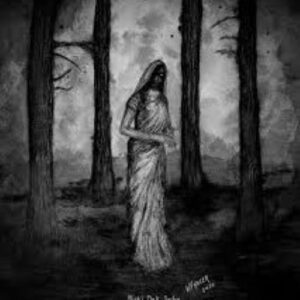
One of the most terrifying aspects of the Nishi Daak is its ambiguous appearance. Witness accounts vary widely—some describe it as a vague human-shaped mist, while others speak of a fleeting, white silhouette barely distinguishable from the night fog. In a few stories, glowing red eyes break through the darkness, piercing the silence like embers from a forgotten fire. However, most who’ve had a brush with the entity never see it at all—only hear the hauntingly familiar voice it uses to bait them. This lack of concrete form adds to its mystique, making the entity less of a ghost and more of a malevolent force camouflaged by shadows.
First Sighting/Reporting
Unlike documented paranormal events, the Nishi Daak legend survives through vivid oral storytelling. Rural families recount tales of individuals vanishing after responding to spectral voices. One widely retold story involves a man named Sujoy, a farmer from a West Bengal village, who heard his deceased aunt call him late one evening. Moved by emotion, he stepped out to follow the voice and was never seen again. The only trace left behind was his lantern, still burning near the edge of a forest. Such stories, often undated and unrecorded officially, are nonetheless passed down with consistent detail, anchoring the legend firmly in local culture.
Other Names
While most commonly called Nishi Daak in Bengal, the spirit’s presence is recognized across Eastern India by different names. In Bihar and Jharkhand, it’s often shortened to simply “Nishi.” Other Indian regions have their own versions of similar spectral entities. For instance, Karnataka has the notorious “Naale Ba” spirit, which also lures people by calling out in familiar voices. Though culturally distinct, these myths share a common core: deception through familiarity. The multiplicity of names reflects regional adaptations while preserving the eerie archetype of a voice in the dark with deadly intentions.
Modus Operandi
What sets the Nishi Daak apart from other paranormal beings is its psychological manipulation. Rather than chase or confront, it seduces its victims emotionally. It calls out in voices that replicate someone dear—often a deceased parent, spouse, or sibling. These calls, almost always occurring at night, are subtle and repeated just once or twice. Folklore holds that if a person hears their name called no more than two times and answers, they fall under the Nishi Daak’s influence.
Once the victim steps out into the dark, entranced by the familiarity, they are led further into isolation—typically toward forests, ponds, or desolate paths. At this point, their senses reportedly dull, and they lose control over their movements. According to legends, the Nishi cannot call out more than twice—if ignored, it loses power. Villagers teach children never to respond to any voice at night unless it repeats more than twice, acting as a folk survival mechanism.
Spiritualists often suggest that Nishi Daak is the wandering soul of someone denied proper funeral rites. Because their spirits remain unfulfilled, they roam at night, cursed and bound to draw others into the same restless existence. Some local beliefs also associate Nishi with astrological phenomena like Kaalratri, when spiritual boundaries are weakest, allowing such entities more influence.
Pop Culture References
The myth of Nishi Daak has not remained confined to village fireside tales. It has seeped into regional literature, television, and cinema. Bengali authors like Sanjib Chattopadhyay and Siddhartha Ghosh have written short stories inspired by the legend, often layering horror with societal commentary. In television, series such as Nishir Dak have dramatized the myth, presenting it as both entertainment and a reflection of deeper fears.
Nationally, the concept parallels stories like Stree (2018), a film based on the “Naale Ba” legend, highlighting similar fears of spirits calling men away at night. In literature and drama, Nishi Daak sometimes features in comedic or satirical contexts too—as seen in adaptations of Shakespeare’s comedies, where its presence is used to heighten confusion and suspense.
This cross-genre relevance shows how adaptable the myth is, acting as a metaphor for deeper societal issues like gender-based safety, loss, or trust. Nishi Daak, thus, moves beyond folklore into a broader cultural narrative.
Current Status
Despite the march of urbanization and technology, belief in Nishi Daak still thrives in rural areas. In parts of Bengal, Bihar, and Jharkhand, elders continue to relay warnings to the younger generation: never respond to nighttime voices, no matter how familiar. For many, these are more than just tales—they are practical advice rooted in cultural memory.
Even today, when unexplained deaths or vanishings occur in remote villages, whispers of the Nishi’s involvement are not uncommon. Religious and spiritual practitioners, such as ojhas and tantriks, are sometimes called to “cleanse” areas or perform rites to appease wandering spirits believed to be Nishi Daak.
At the same time, modern education and scientific reasoning have led many to view the myth as symbolic rather than literal. Psychologists interpret it as an expression of communal anxiety—fears of abandonment, unresolved grief, or the perils of the unknown. In diasporic communities, stories of the Nishi Daak remain nostalgic, evoking a sense of shared history, superstition, and inherited identity.



Source
Leo Patnaik. (2024). The Legend of Bengal’s Nishi Dak: A Call from the Shadows. https://folklorechronicles.com/the-legend-of-bengals-nishi-dak-a-call-from-the-shadows/
Beyond the Supernatural Horror of the Nishi Daak Ghost | Season 5. (2023). https://www.pbs.org/video/beyond-the-supernatural-horror-of-the-nishi-daak-ghost-1jv9c9/
Rohit Bhattacharya. (2020). The Nishi Daak, The Evil Spirit That Lures You By Imitating The … https://www.scoopwhoop.com/culture/nishi-daak-evil-spirit-that-lures-you-by-imitating-familiar-voice/
Frequently Asked Questions
What is Nishi Daak?
What does “Nishi Daak” mean?
“Nishi” means night, and “Daak” means call. Together, the term refers to a supernatural night call.
What happens if you answer Nishi’s call?
According to legend, responding to Nishi’s call can lead to disappearance, unconsciousness, or being led into dangerous isolation.
Is Nishi associated with black magic?
Some versions of the legend connect Nishi to tantric rituals, where it is believed that practitioners may summon or control such spirits.
Is Nishi Daak still believed today?
While largely regarded as folklore, the story remains culturally significant in Bengal and continues to influence regional horror narratives and cautionary tales.


