


Balayang : The Bat Ancestor of Kulin Creation Stories
At a glance
| Description | |
|---|---|
| Origin | Koori Mythology |
| Classification | Spirits |
| Family Members | Bunjil (Brother) |
| Region | Australia |
| Associated With | Bats, Creation, Water |
The Mythlok Perspective
In Mythlok’s Perspective, Balayang represents a vision of creation rooted in relationships between ancestral beings, people and the natural world. His connection to water, the origins of women and the night sky reflects a worldview in which life emerges through interactions with Country rather than through creation alone. In Greek mythology, Gaia similarly embodies the generative power of the natural world, although her role and cultural significance differ considerably from Balayang’s. While Gaia personifies the Earth as a primordial deity, Balayang’s stories are grounded in specific Kulin relationships with land, water and ancestral law.
Balayang
Introduction
Balayang is a bat ancestral being in the creation traditions of the Kulin Nation, a confederation of Aboriginal peoples whose Country includes areas of present-day Victoria in southeastern Australia. He is particularly known as the brother of Bunjil, the powerful eaglehawk creator being associated with the creation of people, Country and the laws governing relationships between them.
Balayang appears in several interconnected stories that explore creation, water, kinship and the relationship between human beings and the natural world. In one account, his actions explain how the first women emerged from muddy water. Another describes how he and his family acquired their dark colouring after a fire swept through their Country. These narratives connect Balayang with the origins of both human relationships and animal characteristics.
The name Balayang is associated particularly with Wurundjeri Woi-wurrung cultural material, while related forms such as Pallian and Palian appear in historical accounts. These variations reflect the different ways Aboriginal names and oral traditions have been recorded.
Although the term Koori is commonly used by Aboriginal people across parts of southeastern Australia, Balayang should not be treated as a universal figure in every Koori tradition. His stories belong to particular cultural contexts and are best understood as part of the continuing Aboriginal knowledge of Country, ancestry and law.
Physical Traits
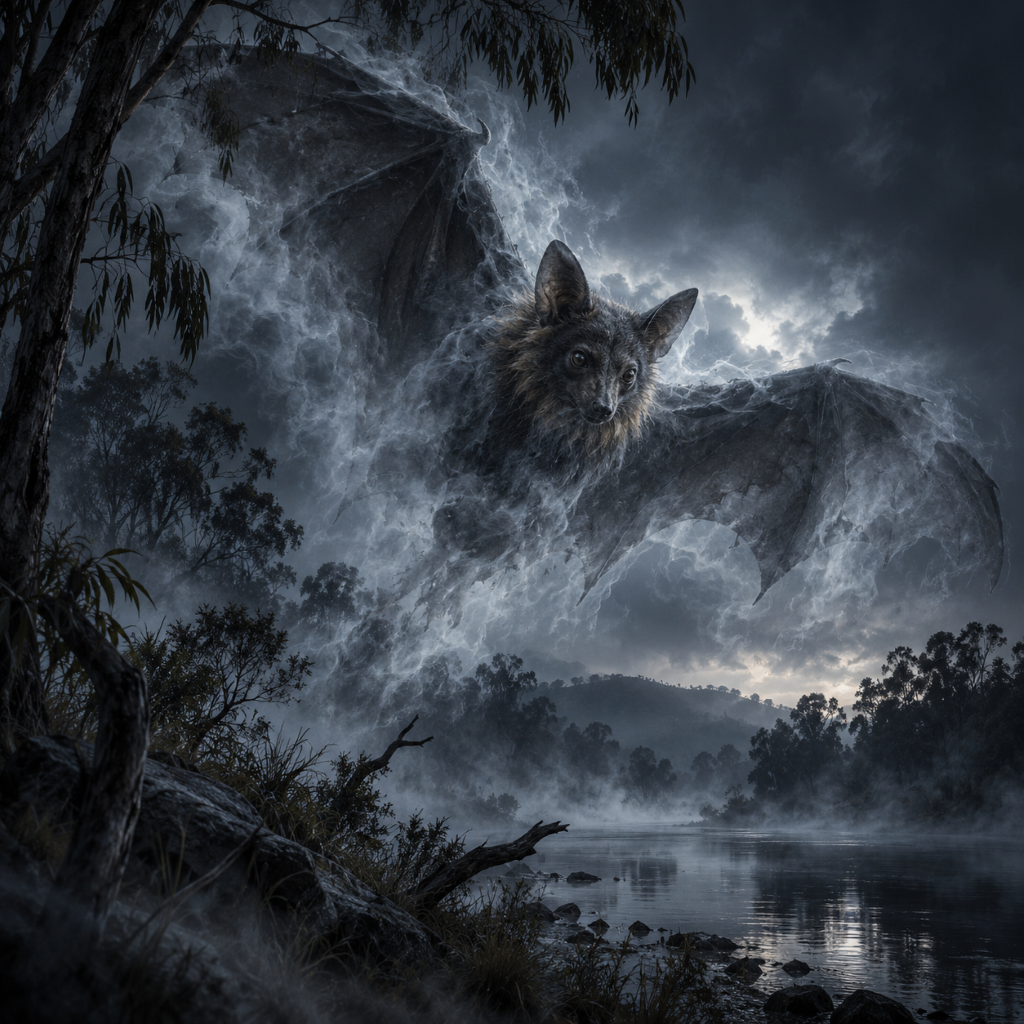
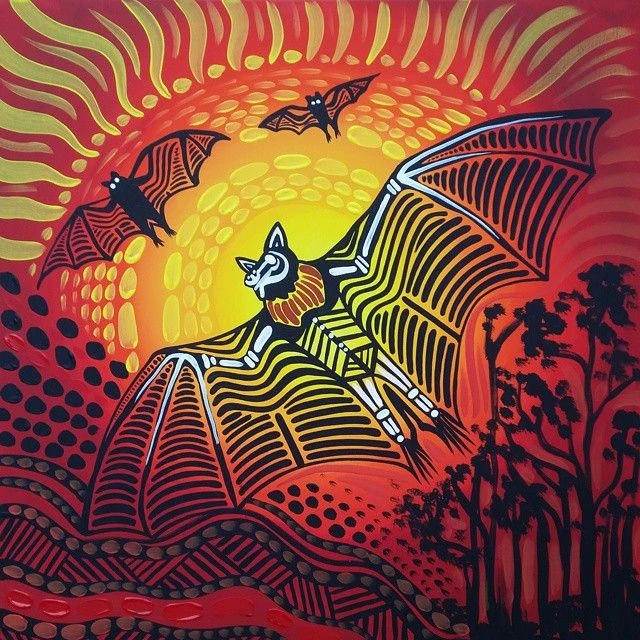
Balayang is represented as a bat, and this animal form is central to his identity in Kulin creation traditions. The surviving accounts do not consistently identify a particular bat species, so assigning him the precise appearance of a grey-headed flying fox or another species would go beyond the available evidence.
One of the best-known stories explains why Balayang and his family became black. According to a narrative recorded by anthropologist A. W. Howitt from Kulin knowledge shared by William Barak, Bunjil invited Balayang to leave his own Country and join him. Balayang declined, explaining that Bunjil’s Country was too dry and suggesting that Bunjil should instead come to his. Bunjil responded by sending his helpers, Djurt-djurt, the nankeen kestrel, and Thara, the quail hawk, to burn Balayang’s Country. The fire spread across the landscape, scorching Balayang and his family and permanently darkening their appearance.
The narrative offers an ancestral explanation for the dark colouring associated with bats. It also connects Balayang with the Crow side of the traditional moiety system in some recorded interpretations, placing his story within a broader framework of kinship and social relationships. These physical characteristics are therefore more than a description of an animal. They connect Balayang’s appearance with a story about Country, conflict and the consequences of relationships between ancestral beings.
Family
Balayang’s most consistently documented family relationship is his connection to Bunjil, the eaglehawk creator being. Historical records identify the two as brothers, although their relationship does not prevent them from having different interests and living in different places. Their disagreement over where to live forms the foundation of the story explaining the bat’s dark colouring. Balayang values his own Country and its conditions, while Bunjil wants him to relocate. Their conflict illustrates that even powerful ancestral beings have distinct relationships with particular places.
Balayang also appears in stories concerning the creation of women and the establishment of relationships between men and women. In a Taungurung account recorded in the collection Nyernila: Listen Continuously—Aboriginal Creation Stories, Balayang is found near Booerrgoen on the Goulburn River, where he plays in the water until it becomes thick with mud. Using a branch, he explores the muddy water and discovers two women. He names them Gannawarra, associated with the black swan, and Gurruk, associated with the native companion or brolga. He subsequently brings them to Bunjil, who assigns them to the men he has created.
The details of this narrative differ from other recorded creation accounts, and the names of the women are not identical in every retelling. Nevertheless, Balayang’s role in bringing forth women is an important part of the traditions associated with him. The surviving material does not establish a single, comprehensive family tree for Balayang. His relationship with Bunjil and the appearance of his family in the fire narrative are the clearest documented elements.
Other names
Balayang appears under several related names in historical and contemporary records. Balayang is the spelling used in Wurundjeri cultural resources, while Pallian and Palian occur in accounts of Kulin creation traditions. The differences reflect the challenges of recording Aboriginal languages and oral knowledge across different periods. Early written accounts frequently relied on the spellings adopted by individual recorders, and the resulting forms do not always correspond neatly to contemporary language practices.
These names should therefore be used with attention to their cultural context rather than assumed to be interchangeable in every instance. A name documented in one Kulin tradition does not automatically establish how the same being is named by another language group. Balayang is also associated with the bat as a spiritual protector in Wurundjeri cultural material. A resource documenting Wurundjeri stories and totems identifies the bat as a protector of Woiwurrung males and the owlet nightjar as a female spiritual protector. This association gives the name significance beyond its appearance in individual creation narratives. It connects Balayang with cultural understandings of identity, kinship and the relationship between people and the natural world.
Powers and Abilities
Balayang’s abilities vary between recorded traditions, but creation and his relationship with water are among his most prominent associations. Some accounts credit him with forming oceans, rivers and creeks. These associations place him within the ancestral understanding of a landscape in which waterways are not simply physical features but part of the history and continuing significance of Country. His role in the creation of women is particularly important. In the Taungurung narrative, Balayang’s repeated movements disturb the water until it becomes muddy. He then uses a branch to investigate the material beneath the surface and discovers two women.
The story connects creation with water, mud and the transformation of the natural environment. Balayang does not simply produce people through an abstract act of supernatural power. Instead, the narrative presents creation as an interaction with the landscape, in which an ordinary activity reveals something previously hidden. Balayang also has a celestial association. Some accounts of Kulin sky traditions identify him with Antares, the reddish star in the constellation Scorpius. Antares becomes visible in particular seasonal circumstances, connecting the ancestral figure with observations of the changing night sky.
This association should be distinguished from other Aboriginal astronomical traditions. Different language groups have their own star names, stories and interpretations, and a celestial identification documented for one group should not be generalised to all Aboriginal Australians. Taken together, the stories associate Balayang with creation, water, kinship and the sky. They present him as an ancestral being whose significance emerges through his relationships with other beings and the environment rather than through a single fixed list of supernatural powers.
Modern Day Influence
Balayang remains present in contemporary cultural education, language resources, astronomy and public interpretation connected with Aboriginal Victoria. The City of Whittlesea’s educational material on Wurundjeri seasons identifies Balayang as the bat and the brother of Bunjil. It places his story within a seasonal framework that connects changes in weather, animal activity and the night sky with observations of Country. This approach presents traditional knowledge as an ongoing way of understanding the environment rather than as a collection of disconnected stories from the distant past.
Balayang’s astronomical association also appears in discussions of Aboriginal sky knowledge. The Royal Society of Victoria’s account of Wurundjeri seasonal observations connects the appearance of Scorpius and Antares with the approach of the solstice, referring to Balayang and noting the distinct Boorong name Djuit in its discussion. This distinction is important because it demonstrates that Aboriginal communities may associate different names and traditions with the same celestial region.
Contemporary artists and educators also draw on Kulin creation stories to explore relationships between people, waterways and Country. The narrative of Balayang discovering women in muddy water provides a particularly powerful example of creation emerging through an interaction with the environment.
These modern uses should not be understood as evidence that every community interprets Balayang identically. Instead, they demonstrate how particular cultural traditions continue to inform education, art, language and public discussions of Aboriginal heritage. Balayang’s continuing significance lies in the survival and transmission of this knowledge. His stories preserve relationships between ancestral beings, animals, water, stars and people, demonstrating the enduring place of Kulin cultural traditions in contemporary Australia.
Related Images

Source
Alderton, S. (2023). Birds as creators. In Birds are dinosaurs: The evolutionary history of birds. ConnectSci. https://connectsci.au/books/monograph/809/chapter/2659255/Birds-as-creators
Massola, A. (1968). Bunjil’s cave: Myths, legends and superstitions of the Aborigines of south-east Australia. Lansdowne Press.
Melbourne Girls Grammar. (2026, July 31). Batman House renaming. https://www.mggs.vic.edu.au/batman-house-referendum
Melbourne United. (2026, October 27). The Kulin Nation, united: Our NBL27 Indigenous Round uniform. https://www.melbourneutd.com.au/news/the-kulin-nation-united-our-nbl27-indigenous-round-uniform
Nicholson, B., & Nicholson, M. (2018, January). Wurundjeri’s cultural heritage of the Melton area [PDF]. Melton City Council. https://www.melton.vic.gov.au/files/assets/public/v/1/services/people/aboriginal-and-torres-strait-islander/bill-and-mandy-nicholson-january-2018.pdf
Royal Society of Victoria. (n.d.). Seasons in the sky: The seven Wurundjeri seasons.
https://www.rsv.org.au/articles/seasons-in-the-sky
Smyth, R. B. (1878). The Aborigines of Victoria: With notes relating to the habits of the natives of other parts of Australia and Tasmania (Vol. 1). John Ferres, Government Printer. https://archive.org/details/aboriginesofvict01smyt
Victorian Collections. (2006). Further detail: Taungurung possum skin cloak.
https://victoriancollections.net.au/stories/possum-skin-cloaks/possum-skin-cloak-taungurung
Whittlesea City Council. (n.d.). Wurundjeri seasons. https://www.whittlesea.vic.gov.au/Services/Support-for-people/Aboriginal-community/Wurundjeri-seasons
Frequently Asked Questions
Who is Balayang in Kulin mythology?
Balayang is a bat ancestral being in Kulin traditions of southeastern Australia. He is known as the brother of Bunjil and appears in stories about creation, water, kinship and the origins of bats’ dark colouring.
What animal is Balayang associated with?
Balayang is associated with the bat. Wurundjeri cultural resources identify him as the bat and the brother of Bunjil, while historical accounts describe how fire turned him and his family permanently black.
Who is Balayang's brother?
Balayang’s brother is Bunjil, the eaglehawk creator being in Kulin traditions. Their relationship features in stories about different territories, a conflict over where to live, and the origin of bats’ dark colouring.
What are Balayang's powers and abilities?
Balayang is associated with creation and water in some Kulin traditions. Stories credit him with forming waterways and discovering the first women in muddy water, while some accounts connect him with the star Antares.
Is Balayang a god or a spirit?
Balayang is best described as an ancestral or creator being in Kulin traditions. These categories are approximate English descriptions and do not fully capture Aboriginal understandings of ancestral beings and the Dreaming.


