



Bunjil : The Creator Eagle Ancestor of the Kulin People
At a glance
| Description | |
|---|---|
| Origin | Koori Mythology |
| Classification | Gods |
| Family Members | Gunawara (Wife), Binbeal (Son), Pallian (Brother) |
| Region | Australia |
| Associated With | Creation, Wedge-tailed eagle, Sky, Landforms |
The Mythlok Perspective
In Mythlok’s Perspective, Bunjil represents a creation tradition in which bringing the world into existence also establishes responsibility towards it. Like Māui in Māori mythology, whose deeds shape the natural world and human experience, Bunjil’s stories connect creation with the relationships that sustain life. However, Bunjil’s role as an ancestral lawgiver places particular emphasis on kinship, cultural law and the care of Country. His continuing presence in Koori traditions demonstrates that creation stories are not merely explanations of the past but living expressions of identity, belonging and collective responsibility.
Bunjil
Introduction
Bunjil is a creator ancestor in the traditions of the Koori peoples of southeastern Australia, particularly the Kulin peoples of present-day Victoria. Associated with the wedge-tailed eagle, Bunjil is remembered for creating the landscape, bringing life into existence and establishing the cultural laws that govern relationships between people and their world. His stories connect creation with kinship, responsibility and the enduring relationship between Aboriginal communities and Country.
Koori is a regional identity used by many Aboriginal people in Victoria and parts of New South Wales. Bunjil, however, is particularly associated with the Kulin peoples, whose traditional Countries include the areas surrounding present-day Melbourne and central Victoria. The Kulin Nation comprises five principal language groups: Woi-wurrung, Boonwurrung, Taungurung, Wathaurong and Dja Dja Wurrung. Although their traditions share connections, individual communities maintain their own cultural knowledge and storytelling traditions.
In Kulin creation stories, Bunjil is more than a powerful supernatural figure. He is an ancestral source of life and cultural order. Museums Victoria describes him as the Ancestral Wedge-tailed Eagle who created much of southeastern Australia, including its geographical features and animals. He also brought people to life by breathing into figures moulded from clay. His stories continue to communicate the relationships between Country, law and community responsibilities.
Physical Traits
Bunjil is primarily associated with the wedge-tailed eagle, a large bird of prey native to Australia. In contemporary presentations of Kulin traditions, he is described as the Ancestral Wedge-tailed Eagle and creator. Some recorded Kulin stories also portray him as a powerful ancestral man, demonstrating that his identity cannot be reduced to the physical form of a bird.
A historical account recorded by Alfred William Howitt describes Bunjil as an ancestral headman who lived with his family before ascending to the sky. This account connects his human-like presence with his continuing identity as a creator ancestor. It should be understood as a particular recorded Kulin tradition rather than a universal physical description shared by every community.
Bunjil’s eagle association connects him with the sky and the wider natural world. His importance, however, comes from his role in creating the landscape and establishing relationships between people and Country, rather than simply from the characteristics of the wedge-tailed eagle.
In Wurundjeri Woi-wurrung traditions, Bunjil is also associated with the skyworld. A contemporary Wurundjeri cultural account describes his family and their celestial associations, including his son Binbeal, who is connected with the rainbow. Historical Kulin accounts also associate Bunjil with the star Altair. These details belong to particular recorded traditions and should not be presented as identical beliefs across every Koori community.
Family
Bunjil’s family relationships are recorded in several Kulin traditions, although the names and details differ between accounts. In a historical account of Wurundjeri traditions, Bunjil has two wives, identified as black swans, and a son named Binbeal, associated with the rainbow. Binbeal’s wife is described as the fainter rainbow that sometimes appears alongside the first.
The Wurundjeri Woi-wurrung Whole-of-Country Plan provides a more specific account of Bunjil’s family. It identifies his wife as Gunawara, associated with two black swans, and names six sons: Binbeal, Tadjeri, Turnung, Yukope, Dantun, Thara and Jurt-jurt. Binbeal is associated with the rainbow, while the other sons are connected with birds and other animals. The source’s description of Gunawara and the two black swans is retained here as recorded rather than interpreted as a definitive account of every Kulin tradition.
Another important ancestral figure in recorded Kulin creation stories is Pallian, also written as Pal-ly-yan or Palliyang. In a Wurundjeri creation account recorded by the Merri Creek Management Committee, Pallian is Bunjil’s brother and is associated with rivers, creeks and billabongs. The story describes Bunjil creating the first men from river clay, while Pallian creates women from water. This account illustrates how different ancestral figures contribute to the creation of human life.
Bunjil is also closely associated with Waa, the Ancestral Crow. In Kulin traditions, Bunjil and Waa are connected with the moiety system, which historically helped organise kinship and marriage relationships. Their roles are complementary: Bunjil is the creator ancestor, while Waa is recognised as a protector. These relationships are culturally significant and should not be simplified into a universal rivalry between two supernatural beings.
Other names
Bunjil appears under several spellings in historical records, including Bundjil, Pundjel, Pund-jel and Bun-jil. These variants reflect differences in historical transcription and the ways Aboriginal names were represented in written English.
Robert Brough Smyth’s The Aborigines of Victoria, published in 1878, records both Pund-jel and Bun-jil. His work contains accounts attributed to different Victorian Aboriginal communities, including the Boonwurrung and Woi-wurrung. These records are useful for understanding how Bunjil’s stories were documented, but they must be read carefully because not every narrative in the book belongs to the same community.
The spelling Bundjil is also used by the Taungurung Land and Waters Council when presenting Taungurung creation stories. This is a relevant Kulin cultural context, but the spelling should not automatically be treated as the preferred form in every Koori language community.
Bunjilaka, the Aboriginal Cultural Centre at Melbourne Museum, takes its name from Bunjil. The centre explains its name as meaning the place of Bunjil, reflecting the ancestral creator’s continuing significance in contemporary Victorian Aboriginal culture. The different spellings generally refer to the same ancestral figure in their respective contexts, rather than necessarily identifying separate beings.
Powers and Abilities
Bunjil’s central role in Kulin traditions is that of a creator ancestor responsible for shaping the world and bringing life into existence. His creation stories explain the origins of the landscape while establishing the relationships between people, animals and Country.
In a Wurundjeri creation story recorded by William Howitt from the account of Elder William Barak, Bunjil gathers clay from a riverbed and shapes it into two human figures. He then breathes into their mouths, nostrils and navels, giving them life. His brother Pallian subsequently creates women from water. This narrative places the river landscape at the centre of human creation and connects human life directly with the natural environment.
Bunjil is also credited with shaping the land. Historical accounts collected by Robert Brough Smyth describe him travelling across the earth with a large knife or sword, cutting the land to form rivers, creeks, mountains and valleys. Because the recorded narratives differ, these details should be attributed to the particular historical account rather than presented as a single definitive version of every Kulin creation story.
Another defining aspect of Bunjil’s influence is the establishment of cultural law. The Wurundjeri Woi-wurrung Whole-of-Country Plan identifies Bunjil as the ancestor who created people and laid down Lore concerning the care of Country. This responsibility gives his stories an enduring ethical dimension: creation establishes obligations, not simply possession or power.
Bunjil is also associated with the skyworld. In a Kulin narrative recorded by Howitt, he ascends with his people during a great whirlwind released by Bellin-bellin, the musk crow, and continues to watch over the world. The story connects his earthly creative activities with his continuing celestial presence. Taken together, these accounts portray Bunjil as a creator, life-giver and guardian of cultural order. His significance rests on the relationship between the world he created and the responsibilities people have towards one another and the land.
Modern Day Influence
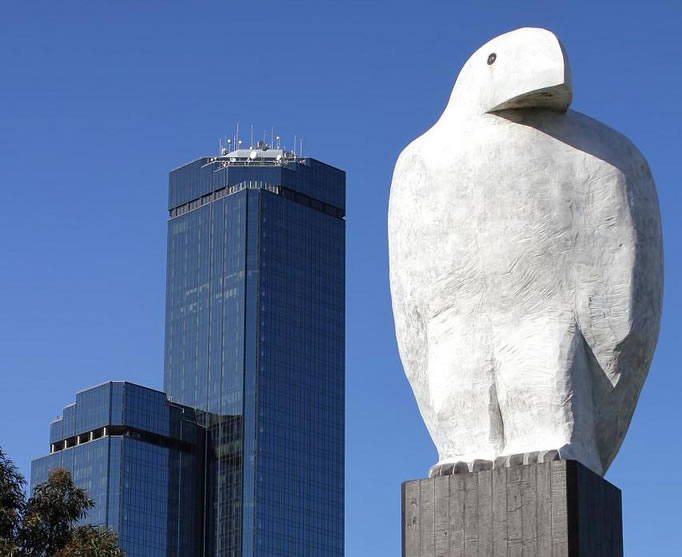
Bunjil remains an important figure in contemporary Koori cultural expression, education and public art across Victoria. His presence in museums, heritage sites and civic architecture connects ancestral traditions with living Aboriginal communities.
Bunjilaka Aboriginal Cultural Centre at Melbourne Museum is a prominent example. Developed in collaboration with Aboriginal people, the centre presents Victorian Aboriginal histories and cultures through exhibitions, storytelling, performances and artwork. Its First Peoples exhibition explores the continuing relationships between Aboriginal communities, Country and cultural knowledge. Bunjil’s story is central to the centre’s presentation of creation and cultural continuity.
Bunjil’s Shelter in Victoria is another important cultural site. The rock shelter contains a recognised depiction of Bunjil and is significant within the region’s Aboriginal heritage. It demonstrates the importance of particular places in preserving cultural knowledge and maintaining connections with ancestral stories. Bunjil has also inspired contemporary public architecture. Bunjil Place, a cultural and community precinct in Narre Warren, Victoria, takes its name from the ancestral eagle. Its architectural design draws inspiration from the image of an eagle in flight, connecting a modern public space with the cultural identity associated with Bunjil.
These contemporary representations should not be mistaken for substitutes for the traditions maintained by Aboriginal communities themselves. Rather, they provide opportunities to encounter Bunjil’s cultural significance while recognising that his stories belong to living traditions. For the Kulin peoples, Bunjil represents more than a creator from the distant past. His stories connect the origins of life with cultural law, kinship and responsibility towards Country. Understanding Bunjil therefore requires attention to the communities that preserve his traditions and respect for the differences between their accounts.
Related Images


Source
AIATSIS. (n.d.). Melbourne dreaming: A guide to important places of the past and present. Australian Institute of Aboriginal and Torres Strait Islander Studies. https://aiatsis.gov.au/sites/default/files/research_pub/melbourne-dreaming-sample_1.pdf
ANU Press. (n.d.). Eastern Kulin songs. In Songs of the Kulin nation. https://press-files.anu.edu.au/downloads/press/n14364/pdf/ch03.pdf
ANU Press. (2022). Skin, kin and clan: The dynamics of social categories in Indigenous Australia.
https://press-files.anu.edu.au/downloads/press/n4082/html/ch06.xhtml?page=13
Bunjil Place. (2017, October 9). Bunjil the creator. City of Casey. https://www.bunjilplace.com.au/our-story/bunjil-creator
Bunjil Place. (2022, May 4). Our story. City of Casey. https://www.bunjilplace.com.au/our-story
Clark, I. D. (2012). The abode of malevolent spirits and creatures: Caves in Victorian Aboriginal social organization. Helictite, 40(1). https://helictite.caves.org.au/pdf1/40.1.Clark.pdf
Deadly Story. (2014). Wurundjeri stories and totems. https://deadlystory.com/page/aboriginal-country-map/Aboriginal_Country_Completed/Wurundjeri/Wurundjeri_Stories_and_Totems
Encyclopedia Mythica. (2001, July 26). Bundjil. https://pantheon.org/articles/b/bundjil.html
Hamacher, D. W., & Norris, R. P. (2014). Archaeoastronomy: The journal of astronomy in culture (Vol. 25). https://arxiv.org/pdf/1408.6368v1.pdf
Howitt, A. W. (1904). The native tribes of south-east Australia. Macmillan. https://catalogue.nla.gov.au/catalog/2250024
Museums Victoria. (n.d.-a). About us: Bunjilaka. https://museumsvictoria.com.au/bunjilaka/about-us/
Museums Victoria. (n.d.-b). First Peoples. https://museumsvictoria.com.au/bunjilaka/whats-on/First-Peoples/
National Gallery of Victoria. (2016). Bruce Armstrong: An anthology of strange creatures. https://www.ngv.vic.gov.au/exhibition/bruce-armstrong/
Frequently Asked Questions
Who is Bunjil in Koori mythology?
Bunjil is a creator ancestor associated with the Kulin peoples of Victoria, Australia. He is commonly represented as the ancestral wedge-tailed eagle.
What did Bunjil create?
Kulin creation stories credit Bunjil with shaping the land, creating animals and bringing people into existence.
What animal represents Bunjil?
Bunjil is associated with the wedge-tailed eagle, a large bird of prey native to Australia.
Who are Bunjil's family members?
Some Kulin accounts identify Binbeal as his son and Pallian as his brother. Wurundjeri Woi-wurrung traditions also record his wife and other sons.
Does Kamohoaliʻi still influence Hawaiian culture today?
Where is Bunjil represented in Victoria today?
Bunjil appears in cultural presentations at Melbourne Museum’s Bunjilaka Aboriginal Cultural Centre and in the rock art at Bunjil’s Shelter.


