


Antü : The Mapuche Sun Spirit of Light, Wisdom and Power
At a glance
| Description | |
|---|---|
| Origin | Mapuche Mythology |
| Classification | Spirits |
| Family Members | Kueyen (Wife), Trentren-Vilu (Son) |
| Region | Chile, Argentina |
| Associated With | Sun, Daylight, Light, Wisdom |
The Mythlok Perspective
In Mythlok’s Perspective, Antü shares the familiar solar symbolism found in figures such as Inti of Inca mythology, where the Sun represents life, power, and continuity. Yet Antü carries a more fluid presence within Mapuche cosmology, where sunlight is connected with spiritual authority, wisdom, ancestry, and the natural world. His importance lies not only in representing the Sun, but in what its light reveals about the relationship between the visible world and the spiritual forces believed to shape it.
Antü
Introduction
Antü is one of the most prominent solar figures associated with Mapuche mythology. His name is directly connected with the Sun and day in Mapudungun, the language of the Mapuche people, and the figure is described in different sources as a powerful Pillán spirit associated with light, wisdom and spiritual authority. The Chilean National Library likewise records Antü, or Chau, as a solar figure known as Antu fucha, the “old sun king,” while describing a feminine lunar dimension as Antu kuche.
Antü belongs to a religious tradition in which spiritual beings, ancestors, natural forces and the structure of the cosmos are closely connected. This makes it difficult to describe him simply as a sun god in the same sense as deities from more centralized pantheons. In some accounts, Antü is the principal or most powerful of the Pillán, commanding other powerful spirits. In others, he is presented more specifically as the personification or spiritual representation of the Sun.
Antü is particularly important in stories concerning the conflict between the forces represented by sunlight and fire. His rivalry with Peripillán forms part of a larger mythic cycle explaining the shaping of the landscape and the origins of powerful serpentine beings.
Physical Traits
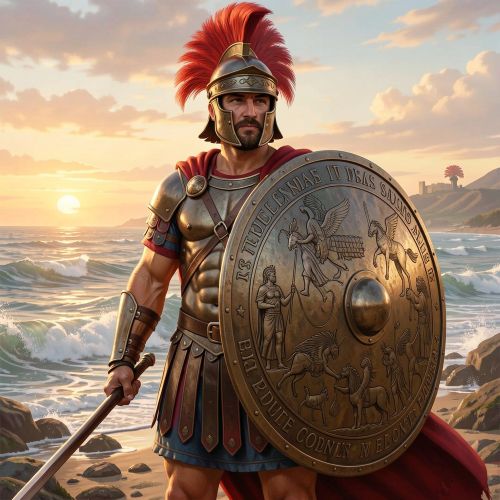
Mapuche traditions do not provide a consistent human-like physical portrait of Antü. Instead, his identity is expressed through the qualities of sunlight itself. Antü represents brightness, radiance and the power associated with the Sun, making light more important to his appearance than any imagined face, body or clothing.
This distinction matters when depicting Antü. A highly detailed warrior with a fixed costume would go beyond what the surviving descriptions establish. A more faithful representation would show a powerful spiritual presence associated with the rising or overhead Sun, with human form used symbolically rather than as a literal canonical appearance.
The name Antü itself supports this solar association. A Mapudungun dictionary published through Chile’s Biblioteca Nacional defines antü as “the Sun,” while also giving meanings connected with day, season and time of day. The word therefore carries a wider relationship with the daily experience of sunlight and time, rather than functioning only as a personal divine name.
Family
Antü is traditionally paired with Kueyen, also written Küyen, the Moon. The pairing represents a natural opposition and complementarity between Sun and Moon, day and night. Some mythic accounts expand this relationship into the story of the Pillán conflict, in which Antü chooses Kueyen from among the Wangulén, the star spirits or star maidens.
The resulting rivalry is connected with Peripillán, a powerful spirit associated with fire. In versions of this story, Peripillán resents Antü’s prominence and the brilliance associated with his golden light. Their rivalry develops into a great conflict among the Pillán, becoming one of the mythic explanations for violent changes in the landscape.
Antü’s connection with Trentren-Vilu requires particular care because versions differ. In one documented tradition, the son of Antü becomes Trentren-Vilu, the enormous serpent associated with the land. Caicai-Vilu, the serpent associated with the sea, is instead linked with Peripillán in that version. Later retellings sometimes simplify or alter these relationships, so both serpents should not automatically be described as Antü’s children.
The famous conflict between Trentren-Vilu and Caicai-Vilu subsequently becomes a major Mapuche story about the relationship between land and sea. The two serpents are associated with rising land and rising waters, while the story also preserves an explanation of the region’s dramatic geological landscape.
Other names
Antü appears under several names and descriptions in sources dealing with Mapuche cosmology. Antu is the spelling commonly found when the diaeresis is omitted, while Antü reflects the Mapudungun spelling used in many modern references.
Chau or Chao is another name associated with the figure. The Chilean National Library identifies “Chau o Antu” and records Antu fucha, meaning “old sun king,” as another designation. The same source describes Antu kuche, the feminine lunar counterpart, as the “old moon queen.” These terms should be understood within particular descriptions of Mapuche cosmology rather than treated as evidence for a universally standardized pantheon.
Antü is also frequently described in English-language material as the Mapuche sun god. That description is useful for readers searching for the figure, but “Pillán spirit” is more precise when discussing the terminology used in Mapuche religious traditions.
The supposed connection between Antü and the Inca sun god Inti should not be treated as an established identity or direct linguistic derivation. The names belong to different Indigenous languages and traditions, and superficial similarity does not demonstrate historical borrowing.
Powers and Abilities
Antü’s principal association is with solar light. He represents the Sun and the qualities that sunlight embodies within the mythology: brightness, vitality, wisdom and spiritual force. His power is therefore less like a list of supernatural abilities and more like an expression of the Sun’s fundamental place in the Mapuche understanding of the world.
Some accounts identify Antü as the principal Pillán and describe him as having authority over other Pillán spirits. This makes him a figure of spiritual hierarchy as well as solar symbolism. However, the exact organization of the supernatural world varies between ethnographic and folkloric sources, so claims that Antü universally rules every spirit in Mapuche religion should be treated cautiously.
Antü is also important within stories explaining the struggle between natural and supernatural forces. His conflict with Peripillán is presented in some versions as a cosmic struggle whose consequences reach the physical landscape. The defeated fire spirit is associated with the subterranean world and, in later interpretations, with volcanic activity. Academic research has shown how Mapuche mythology connects geological and meteorological phenomena with traditional understandings of the landscape.
Antü’s mythological importance can therefore be understood through three closely related ideas: light, authority and cosmic order. He is not merely the object seen in the sky each morning; he represents the spiritual significance of the Sun within a worldview where natural phenomena and sacred forces are deeply intertwined.
The story of Trentren-Vilu and Caicai-Vilu further demonstrates this relationship. Their struggle between land and sea has been interpreted alongside the geological realities of south-central Chile, particularly earthquakes, uplift and tsunamis. The myth does not function simply as a supernatural explanation of nature; it preserves a culturally meaningful way of understanding a landscape shaped by powerful geological forces.
Modern Day Influence
Antü continues to appear in discussions of Mapuche identity, cosmology, language, art and cultural heritage. His name itself remains part of living Mapudungun vocabulary, where antü means the Sun and can also refer to the day and related ideas of time. This linguistic continuity is important because it demonstrates that Antü is not merely a figure preserved in an ancient mythology database; the word remains part of the language spoken and studied by Mapuche communities.
Modern scholarship has also encouraged a more careful understanding of Antü and other Mapuche spiritual figures. Rather than forcing them into categories borrowed from Greek, Roman or Norse mythology, researchers increasingly examine Mapuche concepts within their own cultural and linguistic context. The distinction between creator beings, ancestral spirits, nature spirits and Pillán is particularly important when discussing Mapuche religion.
Antü is also relevant to contemporary interpretations of the Mapuche landscape. The stories surrounding Trentren-Vilu and Caicai-Vilu have been examined by researchers working across geology, history and Indigenous studies. Their work demonstrates how mountains, coastlines, earthquakes and tsunamis can exist simultaneously as physical realities and as elements of cultural memory.
For modern readers, Antü is therefore best understood not simply as a “sun god,” but as a powerful Mapuche solar spirit whose meaning extends into language, cosmology and stories about the relationship between humanity and the natural world. His mythology reveals a worldview in which light is not merely something that illuminates the landscape; it is part of a larger spiritual order connecting the heavens, the Earth and the forces that continually reshape both.
Related Images


Source
Cruz, E. A. (2010). The Grand Araucanian Wars (1541–1883) in the Kingdom of Chile. Xlibris US.
Gods and Monsters. (2024, August 22). Antü: Mapuche sun god and lord of the Pillán spirits. https://godsandmonsters.info/antu/
Hughes, T. (2020). World mythology: From indigenous tales to classical legends. Arcturus Publishing.
I Am Bookface. (2024, August 30). Antu. https://iambookface.com/antu/
Moon, J. (2019). Folk tales of rock and stone. History Press.
Pueblos Originarios. (n.d.). Antu. https://pueblosoriginarios.com/sur/patagonia/mapuche/antu.html
Wikipedia. (2009, September 20). Antu (Mapuche mythology). https://en.wikipedia.org/wiki/Antu_(Mapuche_mythology)
Calfío, M. (2012). Peküyen. Comunidad de Historia Mapuche. Temuco: Ediciones Comunidad de Historia Mapuche.
Bacigalupo, A. (2007). Shamans of the Foye Tree: Gender, Power, and Healing among Chilean Mapuche. University of Texas Press.
Foerster, R. (1993). Introducción a la religiosidad mapuche. Santiago de Chile: Editorial Universitaria.
Frequently Asked Questions
Who is Antü in Mapuche mythology?
Antü is a powerful Mapuche solar spirit associated with the Sun, light, wisdom and spiritual authority. Some traditions describe him as the principal Pillán.
What does Antü mean in Mapudungun?
Antü means “Sun” and can also refer to the day, season or time of day. The word remains part of the Mapudungun language today.
Who is Antü's wife in Mapuche mythology?
Antü is associated with Kueyen or Küyen, the Moon. Their pairing represents the complementary relationship between solar and lunar forces.
Is Trentren-Vilu the son of Antü?
Some versions identify Trentren-Vilu as Antü’s son. However, Mapuche traditions vary, so this relationship should not be treated as universal.
Is Antü a god or a spirit?
Antü is best described as a powerful Pillán spirit, although many modern sources call him the Mapuche sun god. The terminology varies between traditions and sources.


