

Luison : The Cursed Guarani Guardian of Death
At a glance
| Description | |
|---|---|
| Origin | Guarani Mythology |
| Classification | Spirits |
| Family Members | Tau (Father), Kerana (mother), Teju Jagua, Mbói Tu’ĩ, Moñái, Jasy Jatere, Kurupí, Ao Ao, (Siblings) |
| Region | Paraguay, Argentina, Brazil, Uruguay |
| Associated With | Death, Cemeteries, Decay, Curses |
The Mythlok Perspective
In Mythlok’s Perspective, Luison stands apart from the European werewolf because his story is rooted not in the fear of losing control, but in humanity’s relationship with death itself. While both legends feature a man transforming into a fearsome beast, Luison remains deeply connected to Guarani beliefs about cemeteries, ancestral spirits, and the sacred boundary between the living and the dead. His evolution through contact with Iberian folklore demonstrates how Indigenous myths can adapt to outside influences without surrendering their cultural identity.
Luison
Introduction
Luison, also spelled Luisõ, Luisón, or Lobizón, is one of the most feared supernatural beings in Guarani mythology. He is traditionally regarded as the seventh and youngest son of Tau, the spirit of evil, and Kerana, a mortal woman whose children became legendary monsters after their cursed union. While each of his six siblings governs a different aspect of nature or human fear, Luison alone is closely associated with death, cemeteries, decay, and the restless dead.
Although he is often compared to the European werewolf, Luison is not simply a South American version of that creature. His legend developed independently within Guarani traditions before later blending with Iberian folklore during the colonial period. This fusion gave rise to the widespread belief that the seventh son in a family would eventually transform into a monstrous canine creature, a superstition that became deeply rooted across Paraguay, northern Argentina, and parts of Brazil.
Today, Luison remains one of the defining figures of Guarani folklore. His legend reflects ancient beliefs surrounding death and burial while also illustrating how Indigenous traditions evolved after coming into contact with European myths.
Physical Traits
Luison is usually described as a terrifying creature that exists somewhere between human and beast. Traditional Guarani accounts portray him as an unnaturally thin, sickly individual with pale skin, tangled hair, sunken eyes, and an overpowering smell of decay. His appearance alone is enough to signal that he belongs to the world of the dead rather than the living.
When he transforms, Luison becomes a massive black dog or dog-like monster instead of the wolf commonly associated with European werewolves. His body is muscular yet gaunt, with coarse fur, elongated claws, sharp teeth, and glowing eyes that pierce the darkness. Some stories describe him as retaining human characteristics, giving him an unsettling appearance that is neither fully human nor entirely animal.
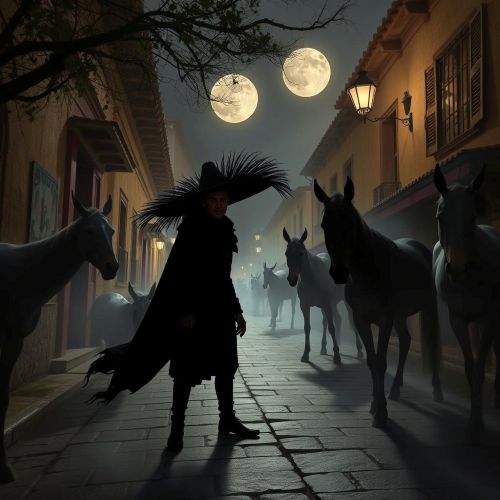
His presence is often announced by an unbearable odor resembling decomposing flesh. Unlike many mythical predators that hunt in forests or mountains, Luison wanders through cemeteries, abandoned roads, and isolated villages after sunset. The silence surrounding his movements only heightens his supernatural reputation.
Regional traditions differ regarding the timing of his transformation. Some stories associate it with stormy nights, while others link it to the full moon or particular nights of the week. Regardless of the version, darkness is always an essential part of his legend.
Family
Luison belongs to one of the best-known families in Guarani mythology. He is the youngest of the seven monstrous children born to Tau and Kerana, whose cursed union produced beings that came to embody different fears and forces of nature.
His siblings are Teju Jagua, the guardian of caves and precious fruits; Mbói Tu’ĩ, the serpent associated with rivers and wetlands; Moñái, the horned spirit linked to trickery and theft; Jasy Jateré, the mysterious child who lures children into the forest; Kurupí, the spirit connected with fertility and desire; and Ao Ao, the monstrous sheep-like predator that hunts humans in the wilderness.
Among these legendary siblings, Luison occupies a unique role. Rather than ruling over forests, rivers, or caves, he is tied directly to cemeteries and the realm of death. This association made him the most feared of the seven, as his domain represented the inevitable fate awaiting every human being.
The legend also gave rise to one of South America’s most enduring folk beliefs. For generations, many communities believed that the seventh consecutive son in a family was destined to become a Lobizón or inherit Luison’s curse. Although viewed today as folklore, this belief shaped social customs well into the twentieth century.
Other names
Luison’s name changes depending on the language and region in which his story is told. The original Guarani form is Luisõ, while Spanish-speaking communities generally use Luisón. In Argentina and Uruguay, he is better known as Lobizón or Lobisón, reflecting the influence of Iberian werewolf traditions. Brazilian folklore uses the related Portuguese term Lobisomem, although that figure is not identical to Luison.
These different names reveal how Indigenous Guarani mythology gradually merged with European folklore after colonization. While the terminology evolved, Luison’s identity as the cursed son of Tau and Kerana remained central to the legend.
Powers and Abilities
Luison’s most famous power is his ability to transform into a monstrous canine creature under the cover of darkness. Unlike European werewolves, however, his transformation is closely connected to death rather than uncontrollable rage or predatory violence.
He is believed to roam cemeteries searching for corpses, feeding upon decaying flesh and lingering among graves. Because of this, many Guarani traditions regard him as the supernatural guardian of burial grounds, existing on the boundary between the living and the dead. Luison is also considered an omen of misfortune. Encountering him at night is said to foretell illness, tragedy, or even death. His terrifying howl and foul smell are often interpreted as warnings that death is nearby.
Some regional traditions claim that his bite or direct contact can spread curses or transform another person into a creature like himself. Other stories describe him as capable of moving silently through darkness or remaining unseen until he chooses to reveal himself. These abilities vary between oral traditions, but all reinforce his reputation as one of the most dreaded beings in Guarani folklore. Unlike heroic mythological figures, Luison possesses no redemptive qualities. His role is to embody humanity’s fear of mortality, decay, and the unknown mysteries surrounding death.
Modern Day Influence
Luison’s influence extends far beyond traditional folklore. His legend became deeply intertwined with social customs across Paraguay and Argentina, particularly the superstition surrounding the seventh son. This belief became so widespread that some families feared their seventh-born child would eventually become a Lobizón. To combat discrimination and abandonment, Argentina introduced a remarkable tradition in which the President serves as the ceremonial godparent of every seventh son or daughter of the same sex. The practice, formally established through Law No. 20,843 in 1974, helped transform an old superstition into a symbol of protection rather than fear.
Luison continues to appear in novels, horror films, comics, television series, and folklore festivals throughout South America. Modern portrayals often emphasize his resemblance to a werewolf, although scholars continue to distinguish the original Guarani legend from European lycanthropy.
His story has also gained renewed attention as interest in Indigenous South American mythology grows worldwide. Cultural organizations in Paraguay increasingly present Luison alongside other Guarani mythological figures as an important part of the region’s living heritage, ensuring that the ancient legend continues to survive in the modern world.
Related Images


Source
Aguilera, D. (2020). Oríguen y esencia de los mitos guaraníes.
Boidin, C. (2023). Decolonizing knowledge: visual representations of Guarani mythology.
Cadogán, L. (1966). Animal and plant cults in Guaraní lore. Revista de Antropologia, 14, 105-124.
Ganson, B. (2019). The Guaraní and Their Legacy. Oxford Bibliographies.
Martínez-Frías, J., Rodríguez-Portillo, E., Wieczorko Barán, T., Vera Gamarra, V. D., Mendoza, G. T., & Villalba Alderete, C. I. (2025). Connecting Guarani Culture to Space—An Intangible Heritage in the Solar System Science and Education Framework: A Review. Heritage, 8(11), 473.
Nimuendajú, C. (1987). Leyenda de la creación y de la destrucción del mundo como fundamentos de la religión de los Apapocuva-Guaraní.
Wikipedia. (n.d.). Luison. https://en.wikipedia.org/wiki/Luison
Frequently Asked Questions
Who is Kamohoaliʻi in Hawaiian belief?
Who is Luison in Guarani mythology?
Luison is the seventh and youngest son of Tau and Kerana, feared as the supernatural being associated with death, cemeteries, and the curse of the seventh son.
Is Luison a werewolf?
Luison shares similarities with werewolf legends but is not a traditional European werewolf. He is a distinct figure from Guarani mythology whose legend later merged with Iberian lycanthropy.
Why is Luison connected to the seventh son?
Guarani and regional folklore evolved into the belief that the seventh consecutive son in a family could inherit Luison’s curse and transform into a monstrous canine creature.
Is Kamohoaliʻi related to Pele?
Yes, he is traditionally regarded as Pele’s elder brother and often serves as her protector during ocean journeys.
Why are sharks considered sacred in Hawaiʻi?
Sharks are viewed as aumakua, or family guardians, a belief strongly connected to deities like Kamohoaliʻi.
What are Luison's powers?
Luison can transform into a giant dog-like monster, roam cemeteries, serve as an omen of death, and in some traditions spread curses through contact or his bite.
Where is the legend of Luison most popular?
The legend is most prominent in Paraguay, northern Argentina, southern Brazil, and other regions influenced by Guarani culture.
