


Sha Wujing : The Fallen Chinese General Who Became a Guardian
At a glance
| Description | |
|---|---|
| Origin | Chinese Mythology |
| Classification | Spirits |
| Family Members | N/A |
| Region | China |
| Associated With | Protection, Loyalty |
Mythlok Perspective
In Mythlok’s Perspective, Sha Wujing is distinctive because his heroism is expressed through discipline rather than rebellion or spectacle. Unlike Sun Wukong, whose journey centres on defiance, Sha Wujing’s story is one of repentance and service. His transformation from a condemned celestial officer and violent river demon into a Golden-Bodied Arhat reflects a different model of spiritual redemption. His character demonstrates how Journey to the West balances extraordinary heroes with the quieter virtues of endurance, obedience, and responsibility.
Sha Wujing
Introduction
Sha Wujing, known in Chinese as 沙悟净, is one of the principal disciples in Journey to the West, the famous Chinese novel attributed to Wu Cheng’en and published during the Ming dynasty. Often called Monk Sha or Friar Sand, he joins Tang Sanzang on his pilgrimage to India alongside Sun Wukong and Zhu Bajie. Although less flamboyant than his companions, Sha Wujing is one of the most dependable members of the group, distinguished by his patience, obedience, physical strength, and willingness to serve.
Sha Wujing was once a celestial officer known as the Curtain-Lifting General in the court of the Jade Emperor. His fall from Heaven began when he accidentally broke a valuable crystal goblet during a celestial banquet. As punishment, he was beaten 800 times and banished to the mortal realm, where he became a fearsome demon living in the Flowing Sands River, or Liusha River. There he attacked travelers and became notorious for killing and eating Buddhist monks. His life changed when Guanyin encountered him and offered him a path toward redemption. After becoming a disciple of Tang Sanzang, Sha Wujing abandoned his violent existence and devoted himself to protecting the pilgrimage. His name, Sha Wujing, is commonly interpreted as “Sand Awakened to Purity,” reflecting the transformation at the heart of his story.
Physical Traits
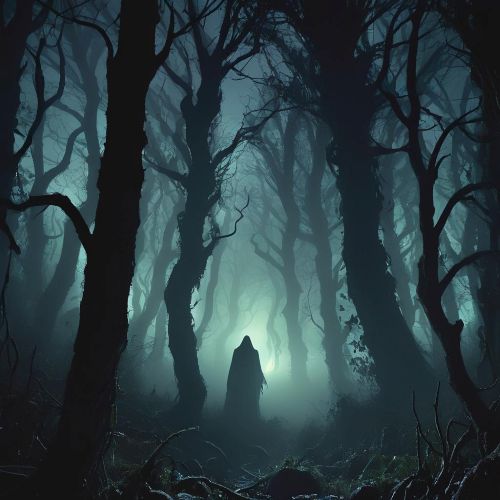
Sha Wujing is initially portrayed as a frightening river demon rather than a conventional human warrior. His appearance includes a blue or indigo complexion, red hair, a beard, and a fierce expression that reflects his supernatural nature. One of his most distinctive features is the necklace of nine skulls that he wears around his neck. These belonged to Buddhist monks whom he had killed after they attempted to cross the Flowing Sands River. The skulls could not sink into the river, making them unusual among the remains of his victims and an important part of his legend.
After joining Tang Sanzang, Sha Wujing is generally represented in the appearance of a Buddhist monk, although his imposing physical presence remains. He carries a magical staff that serves as his principal weapon in the original novel. Later paintings, stage performances, films, and other adaptations frequently depict him with a crescent-shaped shovel or spade, but this should not be confused with the weapon described in Wu Cheng’en’s novel. The contrast between his monstrous appearance as a river demon and his later identity as a disciplined disciple reinforces the character’s larger theme of repentance and spiritual transformation.
Family
Journey to the West provides little information about Sha Wujing’s biological family. His story begins with his position in the celestial bureaucracy rather than with a mortal birth or genealogy, and the novel does not establish a significant family lineage for him. His most important relationships are instead formed through his service in Heaven and, later, through the pilgrimage.
Within Tang Sanzang’s group, Sha Wujing occupies a particularly stable position. Sun Wukong is powerful but frequently rebellious, while Zhu Bajie is intelligent and capable but often distracted by food, comfort, and worldly desires. Sha Wujing is considerably more restrained. He follows Tang Sanzang’s instructions, helps protect the group, and regularly carries the pilgrimage baggage. This makes him an important counterbalance to the stronger personalities around him. His relationship with the other disciples is therefore better understood as a spiritual brotherhood created through shared hardship rather than as a conventional family relationship.
Other Names
Sha Wujing is known by several names in Chinese tradition and in adaptations of Journey to the West. His principal name is Sha Wujing (沙悟净), while Sha Heshang (沙和尚) and Sha Seng (沙僧) are commonly translated as “Monk Sha.” The character’s name is associated with sand through the surname Sha and with spiritual purity through Wujing. English translations have variously rendered him as Friar Sand, Monk Sand, or Sandy.
Before his exile, he held the celestial title Curtain-Lifting General (卷帘大将). This title reflects his former position in the heavenly court and contrasts sharply with his later existence as a river demon. In Japanese adaptations he is generally known as Sha Gojō, while Korean and Vietnamese traditions use forms such as Sa Ojeong and Sa Tăng. These versions preserve his connection with the wider East Asian tradition of Journey to the West, although individual adaptations often give him different personalities, appearances, and abilities.
Powers and Abilities
Sha Wujing is a formidable supernatural warrior whose abilities reflect his former status as a celestial general and his long existence as a river demon. He possesses considerable physical strength and martial skill and is capable of fighting demons and other supernatural beings encountered during the pilgrimage. His most recognizable weapon in the original novel is a magical staff, described as a remarkable treasure associated with celestial craftsmanship. It becomes his principal weapon after he joins Tang Sanzang.
Sha Wujing is also associated with eighteen transformation methods, giving him a useful but more limited repertoire of transformations than Sun Wukong, who possesses seventy-two. His experience in the Flowing Sands River makes him particularly capable in aquatic environments, and he is a dangerous opponent in water. These abilities complement Sun Wukong’s magical versatility and Zhu Bajie’s physical power, allowing the three disciples to approach different dangers in different ways.
Yet Sha Wujing’s greatest contribution to the pilgrimage is not a single supernatural technique. His value lies in his endurance, discipline, and reliability. He does not seek glory or frequently challenge Tang Sanzang’s authority. Instead, he performs the practical work required to keep the pilgrimage moving and remains committed when the group encounters repeated attacks and hardships. At the end of the journey, after the scriptures have been successfully brought back from India, Buddha rewards Sha Wujing by appointing him a Golden-Bodied Arhat, marking his successful completion of the path from condemned celestial being to enlightened Buddhist disciple.
Modern Day Influence
Sha Wujing remains an important part of the continuing cultural legacy of Journey to the West, appearing in television dramas, films, animation, manga, comics, stage productions, and video games. His comparatively restrained personality gives modern creators considerable freedom to reinterpret him. While Sun Wukong usually dominates adaptations because of his extraordinary powers and rebellious personality, Sha Wujing frequently serves as the dependable warrior whose loyalty keeps the travelling group together.
One of the best-known portrayals came in the celebrated 1986 Chinese television adaptation of Journey to the West, in which Yan Huaili played Sha Wujing. The character was later portrayed by Liu Dagang in the subsequent production. Sha Wujing has also appeared in Japanese adaptations, including Saiyuki and Monkey Magic, where creators have given him new personalities and character arcs while retaining his basic role as one of Tang Sanzang’s companions. Chinese film adaptations of the Monkey King and Journey to the West tradition have likewise continued to feature versions of the character.
In comics, manga, and contemporary literature, Sha Wujing is often given greater psychological depth than he receives in straightforward retellings. Some adaptations emphasize his violent past and portray his loyalty as the result of hard-won redemption, while others focus on his calm temperament and physical strength. He has also appeared in video games inspired by Journey to the West, where his dependable nature commonly translates into a defensive or supporting role. His presence in modern popular culture demonstrates the flexibility of the original character: Sha Wujing can function as a warrior, companion, comic character, or symbol of repentance without losing the essential identity established by the Chinese novel.
Sha Wujing’s enduring appeal ultimately comes from the contrast between his past and his role in the pilgrimage. He begins as a disgraced celestial officer and a violent river demon, yet becomes one of Tang Sanzang’s most faithful disciples. Unlike Sun Wukong, whose story is driven by rebellion, or Zhu Bajie, whose character is shaped by desire and temptation, Sha Wujing represents restraint and service. His journey shows that redemption in Journey to the West is not reserved for perfect heroes; even a figure burdened by violence and punishment can change through discipline, loyalty, and spiritual practice.
Related Images





Source
Wu, C. (1592/2023). Journey to the West. Translated by A. C. Yu. University of Chicago Press.
Wu, C. (2006/2012). The Journey to the West (Rev. ed., Vols. 1–4). Translated and edited by Anthony C. Yu. University of Chicago Press. https://press.uchicago.edu/ucp/books/book/chicago/J/bo3684372.html
McClanahan, J. R. (2017). Modern Depictions of Sha Wujing’s Weapon and Its Origins. Journey to the West Research. https://journeytothewestresearch.com/2017/07/09/modern-depictions-of-sha-wujings-weapon-and-its-origins/
Wikipedia. (2025). Sha Wujing. Retrieved from https://en.wikipedia.org/wiki/Sha_Wujing
Sciedu Press. (2024). Comparative Studies on English Translation of the Four Great Classical Novels. World Journal of English Language, 14(5), 39–40.
Journey to the West Xiyouji Fandom. (2024). Sha Wujing. Retrieved from https://journey-to-the-west-xiyouji.fandom.com/
Frequently Asked Questions
Who is Sha Wujing in Journey to the West?
Sha Wujing is one of the main disciples who accompanies Tang Sanzang on his pilgrimage, serving as a loyal protector and warrior.
What was Sha Wujing before joining the pilgrimage?
He was once a river-dwelling demon who was banished to Earth for breaking a heavenly treasure, eventually finding redemption by helping the monk.
What does Sha Wujing represent?
He symbolizes loyalty, humility, and perseverance, balancing the impulsiveness of Zhu Bajie and the boldness of Sun Wukong.
What weapons or skills does Sha Wujing have?
He wields a demon-subduing staff and possesses great physical strength, especially in battles against aquatic or monstrous enemies.
Why is Sha Wujing sometimes called the “Sand Monk”?
Because he once guarded the Flowing Sand River, a hostile desert river crossing, before joining the pilgrimage as a disciplined and peaceful monk.


