Figures Associated With Night in Ancient Civilizations and Sacred Traditions
Night has inspired powerful figures across world mythology, representing everything from primordial darkness and celestial order to protection, dreams, and mystery. Before artificial lighting, the arrival of night transformed familiar landscapes and revealed a sky filled with stars. Cultures interpreted these experiences through deities who personified darkness, governed the night sky, or explained the relationship between darkness and daylight.
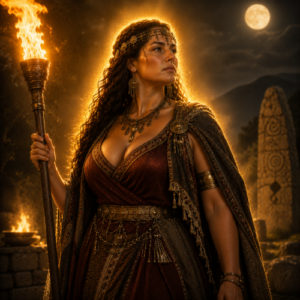
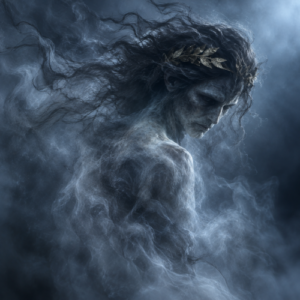
In Greek mythology, Nyx is the primordial goddess and personification of Night. She emerges from the earliest stages of creation and represents a cosmic force older than many of the Olympian gods. Ancient sources portray her as a formidable figure, and her family includes Hypnos, the personification of Sleep, and Thanatos, the personification of Death. Through Nyx, Greek mythology presents night as a fundamental power rather than simply the absence of sunlight.
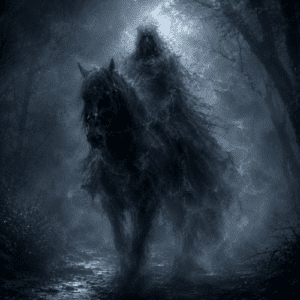
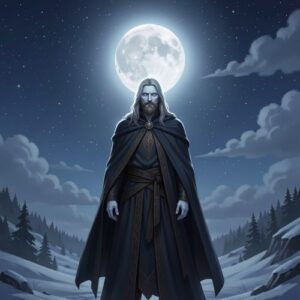
In Norse mythology, Nótt personifies Night and travels across the heavens on her horse, Hrímfaxi. According to the Prose Edda, the foam from the horse’s mane falls upon the earth as dew. Nótt’s journey forms part of a larger celestial cycle involving Dagr, the personification of Day. Their stories explain the regular alternation of darkness and daylight through the movements of divine beings.
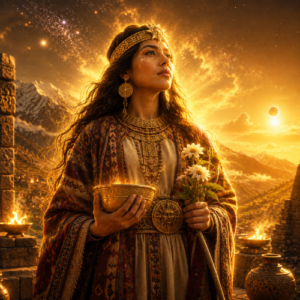
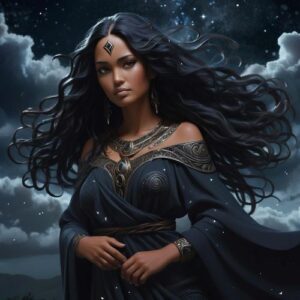
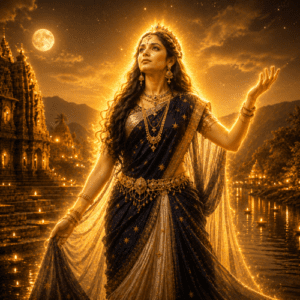
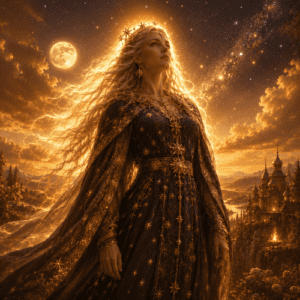
Indian tradition features Ratri, the Vedic goddess of Night. A hymn in the Rigveda describes her arrival as she illuminates the darkness with stars and protects living beings from dangers concealed by the night. Ratri represents a more reassuring dimension of darkness, offering shelter and rest rather than embodying fear alone. Her mythology demonstrates how night could be understood as a necessary and protective part of existence.
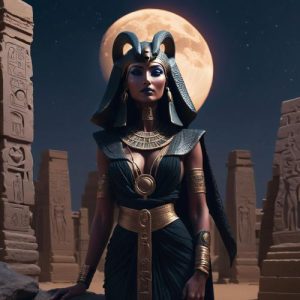
In ancient Egyptian mythology, Nut is the goddess of the sky, commonly depicted with stars across her body. Although she is not exclusively a night goddess, she is closely connected with the celestial journey of the sun. Egyptian cosmology describes the sun travelling through the underworld during darkness before returning at dawn. This nightly passage links the darkness of night with renewal, continuity, and the promise of another day.
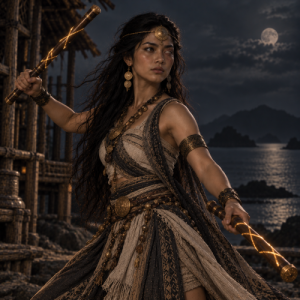
Japanese mythology includes Tsukuyomi, the moon deity associated with the night sky. In the Kojiki and Nihon Shoki, Tsukuyomi appears in creation narratives involving Izanagi and is connected with the separation of day and night. The deity’s lunar association reflects the importance of the moon in understanding celestial rhythms. Chinese mythology offers another lunar figure in Chang’e, whose legendary ascent to the moon connects her with moonlight, immortality, and the traditions surrounding the Mid-Autumn Festival.
Night is also closely associated with sleep and dreams. In Greek mythology, Hypnos personifies Sleep, while Morpheus is connected with dreams and the forms that appear within them. Although neither is strictly a personification of night, their stories reveal how darkness became linked with altered consciousness, visions, and experiences beyond ordinary waking life.
These figures illustrate the varied meanings cultures assigned to night. Nyx represents primordial darkness, Nótt embodies its recurring arrival, and Ratri offers protection during its hours. Nut connects the heavens with cosmic renewal, while Tsukuyomi and Chang’e reflect the moon’s significance. Together, their traditions show that night could inspire fear and uncertainty while also providing rest, guidance, and a sense of wonder.