


Ratri : Goddess of the Night in Indian Vedic Scriptures
At a glance
| Description | |
|---|---|
| Origin | Hawaiian Mythology |
| Classification | Gods |
| Family Members | Ushus (Sister) |
| Region | India |
| Associated With | Night, Protection, Rest, Cosmic order |
The Mythlok Perspective
In Mythlok’s Perspective, Ratri occupies a fascinating space among the world’s night deities. Unlike figures such as the Greek Nyx, who often embodies primordial mystery and immense cosmic power, Ratri feels deeply nurturing and reassuring. She transforms darkness from something threatening into something essential. Her partnership with Ushas is also unique because it presents light and darkness not as rivals but as collaborators in maintaining universal balance. Ratri reminds us that growth does not happen only in moments of action and visibility. Sometimes the most important transformations occur in silence, rest, and reflection. Her mythology teaches that every dawn is meaningful because it is preceded by a night that allowed the world to recover.
Ratri
Introduction
Ratri (Sanskrit: रात्रि, Rātrī) is the Vedic goddess of night in Hindu mythology. She is one of the oldest divine figures mentioned in the Rigveda, where she is celebrated not as a force of fear but as a guardian who brings peace, protection, and rest to the world after sunset. Her most famous appearance is in the Ratri Sukta (Rigveda 10.127), a hymn dedicated entirely to her divine presence.
Unlike many mythological traditions that portray darkness as dangerous or chaotic, the Vedic view of Ratri is remarkably positive. She represents the natural rhythm of existence, allowing living beings to pause, recover, and prepare for the arrival of a new day. As the sister of Ushas, the goddess of dawn, Ratri forms one half of a sacred cycle that governs the passage of time. Together, they symbolize the eternal balance between darkness and light, rest and activity, endings and beginnings.
Although she never became as widely worshipped as later Hindu goddesses such as Durga, Lakshmi, or Kali, Ratri remains an important figure in Vedic literature and offers valuable insight into how early Hindu thought understood nature, time, and cosmic order.
Physical Traits
The Vedas provide very little in the way of detailed physical descriptions for Ratri. Rather than focusing on her appearance, the ancient hymns emphasize her divine function and presence. She is portrayed as the embodiment of the night sky itself, spreading darkness gently across the world while maintaining harmony and order.
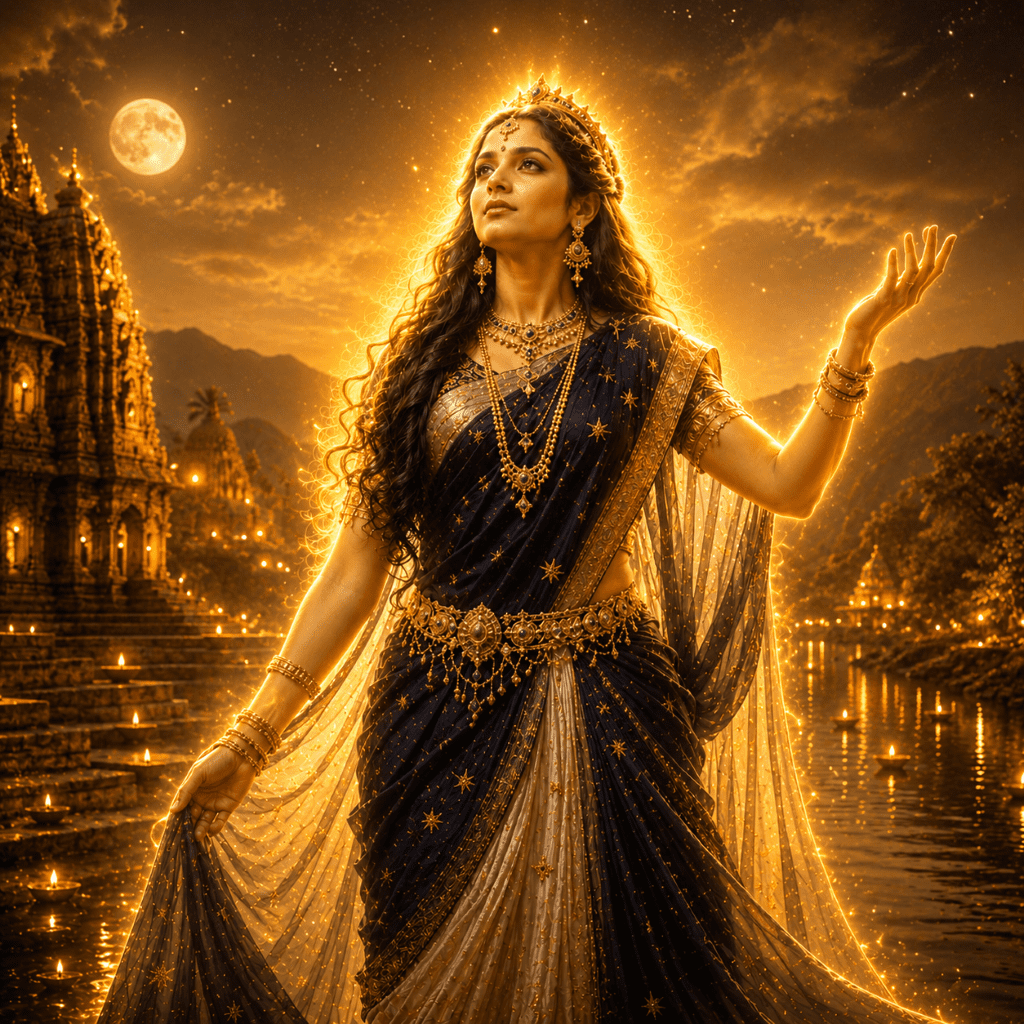
In poetic imagery, Ratri is often envisioned as a beautiful celestial maiden draped in darkness and adorned with countless stars. These stars are sometimes described as her eyes, watching over the world while people sleep. This symbolism reinforces her role as a vigilant protector rather than a threatening force.
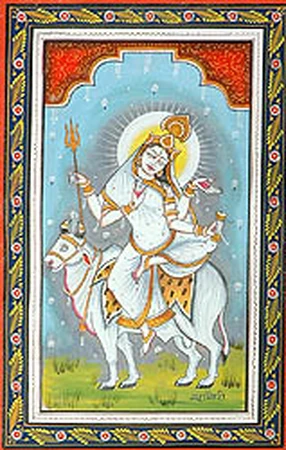
Later Hindu texts and interpretations occasionally provide a more developed iconography. Some traditions depict her as a graceful goddess associated with the moon, stars, and the vast night sky. Unlike many later deities, however, Ratri has no universally recognized vehicle, weapon, or standard temple image. Her identity remains closely tied to the natural phenomenon she personifies, making her one of the most direct examples of divine personification in Vedic mythology.
Family
Ratri’s most well-known familial relationship is with Ushas, the goddess of dawn. The Rigveda frequently presents them as sisters whose appearances follow one another in an endless cycle. As Ratri withdraws, Ushas emerges to illuminate the world, and when daylight fades, Ratri returns once again.
This relationship is more than a simple family connection. It reflects the Vedic understanding of cosmic balance. Neither goddess dominates the other; instead, they cooperate to sustain the natural order of the universe. Their partnership illustrates the principle that opposing forces can work together harmoniously rather than exist in conflict.
Some later traditions connect Ratri to broader Hindu cosmological genealogies. Certain sources associate her with Brahma as part of creation itself, while others place her among the children of the primordial sky and earth deities. These traditions vary considerably, and no single genealogy became universally accepted.
Unlike many Puranic goddesses, Ratri is not associated with a prominent consort, children, or elaborate family narratives. Her significance lies primarily in her cosmic role rather than in mythological family dramas.
Other names
Ratri’s primary name simply means “night” in Sanskrit, reflecting the close connection between language and divine personification in Vedic religion. Several related names and titles appear across Hindu literature and later interpretations. One of the oldest alternative names associated with her is Nakt or Nakta, a Vedic term that also refers to night. This name appears in early Indo-European linguistic traditions and highlights her ancient origins.
She is sometimes called Ratridevi, meaning “Goddess Ratri,” particularly in later devotional and scholarly works. Certain traditions also associate aspects of her nature with Nidra, the divine embodiment of sleep, due to her connection with rest and rejuvenation.
Ratri should not be confused with Kalaratri, a fierce form of the goddess Durga worshipped during Navaratri. While both are associated with darkness, they represent very different theological concepts. Ratri embodies the peaceful and protective qualities of night, whereas Kalaratri represents destructive power directed against evil.
Powers and Abilities
Ratri’s powers are closely connected to her role as the divine embodiment of night. Her greatest ability is the orderly arrival of darkness, which she spreads across the world according to the cosmic rhythm established by the gods.
In the Rigveda, she is invoked as a protector who safeguards people from dangers that may arise after sunset. Worshippers ask her to shield them from thieves, wild animals, and unseen threats. This protective role is central to her character and distinguishes her from darker depictions of night found in other mythological traditions.
Ratri is also associated with rest, healing, and renewal. By bringing an end to the activities of the day, she creates the conditions necessary for recovery and regeneration. Her presence allows humans, animals, and nature itself to pause and regain strength.
Another important aspect of her power is her connection to Rta, the Vedic principle of cosmic order. Alongside Ushas, she helps regulate the cycle of time and ensures the continuous alternation between darkness and light. This function places her among the divine forces responsible for maintaining the stability of the universe.
Symbolically, Ratri represents the ability to navigate uncertainty without fear. Her darkness is not destructive but nurturing, reminding believers that periods of stillness and reflection are essential parts of life.
Modern Day Influence
Ratri is not the focus of a major independent cult in modern Hinduism, but her influence continues through Vedic traditions, scholarship, and spiritual symbolism. The Ratri Sukta remains an important hymn studied by scholars and recited by practitioners interested in Vedic spirituality.
In contemporary interpretations, Ratri is often viewed as a symbol of rest, introspection, and inner peace. As modern life becomes increasingly fast-paced, her association with recovery and balance has gained renewed relevance. Many spiritual teachers use her symbolism to illustrate the importance of embracing periods of silence and reflection rather than constantly seeking activity and achievement.
Ratri also plays a significant role in comparative mythology. Scholars frequently compare her with other night deities such as the Greek goddess Nyx and the Norse goddess Nótt. These comparisons reveal how different cultures interpreted darkness and the passage of time. Today, Ratri remains an enduring reminder that darkness is not always something to fear. In Vedic thought, it is a sacred and necessary part of existence that allows life to renew itself before the coming of dawn.
Related Images





Source
Jamison, S. W., & Brereton, J. P. (2014). The Rigveda: The earliest religious poetry of India (2 vols.). Oxford University Press.
Macdonell, A. A. (1897). Vedic mythology. Strassburg: Karl J. Trübner.
Monier-Williams, M. (1899). A Sanskrit-English dictionary etymologically and philologically arranged. Oxford: Clarendon Press.
Ratri. (n.d.). In Wikipedia. Retrieved June 22, 2026, from https://en.wikipedia.org/wiki/Ratri
Ratri. (n.d.). In Indianetzone. Retrieved June 22, 2026, from https://www.indianetzone.com/ratri_night_deity
Goddess Ratri. (n.d.). In Indianetzone. Retrieved June 22, 2026, from https://www.indianetzone.com/goddess_ratri
Ratri. (n.d.). In Wikipedia Bahasa Indonesia. Retrieved June 22, 2026, from https://id.wikipedia.org/wiki/Ratri
Meaning of the name Ratri. (n.d.). In Wisdom Lib. Retrieved June 22, 2026, from https://www.wisdomlib.org/names/ratri
Jordan, M. (2014). Dictionary of Gods and Goddesses. Infobase Publishing.
Kinsley, D. (2005). Hindu Goddesses: Visions of the Divine Feminine in the Hindu Religious Tradition. Motilal Banarsidass.
Mishra, N. R. (1994). Philosophy Series: Pandit N.R. Bhatt Felicitation Volume II. Motilal Banarsidass Publishers.
Frequently Asked Questions
Who is Ratri in Hindu mythology?
Ratri is the Vedic goddess of night, mentioned prominently in the Rigveda. She personifies the night and serves as a protector who brings rest, safety, and cosmic balance.
What is the relationship between Ratri and Ushas?
Ratri and Ushas are described as sisters in the Rigveda. Ratri represents night, while Ushas represents dawn, and together they govern the daily cycle of time.
What is the Ratri Sukta?
The Ratri Sukta is a hymn in the Rigveda (10.127) dedicated to the goddess Ratri, praising her protective nature and role in maintaining cosmic order.
Is Ratri the same as Kalaratri?
No. Ratri is the Vedic goddess of night, while Kalaratri is a fierce form of Goddess Durga associated with destruction of evil and protection.
What does Ratri symbolize?
Ratri symbolizes night, rest, protection, renewal, introspection, and the cyclical balance between darkness and light.
