


Bugul Noz : The Lonely Night Shepherd of Brittany
Listen
At a glance
| Description | |
|---|---|
| Origin | Breton Mythology |
| Classification | Spirits |
| Family Members | N/A |
| Region | France |
| Associated With | Night, Forests, Protection of travelers, Isolation, |
The Mythlok Perspective
In Mythlok’s Perspective, the Bugul Noz represents the emotional depth hidden within European folklore. Unlike gods who command or monsters who destroy, this Breton spirit protects through fear and solitude. It mirrors figures like the Slavic Leshy or the Japanese Kodama, both guardians of forests who evoke caution rather than violence. Across cultures, woodland spirits often stand at the boundary between safety and wilderness. The Bugul Noz reminds us that not all frightening beings are enemies. Some are guardians misunderstood by the very people they try to protect.
Bugul Noz
Introduction
The Bugul Noz is one of the most haunting figures in Breton folklore. Originating in Brittany, particularly the Morbihan region of northwestern France, this mysterious being belongs to the Celtic storytelling traditions that shaped rural life for centuries. The name comes from the Breton language. “Bugul” means shepherd or herdsman, while “noz” means night. The figure is therefore commonly translated as “Night Shepherd.” In some interpretations, the closely related Breton word “bugel” meaning child gives rise to the poetic variation “Child of the Night.”
Unlike violent monsters or trickster fairies, the Bugul Noz occupies a deeply tragic space in folklore. It is neither fully a bogeyman nor a benevolent guardian. Instead, it is remembered as a solitary woodland spirit whose frightening appearance masks a protective role. Nineteenth-century folklorists such as Paul Sébillot and Anatole Le Braz recorded oral traditions describing it as a nocturnal presence that roamed forests and fields at dusk, warning humans to return home before darkness deepened.
The Bugul Noz represents more than a supernatural creature. It embodies rural anxiety about the dangers of night, the unknown spaces of woodland paths, and the fragile boundary between safety and wilderness.
Physical Traits
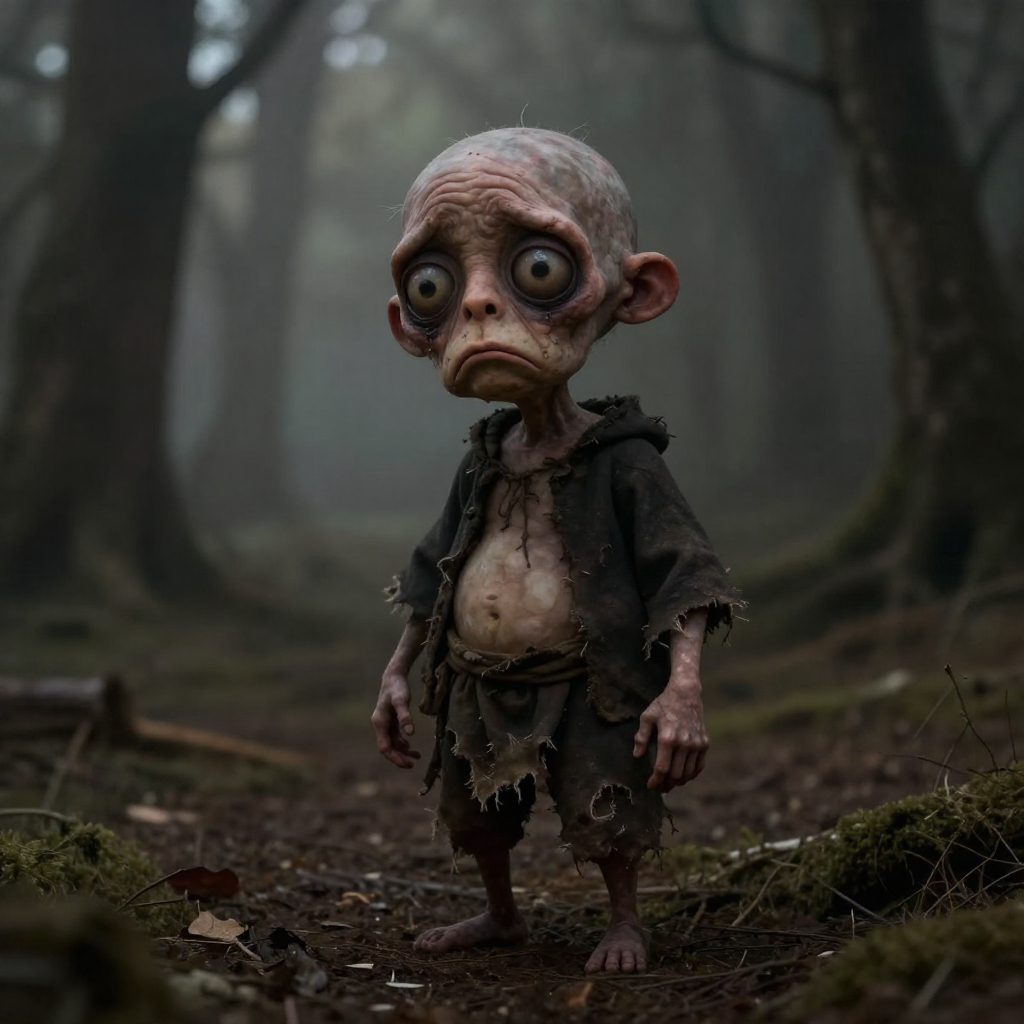
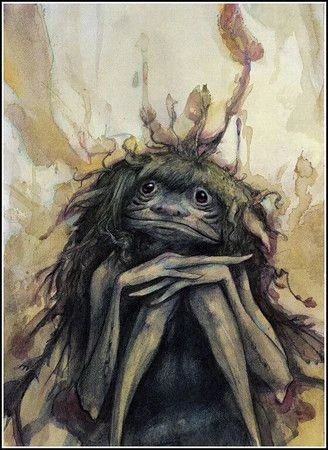
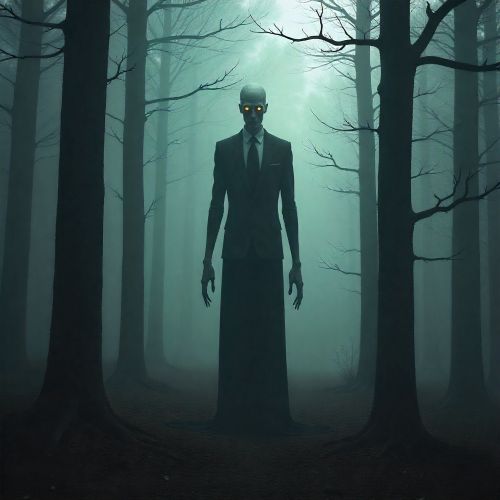
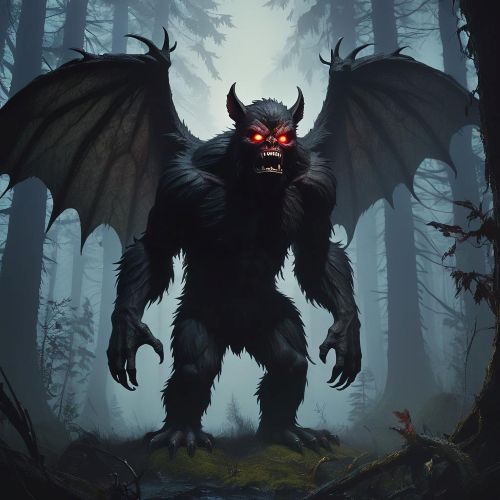
Descriptions of the Bugul Noz vary across Breton oral tradition, but one feature remains consistent: its unsettling ugliness. Folklore portrays the Bugul Noz as grotesquely disfigured, with exaggerated facial features that inspire immediate fear. Some accounts describe glowing or fiery eyes, clawed hands, and an unnaturally thin or elongated body. Others present it as a hunched, goblin-like man with a shrill whistling voice that echoes through the trees.
Interestingly, not all traditions agree on its size. In some villages, it appears tall and looming, visible as a dark silhouette against twilight skies. In others, it is depicted as small, almost kobold-like, scurrying through underbrush. Certain accounts mention a wide-brimmed hat and a long pale coat, reinforcing its eerie yet human-adjacent appearance.
Its ugliness is central to its legend. The Bugul Noz is often described as the last of its kind, condemned to isolation because even woodland animals flee at the sight of it. This detail transforms the figure from a mere frightful spirit into a symbol of sorrow and rejection. Rather than seeking to harm humans, it is said to avoid them, aware that its appearance alone causes terror.
Family
Breton folklore does not record any family lineage, divine ancestry, or offspring connected to the Bugul Noz. It stands alone in the tradition. There are no parents, siblings, or fairy courts tied to its existence. Instead, the creature is frequently described as “the last of its kind.”
This absence of family strengthens the melancholic tone of the myth. Unlike structured pantheons found in other Celtic or European traditions, the Bugul Noz does not belong to a clearly defined supernatural hierarchy. It is neither a god nor a demigod. It has no clan, no tribe, and no community.
Its solitude reinforces its narrative function. It is not part of an organized fairy race; it is an isolated remnant of something older, perhaps a fading echo of pre-Christian woodland spirits. The legend suggests extinction rather than continuation, making it one of the more emotionally resonant figures in Breton folklore.
Other names
The primary name remains Bugul Noz, though spelling variations appear in written sources. Early French-influenced texts often render it as “Bugul-Noz” with a hyphen. The variation “Bugel Noz” emphasizes the “child of the night” interpretation rather than “night shepherd.”
While modern fantasy adaptations sometimes compare it to goblins or kobolds, these are descriptive parallels rather than authentic alternate names. Unlike more widely spread European spirits, the Bugul Noz remains distinctly Breton. Its identity is linguistically and geographically anchored in Brittany.
The preservation of its Breton name is significant. It reflects the cultural resilience of the Breton language, one of the surviving Celtic languages of Europe. Even today, discussions maintain its original terminology rather than translating it into French or English equivalents.
Powers and Abilities
The Bugul Noz is primarily associated with sound. Folklore describes it emitting mournful cries, whistles, or song-like calls that echo through the forest at dusk. These eerie sounds serve as warnings rather than threats. Shepherds and travelers who heard it understood that night was approaching and that it was time to return home.
Its greatest power is the ability to instill fear without direct violence. The Bugul Noz rarely attacks. Instead, it frightens people away from danger. In rural Brittany, forests after sunset could conceal real hazards: wild animals, treacherous terrain, or bandits. The legend functioned as both myth and practical safety lesson.
Some modern retellings attribute shape-shifting abilities or enhanced forest navigation to the Bugul Noz, but primary folklore sources focus more on its protective cries and woodland guardianship. It is often described as deeply tied to its homeland, unable or unwilling to leave Brittany’s forests. This geographical confinement reinforces its role as a territorial spirit.
Despite its terrifying appearance, the Bugul Noz is generally portrayed as benevolent. Its tactics stem from self-preservation and protection rather than cruelty.
Modern Day Influence
Today, the Bugul Noz continues to appear in Breton cultural discourse and modern fantasy reinterpretations. Folklore podcasts, regional festivals, and Celtic revival movements frequently revisit the legend as part of Brittany’s mythic heritage. In some tabletop role-playing games and fantasy adaptations, the Bugul Noz appears as a solitary fey creature wandering mist-covered forests.
Contemporary portrayals often soften its grotesque features, emphasizing its loneliness and tragic nature. Rather than a bogeyman, it becomes a misunderstood guardian spirit. Scholars studying Breton folklore continue to reference the Bugul Noz when exploring themes of liminality, rural belief systems, and the transformation of pre-Christian woodland spirits under later cultural influences.
In children’s retellings, the figure still functions as a cautionary presence, reminding young listeners not to wander after dark. Online folklore communities frequently discuss the Bugul Noz as a symbol of fading Celtic traditions and the preservation of regional identity.
The Bugul Noz remains uniquely Breton. Unlike pan-European fairy figures, it has not been widely commercialized. Its survival depends largely on cultural preservation efforts and renewed interest in Celtic heritage.
Related Images


Source
Carpentier, É. (n.d.). Description of Breton folklore figures. Cited in Wikipedia. (https://en.wikipedia.org/wiki/Bugul_Noz)[2]
Dubois, P. (2005). La grande encyclopédie des lutins. Hoëbeke.
Evans-Wentz, W. Y. (1911). The fairy-faith in Celtic countries. Oxford University Press.
Le Braz, A. (1893). La légende de la mort chez les Bretons armoricains. Champion.
Markale, J. (1984). The Bretons and their world. Inner Traditions.
Sébillot, P. (1880). Le folk-lore du pays breton. Bibliothèque de l’Ecole des Hautes Études.
Mythical Encyclopedia. (2023). Bugul Noz: A Breton legend. https://mythicalencyclopedia.com/bugul-noz/
Nightbringer.se. (n.d.). Bugul Noz. https://nightbringer.se/myths-and-legends/mythic-fairies-and-elves/bugul-noz/
Frequently Asked Questions
What does Bugul Noz mean?
Bugul Noz means “Night Shepherd” in the Breton language. Some interpretations also translate it as “Child of the Night.”
Is the Bugul Noz evil?
No, the Bugul Noz is generally considered benevolent. Although frightening in appearance, it primarily serves as a warning spirit rather than a malicious entity.
Where does the Bugul Noz originate?
The Bugul Noz originates from Brittany in northwestern France, particularly the Morbihan region.
What powers does the Bugul Noz have?
The Bugul Noz is known for its eerie cries that warn travelers to return home before nightfall. It is deeply connected to forests and nocturnal spaces.
Is the Bugul Noz still part of Breton culture today?
Yes, the Bugul Noz remains part of Breton folklore discussions, cultural festivals, and modern fantasy adaptations.