Mediterranean Mythology
Mediterranean mythology is best understood as a broad cultural landscape of myths, religious traditions, legends, and supernatural beliefs that developed among the many civilizations surrounding the Mediterranean Sea. Rather than representing one unified mythology, it encompasses traditions that emerged independently and also influenced one another through trade, migration, conquest, and cultural exchange. Greek, Roman, Etruscan, Egyptian, Phoenician, Levantine, North African, and other Mediterranean traditions each developed distinctive religious systems while sharing certain themes, symbols, and divine figures.
Among the most influential Mediterranean traditions is Greek mythology. Greek religious traditions produced an extensive body of stories concerning gods, heroes, monsters, creation, fate, and the relationship between mortals and divine powers. Zeus, Hera, Athena, Apollo, Artemis, Aphrodite, Poseidon, and Hades became some of the most recognizable figures in ancient mythology. Heroic narratives surrounding Heracles, Perseus, Theseus, Jason, and Odysseus explored courage, ambition, loyalty, revenge, and the consequences of challenging divine or natural limits.
Greek mythology was preserved through a wide range of sources rather than one sacred book. Epic poetry associated with Homer, Hesiod’s works, lyric poetry, hymns, drama, visual art, inscriptions, and archaeological evidence all contribute to our understanding of Greek religious culture. Myths also changed across regions and periods, meaning that different Greek communities could tell different versions of the same story.
Roman mythology developed within a different cultural and religious environment, although Roman religion was profoundly influenced by the Greek world. Roman gods such as Jupiter, Juno, and Minerva formed the Capitoline Triad, while figures such as Mars, Venus, Janus, and Vesta played important roles in Roman religious life. Roman tradition also preserved distinctly Roman stories, including the foundation of Rome by Romulus and Remus and the legendary history of early Roman kings.
Roman religion was closely connected with public life. Festivals, sacrifices, household rituals, priesthoods, omens, and ceremonies reinforced relationships between the gods, families, communities, and the Roman state. As Rome expanded, its religious culture absorbed and adapted traditions from many peoples throughout the Mediterranean and beyond. Greek gods were frequently identified with Roman deities, but this process involved reinterpretation rather than simple renaming.
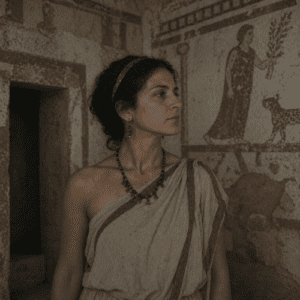
Etruscan mythology provides another important perspective on ancient Italy. The Etruscans developed a distinctive religious tradition before and alongside the expansion of Rome. Tinia, Uni, and Menrva were among their principal deities, corresponding in some respects to Jupiter, Juno, and Minerva. Etruscan religious practice placed considerable importance on interpreting divine signs, including lightning and other omens, and Roman authors later associated Etruscan specialists with important traditions of divination.
Etruscan funerary art also provides valuable evidence for beliefs concerning death and the afterlife. Figures such as Charun and Vanth appear in funerary contexts and are associated with the journey of the dead and the underworld. Their exact roles varied, and modern descriptions of them as straightforward equivalents of Greek or Roman demons can obscure their distinctive Etruscan character.
The Mediterranean was never culturally isolated. Greek colonies spread across many coastal regions, Phoenician merchants established settlements throughout the western Mediterranean, and Roman expansion brought numerous local religions into contact with one another. Gods, rituals, artistic motifs, and religious ideas could therefore travel across linguistic and political boundaries while acquiring new meanings in different communities.
Death, fate, fertility, warfare, kingship, the sea, agriculture, and the relationship between mortals and supernatural powers are recurring themes across many Mediterranean traditions. Yet these similarities should not erase the differences between cultures. A Greek god, an Etruscan deity, and a Roman god might share characteristics while remaining products of very different religious environments.
Mediterranean mythology is therefore best understood as a network of interconnected traditions rather than a single mythology. Its stories reveal how ancient communities interpreted nature, society, mortality, divine power, and the uncertain boundaries between the human and supernatural worlds. From Greek epics and Roman foundation legends to Etruscan divination and funerary traditions, the mythologies of the Mediterranean preserve the cultural memories of civilizations that shaped the history of Europe, North Africa, and the Near East.