
Vanth : The Etruscan Guide of the Dead
At a glance
| Description | |
|---|---|
| Origin | Etruscan Mythology |
| Classification | Spirits |
| Family Members | N/A |
| Region | Italy |
| Associated With | Death, Afterlife guidance, Fate, Underworld passage |
The Mythlok Perspective
In Mythlok’s Perspective, Vanth represents one of the most balanced interpretations of death found in ancient cultures. She does not dominate, punish, or judge. Instead, she ensures continuity, acting as a bridge between existence and what lies beyond. This places her closer to figures like the Egyptian Anubis, who guides souls with order and purpose, rather than the Greek Charon, who embodies obligation and distance. Similarly, her calm presence contrasts with the fear-driven death spirits of Mesopotamian traditions. Vanth stands as a reminder that death, in many early belief systems, was not chaos but passage. And among global archetypes, she remains one of the clearest symbols of death as guidance rather than finality.
Vanth
Introduction
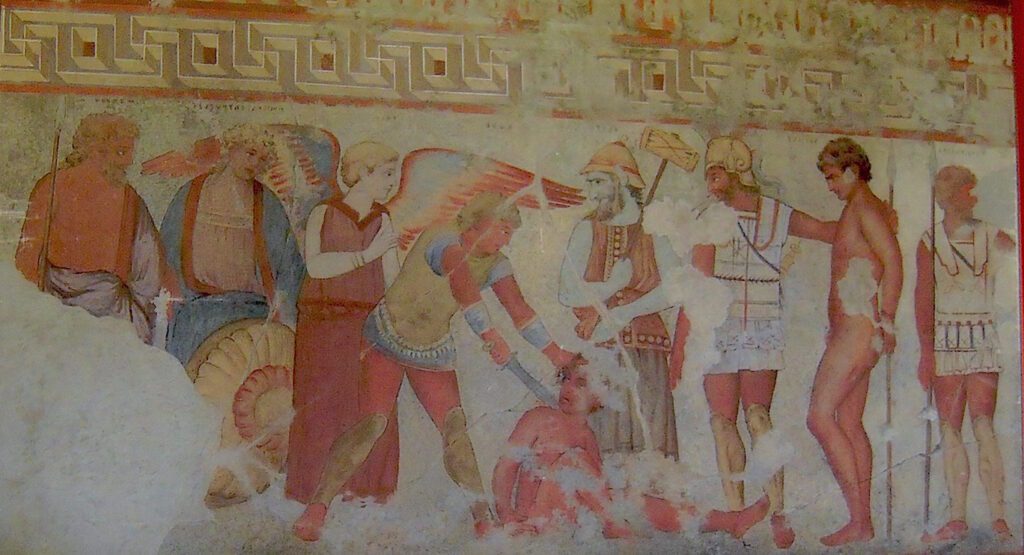
Vanth is one of the most fascinating figures from Etruscan belief systems, embodying a unique and surprisingly compassionate vision of death. Emerging prominently in art from around the 4th century BCE, she is most often seen in tomb paintings, urns, and sarcophagi, where her presence signals a transition rather than an ending.
Unlike many underworld beings in ancient traditions, Vanth is not feared as a bringer of death. Instead, she serves as a psychopomp, a guide who escorts souls safely into the afterlife. Her repeated appearance across Etruscan funerary imagery reflects a cultural perspective that viewed death as a journey requiring guidance, protection, and structure.
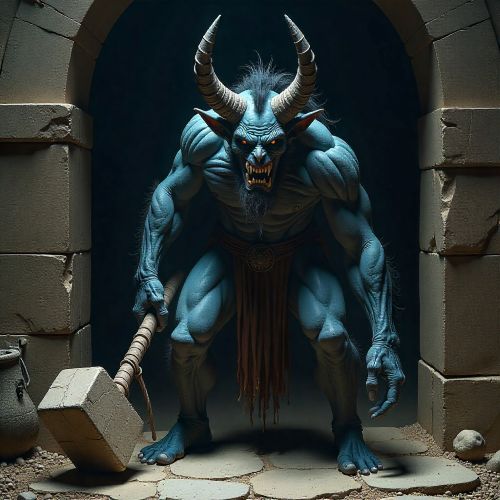
She often appears alongside Charun, a more intimidating underworld entity, creating a visual contrast between terror and reassurance. While Charun represents the harsh inevitability of death, Vanth offers direction and calm, reinforcing her role as a stabilizing presence during life’s most uncertain transition.
Physical Traits
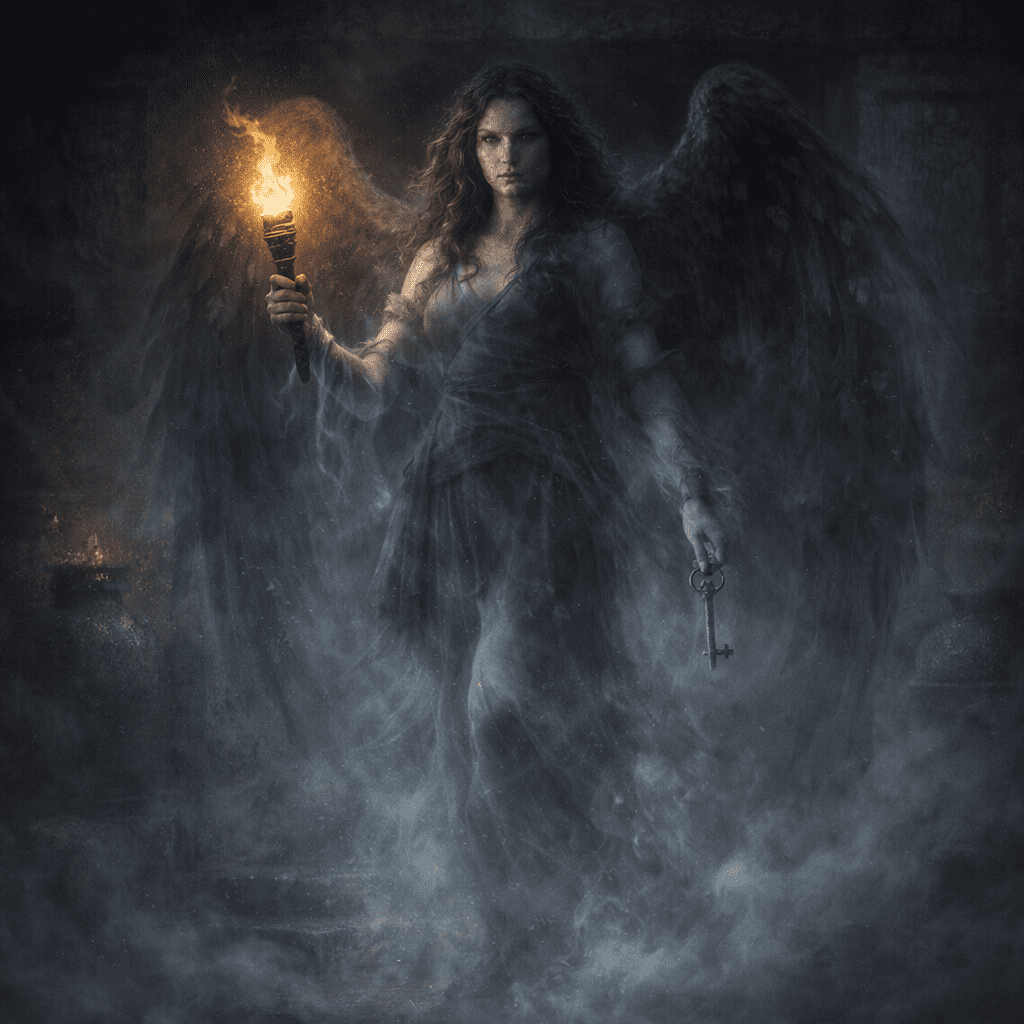
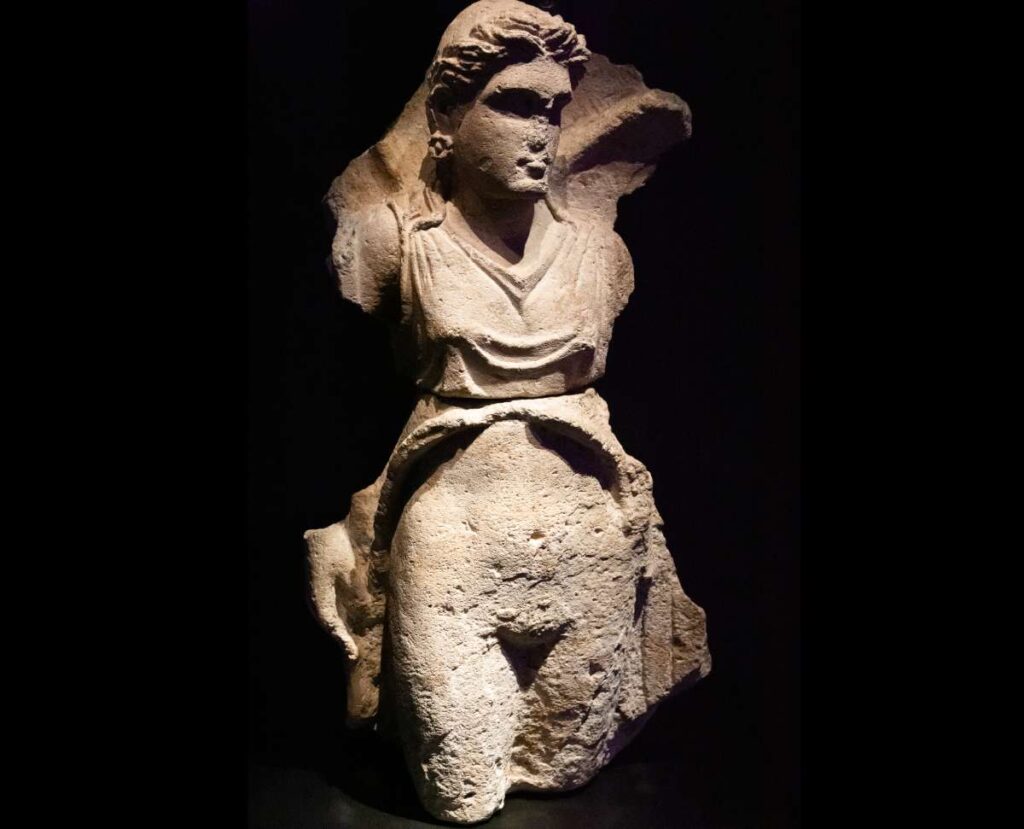
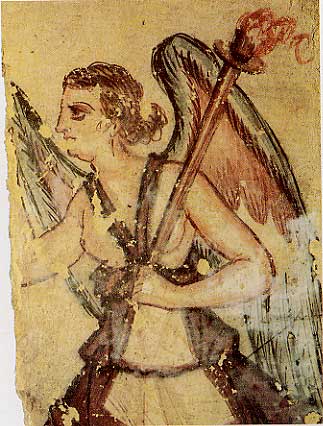
Vanth’s appearance is striking and consistent across centuries of artistic representation. She is almost always depicted as a winged female figure, youthful and active, suggesting movement between worlds rather than permanence in one. Her wings are large and expressive, sometimes decorated with eyes, a detail believed to symbolize awareness, inevitability, and the inescapable nature of mortality.
Her clothing sets her apart from other underworld figures. She wears a short, pleated skirt secured with double belts, along with practical hunting boots and minimal upper garments. Straps or a baldric cross her chest, giving her the appearance of a huntress. This visual language aligns her more with action and mobility than with static divinity, emphasizing her role as an active guide.
Vanth is also frequently shown holding symbolic objects. These include torches that illuminate darkness, keys that open thresholds, scrolls that may record fate, and snakes that coil around her arms. Each of these elements reinforces her connection to transition, knowledge, and the unseen processes of death.
Family
Unlike many mythological figures, Vanth does not belong to a clearly defined divine lineage. Etruscan mythology, as preserved today, lacks extensive written narratives, and much of what is known comes from visual sources rather than textual genealogies.
Her lack of family ties suggests that she is not meant to be understood as an individual personality within a divine hierarchy, but rather as a functional presence within the structure of the underworld. In many depictions, she appears independently or alongside other beings like Charun, but without any indication of kinship or hierarchy.
Interestingly, some interpretations suggest that Vanth may not be a singular entity at all. The occasional use of plural forms implies that she could represent a class of similar beings, each fulfilling the same role of guiding souls. This interpretation aligns with the broader Etruscan tendency to conceptualize death as a process managed by multiple forces rather than a single ruler.
Other names
The name “Vanth” appears consistently in inscriptions, typically written as “vanθ” in Etruscan script. There are no widely accepted alternative names or titles associated with her, which further reinforces her distinct identity within Etruscan belief.
Some scholars have attempted to compare Vanth to figures from other mythologies, particularly the Greek Furies. However, this comparison does not hold up under closer examination. The Furies are agents of vengeance and punishment, while Vanth is almost always portrayed as calm, neutral, or even protective.
Occasionally, references to multiple Vanth figures have led to the use of the plural “Vanths,” but this does not indicate a different name so much as a broader classification. Her identity remains remarkably consistent across regions and time periods.
Powers and Abilities
Vanth’s primary role is that of a psychopomp, and all of her abilities revolve around guiding and managing the transition from life to death. Her wings allow her to move freely between realms, symbolizing her ability to traverse boundaries that mortals cannot cross.
The objects she carries are not decorative but functional. The torch she holds lights the path into the underworld, suggesting that death is not a descent into chaos but a guided journey. The key she carries represents access, implying that the afterlife is structured and requires passage through defined thresholds.
Her scroll is particularly intriguing. It is often interpreted as a record of fate, indicating that she may possess knowledge of an individual’s destiny. This connects her not only to death but also to the concept of predetermined outcomes.
Snakes, when present, add another layer of meaning. In many ancient cultures, snakes symbolize renewal and cyclical existence. Their presence in Vanth’s imagery suggests that death, under her guidance, is part of a larger cycle rather than a final conclusion.
Although she is often present at moments of violence or death, Vanth does not cause these events. Instead, she appears as an observer and guide, ensuring that the transition that follows is carried out properly. In some rare depictions, she even appears to protect individuals, reinforcing her benevolent nature.
Modern Day Influence
While Vanth does not enjoy the same level of recognition as figures from Greek or Roman traditions, her influence continues in subtle but meaningful ways. She remains a subject of academic study, particularly in the fields of archaeology and art history, where her consistent depiction provides valuable insight into Etruscan beliefs about death.
One of the most notable modern references to Vanth is astronomical. In 2009, the moon of the dwarf planet Orcus was named Vanth, reflecting a continued fascination with underworld symbolism in scientific naming conventions.
Her imagery also resonates in broader cultural contexts. The idea of a winged guide who leads souls peacefully into the afterlife has parallels in modern depictions of angels and spiritual escorts. While not directly derived from Vanth, these similarities highlight the enduring appeal of her archetype.
In visual storytelling and digital art, Vanth’s design—particularly her wings, torch, and calm demeanor—continues to inspire reinterpretations of death as something navigable rather than terrifying. Her legacy lies not in widespread popularity, but in the quiet persistence of her symbolism.
Related Images



Source
de Grummond, N. T. (2006). Etruscan myth, sacred history, and legend. University of Pennsylvania Museum of Archaeology and Anthropology. https://books.google.com/books/about/Etruscan_Myth_Sacred_History_and_Legend.html?id=TVAtdzbV-yIC
Krauskopf, I. (n.d.). Gods and demons in the Etruscan pantheon. https://d-nb.info/1258067900/34
Took, T. (n.d.). Vanth, Etruscan Goddess of Death. https://www.thaliatook.com/OGOD/vanthogod.php
Weird Italy. (2023, March 17). Vanth: the Chtonic female demon of the Etruscan mythology. https://weirditaly.com/2023/03/17/vanth-the-chtonic-female-demon-of-the-etruscan-mythology/
Wiktionary. (2022). Vanth. https://en.wiktionary.org/wiki/Vanth
Weir, A. J. (2014). Not so passive: A new suggestion for the roles of an Etruscan female chthonic deity. Academia.edu. https://www.academia.edu/1673079/Not_so_Passive_a_new_suggestion_for_the_roles_of_an_Etruscan_female_chthonic_deity
Small, J. P. (2021). Vanth: An iconographical study of an Etruscan psychopomp [Conference paper]. Academia.edu. https://www.academia.edu/79264926/Vanth_An_Iconograpical_Study_of_an_Etruscan_Psychopomp
Frequently Asked Questions
Who is Vanth in Etruscan belief?
Vanth is a winged underworld guide who escorts souls to the afterlife, acting as a benevolent psychopomp.
Is Vanth a goddess of death?
Not exactly. She does not cause death but assists in the transition after it occurs.
What does Vanth symbolize?
She represents guidance, transition, fate, and the structured journey into the afterlife.
How is Vanth different from Charun?
Charun is often depicted as harsh and intimidating, while Vanth appears calm, protective, and guiding.
Does Vanth have a Greek equivalent?
No direct equivalent exists. Comparisons to Greek figures like the Furies are inaccurate due to her benevolent nature.