Etruscan Mythology
Etruscan mythology and religion developed among the Etruscans of ancient central Italy before and alongside the rise of Rome. Flourishing particularly in the region known as Etruria, the Etruscan civilization developed a distinctive religious tradition shaped by local Italic practices and cultural interaction with the Greek and wider Mediterranean worlds. Much of what is known comes from inscriptions, temples, votive objects, tomb paintings, funerary monuments, archaeology, and accounts written by later Roman authors. Because the Etruscans left relatively little surviving literary material, their mythology must be reconstructed from these diverse sources.
At the centre of Etruscan religious tradition was a group of powerful deities. Tinia was one of the most important gods and is frequently associated with the sky and supreme divine authority. Uni was a major goddess associated with marriage and sovereignty, while Menrva was an important goddess connected with wisdom, warfare, protection, and prophecy. These three formed a prominent divine group and were worshipped in important Etruscan religious centres. Their similarities to Jupiter, Juno, and Minerva encouraged Roman comparisons, but the Etruscan deities retained distinctive identities within their own religious system.
Etruscan religion placed exceptional importance on understanding divine will. The gods were believed to communicate through signs in the natural world, and specialists were responsible for interpreting those signs. Lightning was particularly significant, while the examination of the liver and internal organs of sacrificed animals became one of the most famous forms of Etruscan divination. The priests known as haruspices interpreted these signs to determine whether particular actions were favored or opposed by divine powers.
This practice was not simply a form of personal fortune-telling. Divination could have public and political significance, influencing decisions concerning warfare, religious ceremonies, construction, and other matters affecting the community. Roman writers regarded Etruscan expertise in divination as highly important, and the practice continued to influence Roman religious life long after Etruscan political power had declined.
The Etruscans also devoted considerable attention to death and the afterlife. Their tombs provide some of the most remarkable surviving evidence of their religious imagination. Wall paintings depict banquets, musicians, dancers, animals, supernatural beings, and scenes associated with the transition from life to death. These images suggest that funerary traditions were not simply expressions of fear but also reflected ideas about identity, memory, family, and existence beyond the grave.
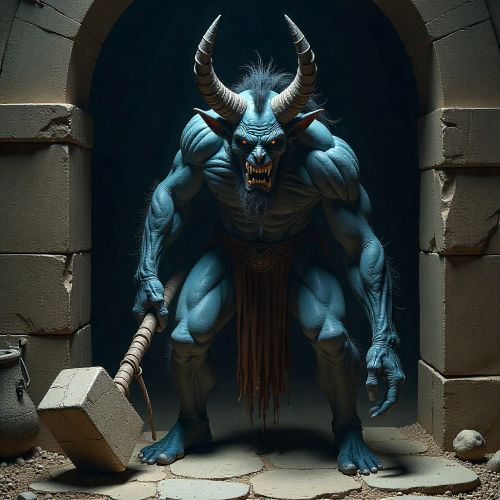
Several supernatural figures appear in Etruscan funerary art. Vanth is commonly represented as a winged female figure associated with the world of the dead and is frequently shown accompanying or appearing near the deceased. Charun is another prominent funerary figure, often depicted as a frightening supernatural being connected with death and the underworld. His appearance differs significantly from the Greek Charon despite the similarity of their names, and he should not simply be treated as an Etruscan copy of the Greek ferryman.
The Etruscan underworld was not necessarily represented through one uniform narrative. Different images and texts provide glimpses of a complex supernatural landscape populated by divine, heroic, and funerary figures. Some Etruscan tomb paintings emphasize feasting and celebration, while others contain frightening supernatural imagery. Together, these traditions reveal a culture deeply concerned with mortality and the relationship between the living and the dead.
Etruscan religion also influenced the developing Roman religious system. Roman authors credited the Etruscans with important traditions of divination and religious interpretation, while Etruscan expertise influenced Roman practices involving temples, ritual procedures, omens, and sacred law. Roman adoption of these traditions was part of a much broader process of cultural interaction between Rome and the peoples of Italy.
The Etruscan religious world remains fascinating precisely because so much of it survives in fragments. There is no surviving Etruscan epic that explains the origins of the gods or provides a complete mythology. Instead, their beliefs emerge through painted tombs, inscriptions, ritual objects, temples, divine images, and the observations of later writers. These fragments reveal a culture in which divine authority, fate, ritual precision, divination, and the mysteries of death were central to understanding existence.
Etruscan mythology is therefore best approached not as a lost collection of complete stories, but as a religious and symbolic world reconstructed from archaeological and textual evidence. From Tinia, Uni, and Menrva to Vanth and Charun, its surviving figures provide a glimpse into one of ancient Italy’s most distinctive traditions and into the religious culture that would leave a lasting mark on Rome.