Jason and the Argonauts (1963) : A Timeless Greek Heroic Quest
| Description | |
|---|---|
| Country of Origin | United States of America, United Kingdom |
| Language | English |
| Genre | Action/Adventure |
| Cast | Todd Armstrong, Nancy Kovack, Gary Raymond, Laurence Naismith |
| Directed by | Don Chaffey |
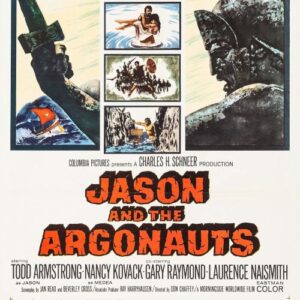
Jason and the Argonauts
The 1963 film Jason and the Argonauts stands as one of the most iconic cinematic interpretations of ancient Greek legend, not because it retells the story with strict textual accuracy, but because it captures the spirit of heroic adventure, divine manipulation, and mythic spectacle that defines the tale of Jason. Even decades later, the film remains a benchmark for how classical stories can be translated into visual storytelling without losing their larger-than-life essence.
At its core, the narrative follows Jason’s quest for the Golden Fleece, a story rooted in ancient Greek tradition where kingship, destiny, and divine will intertwine. The film simplifies many elements of the original sources, particularly those found in Apollonius of Rhodes’ Argonautica, but what it loses in detail, it compensates for in clarity and accessibility. Jason is portrayed less as a cunning strategist and more as a straightforward heroic leader, which aligns well with mid-20th century cinematic ideals of heroism but slightly flattens the complexity found in the older traditions.
One of the strongest mythological elements in the film is the active presence of the gods. Zeus and Hera play direct roles in guiding and observing Jason’s journey, reinforcing a key feature of Greek belief systems where human fate is rarely independent of divine influence. Hera’s support for Jason reflects her traditional role as both protector and manipulator, though the film softens her more unpredictable and often vengeful aspects seen in classical sources. Zeus, on the other hand, serves as a detached overseer, embodying the idea of cosmic order rather than personal involvement.
The monsters and trials encountered by the Argonauts form the backbone of the mythological experience in the film. Creatures such as Talos, the bronze giant, and the Hydra are not just obstacles but symbols of the unknown and the supernatural forces that heroes must confront. Talos, in particular, is a fascinating inclusion, as his origin in Greek lore represents early ideas of artificial life and divine craftsmanship. The film’s depiction of him—brought to life through Ray Harryhausen’s stop-motion animation—adds a sense of awe that still holds up remarkably well. These creatures are not merely antagonists; they are embodiments of mythic fear, testing both courage and ingenuity.
Perhaps the most famous sequence in the film, the battle with the skeleton warriors, is not directly drawn from a specific ancient text but captures the essence of Greek mythological combat. It reflects the idea that heroes must face overwhelming, often unnatural odds, where victory is never guaranteed. This creative liberty demonstrates how the film blends authentic mythological themes with imaginative additions, creating a narrative that feels true to the spirit, even when it diverges from strict tradition.
However, the film does take liberties that reshape key mythological dynamics. The role of Medea, for example, is significantly reduced. In Greek tradition, Medea is central to Jason’s success, using her knowledge of magic and divine ancestry to help him overcome impossible challenges. Her diminished presence in the film removes an important layer of the myth, particularly the theme of intelligence and enchantment as complements to brute strength. This shift makes Jason’s journey feel more solitary and less dependent on collaboration, which contrasts with the original narrative where success is deeply collective.
Another notable change is the portrayal of the Argonauts themselves. In myth, the crew includes some of the greatest heroes of Greece, such as Heracles, Orpheus, and Castor and Pollux, each bringing unique abilities and symbolic significance. The film narrows this ensemble, focusing more on Jason as the central figure rather than emphasizing the collective heroism that defines the original expedition. While this streamlines the story, it reduces the sense of a shared legendary journey.
Despite these alterations, the film succeeds in preserving the thematic core of the myth: the pursuit of glory, the testing of human limits, and the ever-present influence of forces beyond mortal control. The journey for the Golden Fleece is not just a physical quest but a symbolic one, representing legitimacy, power, and divine approval. Jason’s success is not solely his own achievement but a reflection of the delicate balance between human effort and divine favor.
What makes Jason and the Argonauts enduring is its ability to translate ancient storytelling into a visual language that still resonates. The film respects the scale and wonder of Greek legend, presenting a world where gods watch from above, monsters lurk in uncharted lands, and heroes are defined not just by strength but by their willingness to face the unknown. It may not be a perfect retelling, but it is a faithful representation of how these stories feel—grand, unpredictable, and deeply symbolic.
In the end, Jason and the Argonauts remains a cornerstone of myth-inspired cinema. It captures the essence of Greek heroic tradition while making it accessible to modern audiences, proving that even simplified versions of ancient stories can retain their power when handled with imagination and respect.