


Tāwhirimātea : The Māori Atua Who Commands the Winds and Storms
At a glance
| Description | |
|---|---|
| Origin | Maori Mythology |
| Classification | Gods |
| Family Members | Ranginui (Father), Papatūānuku (Mother), Tāne Mahuta, Tangaroa, Rongomātāne, Haumia-tiketike and Tūmatauenga (Siblings) |
| Region | New Zealand |
| Associated With | Wind, Storms, Clouds, Rain, Hail, Weather |
The Mythlok Perspective
In Mythlok’s Perspective, Tāwhirimātea represents a truth that modern society often struggles to accept: nature does not exist simply to serve humanity. Like Thor in Norse mythology, who wields thunder and lightning, Tāwhirimātea embodies the immense power of the natural world. However, while Thor is renowned for defending the gods and humanity against threatening forces, Tāwhirimātea’s story centres on his fury following the separation of Ranginui and Papatūānuku. His continuing conflict with Tūmatauenga reflects humanity’s struggle to coexist with forces it cannot fully control.
Tāwhirimātea
Introduction
Tāwhirimātea is a major atua in Māori mythology, associated with winds, clouds, rain, hail, snow and storms. As the son of Ranginui, the Sky Father, and Papatūānuku, the Earth Mother, he occupies a central place in Māori creation traditions. His story explains the origins of destructive weather while exploring the relationships between the natural world, ancestral beings and humanity.
Unlike his brothers, Tāwhirimātea opposed the separation of his parents. In the creation narrative, Ranginui and Papatūānuku lay tightly together, leaving their children in darkness between them. The children eventually decided to separate their parents to allow light to enter the world. Tāne Mahuta succeeded in pushing Ranginui into the sky, opening the space in which life could flourish.
Tāwhirimātea rejected this decision. Distressed by the separation, he joined his father in the sky and directed his anger towards his brothers. His response unleashed powerful winds, rain and storms upon the world below. According to Te Ara: The Encyclopedia of New Zealand, this conflict provides a traditional explanation for the destructive weather experienced across Aotearoa.
Tāwhirimātea’s story is more than an account of divine anger. It connects weather with whakapapa, the Māori understanding of genealogy and relationships between beings. The atmosphere is not simply an environmental backdrop but part of a living network of relationships that connects the sky, land, sea and people.
Physical Traits
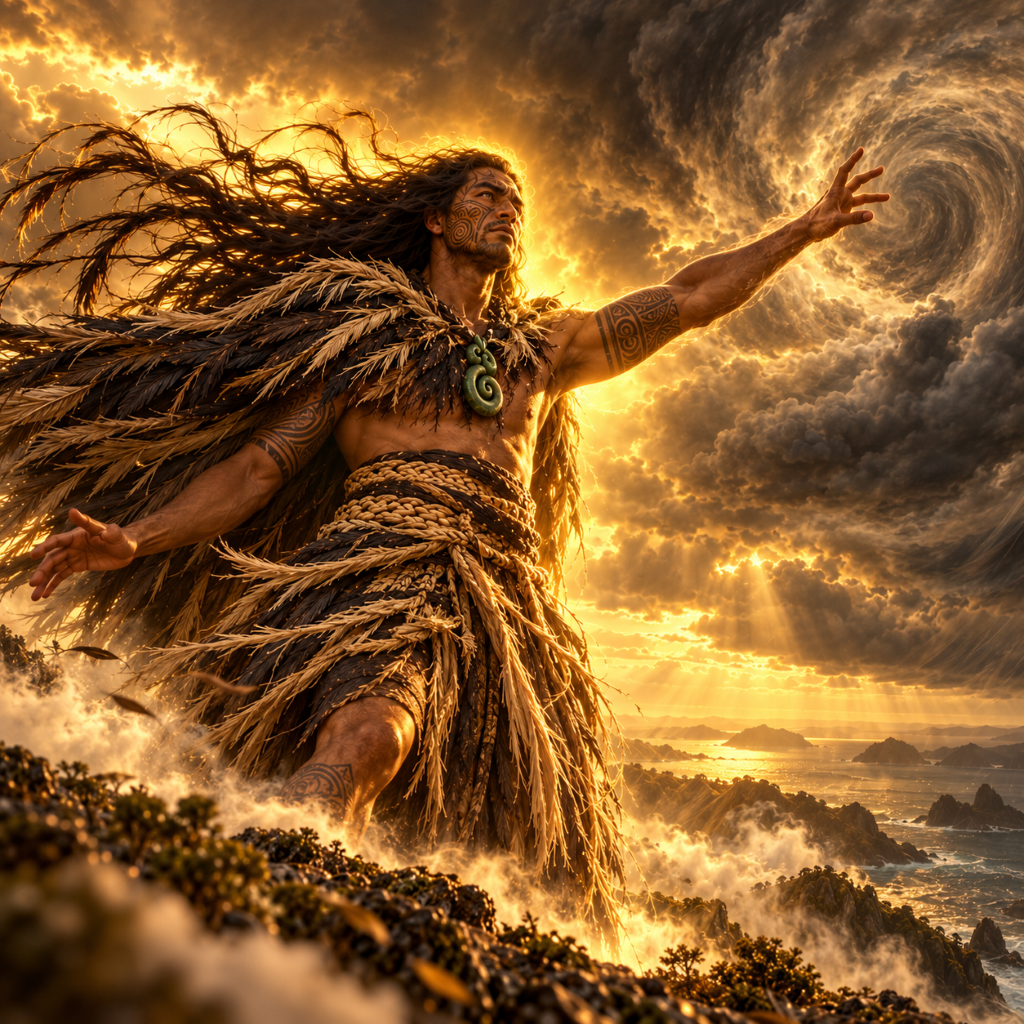
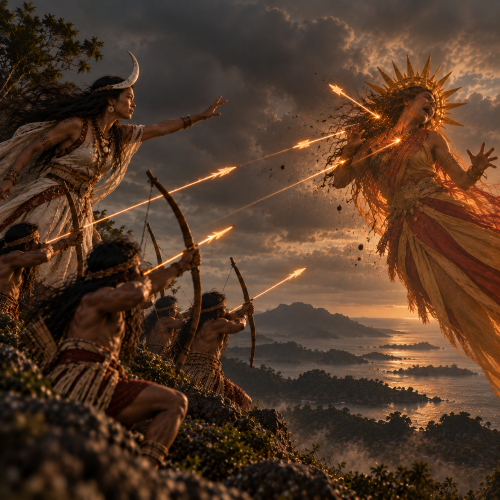
Māori traditions do not establish one universally accepted physical appearance for Tāwhirimātea. His identity is primarily expressed through the forces of nature he commands rather than through a consistent description of his height, facial features or clothing. Artistic representations often depict him as a powerful, human-like atua surrounded by violent weather. One illustration featured by Te Ara shows him holding lightning in one hand while a whirlwind envelops his body. Such imagery communicates his authority over the atmosphere without establishing a single canonical appearance.
His association with the sky is central to his visual identity. After the separation of his parents, Tāwhirimātea chose to remain with Ranginui, from where he directed winds and storms towards the earth. Artists can therefore represent his presence through swirling clouds, turbulent skies and forceful gusts. For Tāwhirimātea, the natural world becomes an expression of his power. His presence can be understood through the changing weather that affects forests, oceans and communities throughout Aotearoa.
Family
Tāwhirimātea is the son of Ranginui and Papatūānuku, whose separation marks a defining moment in Māori creation traditions. His siblings include Tāne Mahuta, associated with forests and birds; Tangaroa, associated with the sea; Rongomātāne, associated with cultivated food; Haumia-tiketike, associated with uncultivated food; and Tūmatauenga, associated with war and humanity. These relationships explain the central conflict in his mythology. Tāne Mahuta’s separation of their parents provoked Tāwhirimātea’s anger, while his attacks on the other brothers brought the natural world into turmoil.
Tāwhirimātea also has a family of weather-associated beings. Traditional accounts describe winds, clouds, rain and hail as his offspring. Among these are Uanui, associated with terrible rain; Uaroa, associated with prolonged rain; and Uawhatu, associated with fierce hailstorms. Their descendants include beings associated with mist and dew. The four directional winds are also connected with his domain. This genealogy reflects the Māori concept of whakapapa, which connects people, ancestors and elements of the natural world through relationships of origin. Rather than treating different weather conditions as unrelated events, these traditions place them within a broader network of kinship.
Other names
Tāwhirimātea is sometimes shortened to Tāwhiri. English-language sources may omit the macrons and write his name as Tawhirimatea, while Māori orthography commonly uses the form Tāwhirimātea. The Te Aka Māori Dictionary also records the alternative names Tāwhiri-rangi and Tāwhiri-mate-a-Rangi. These forms are associated with the atua of winds, clouds, rain, hail, snow and storms.
The spelling Tāwhirimātea is preferable for Mythlok’s main article because it follows standard Māori orthography. Macrons are important in written te reo Māori because they indicate long vowels. Tāwhirimātea is also connected with the Matariki star cluster through the expression Ngā mata o te ariki o Tāwhirimātea, commonly translated as “the eyes of the god Tāwhirimātea”. Matariki is the name of the star cluster associated with the Māori New Year; it is not another personal name for the weather atua.
Powers and Abilities
Tāwhirimātea’s principal domain is the weather. His powers encompass winds, clouds, rain, hail and storms, allowing him to influence the conditions that shape life across land and sea. His most significant display of power occurs after his parents are separated. He sends the winds against his brothers, damaging their domains and demonstrating that no part of the natural world is beyond his reach. His attack on Tāne Mahuta breaks mighty forest trees, while his assault on Tangaroa agitates the sea and raises enormous waves. Rongomātāne and Haumia-tiketike seek refuge within Papatūānuku, a traditional explanation connecting cultivated kūmara and uncultivated food, including fern root, with the earth.
Tāwhirimātea also commands different forms of atmospheric disturbance. His weather-associated offspring include beings representing dense clouds, dark clouds, thunderstorm clouds, prolonged rain and fierce hail. These figures give distinct identities to the many conditions that can emerge from the sky. His conflict with Tūmatauenga, the atua associated with war and humanity, is especially significant. Tūmatauenga withstands Tāwhirimātea’s attacks, establishing an enduring struggle between human resilience and the forces of nature.
In the tradition recorded by Te Ara, Tūmatauenga develops incantations for favourable winds and practices intended to bring fair weather. Neither brother achieves a final victory. Their continuing opposition expresses humanity’s vulnerability to the weather and its efforts to survive, adapt and understand the environment.
Modern Day Influence
Tāwhirimātea remains an important figure in contemporary Māori education, literature, environmental discussions and artistic expression. His significance extends beyond traditional creation narratives because Māori understandings of the atmosphere and climate can connect environmental processes with ancestral relationships.
New Zealand’s Ministry for the Environment identifies Tāwhirimātea as the atua associated with weather and describes him as the parent of kōhauhau (atmosphere) and āhuarangi (climate). This provides a contemporary example of Māori knowledge being incorporated into discussions about environmental systems.
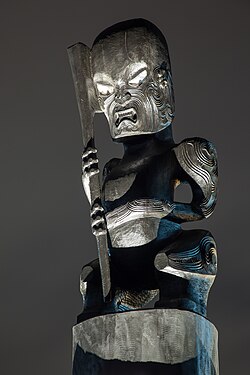
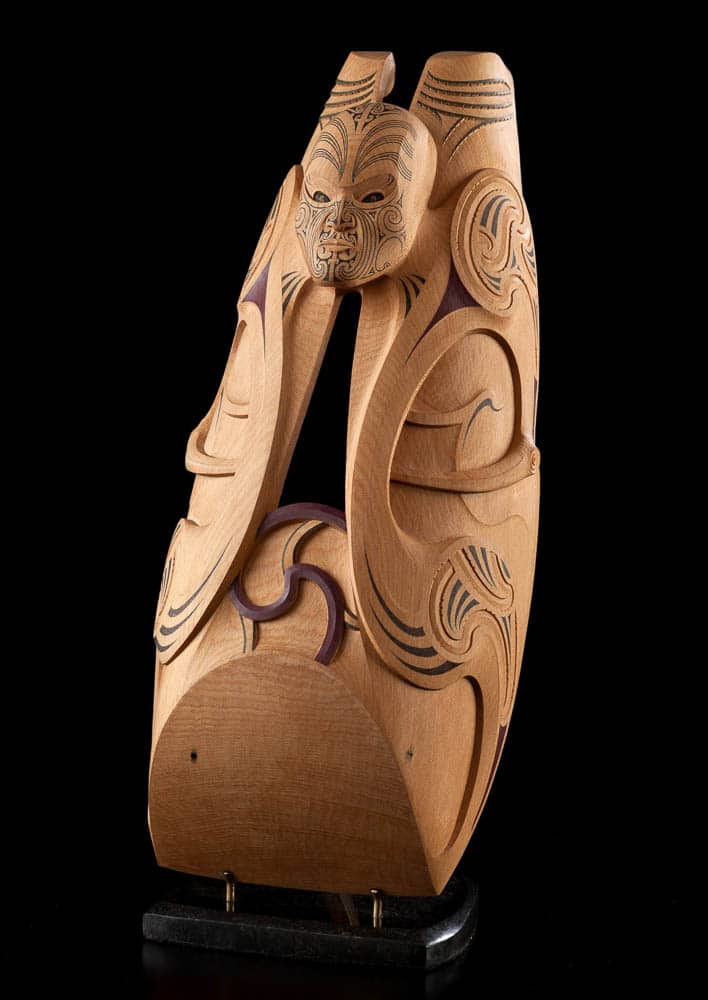
His story also appears in educational resources that introduce children to Māori creation traditions and the relationship between the natural world and its ancestral figures. These retellings help preserve cultural knowledge while making traditional narratives accessible to younger audiences. Māori artists have continued to reinterpret Tāwhirimātea through paintings, murals and other visual forms. In one well-known representation, artist Cliff Whiting depicted the atua and his weather-associated children through swirling forms that evoke wind and atmospheric movement.
His influence also appears in public discussions of climate change. Auckland Council’s climate strategy, Te Tāruke-ā-Tāwhiri, draws on Māori concepts and the name of Tāwhiri in framing environmental responsibility. Such uses should not be mistaken for evidence that the traditional atua is simply a personification of modern climate science. Rather, they demonstrate how Māori cultural frameworks can inform contemporary conversations about the environment.
Tāwhirimātea therefore remains relevant as both a figure in Māori mythology and a cultural reference through which people explore the relationships between weather, ancestry, the environment and human responsibility.
Related Images
Source
Auckland Council. (2025, October 16). He aha ai, ko te kaupapa o Te Tāruke-ā-Tāwhiri? Why Te Tāruke-ā-Tāwhiri? https://www.aucklandcouncil.govt.nz/en/plans-policies-bylaws-reports-projects/our-plans-strategies/topic-based-plans-strategies/environmental-plans-strategies/climate-plan/response/why-te-taruke-a-tawhiri.html
Best, E. (2005). Māori religion and mythology (2 vols.). Te Papa Press. (Original work published 1924)
Ministry for the Environment. (2020). Our atmosphere and climate 2020: Chapter 1—Our climate, our future. https://environment.govt.nz/publications/our-atmosphere-and-climate-2020/chapter-1-our-climate-our-future/
National Library of New Zealand. (2011). Tāwhirimātea [Artwork record]. https://natlib.govt.nz/records/33724755
Orbell, M. (1998). A concise encyclopedia of Māori myth and legend. Canterbury University Press.
Reed, A. W. (2004). Reed book of Māori mythology (R. Calman, Rev.). Reed.
Royal, T. A. C. (2004). Tāwhirimātea – the weather. Te Ara – The Encyclopedia of New Zealand. https://teara.govt.nz/en/tawhirimatea-the-weather/page-1
Te Aka Māori Dictionary. (n.d.). Tāwhiri-mātea. https://maoridictionary.co.nz/word/7862
Frequently Asked Questions
Who is Tāwhirimātea in Māori mythology?
Tāwhirimātea is a major Māori atua associated with wind, clouds, rain, hail and storms. He is the son of Ranginui and Papatūānuku and opposed their separation.
Why was Tāwhirimātea angry with his brothers?
Tāwhirimātea opposed the separation of his parents, Ranginui and Papatūānuku. After Tāne separated them, he retaliated against his brothers with powerful winds and storms.
What powers does Tāwhirimātea possess?
Tāwhirimātea commands winds, clouds, rain, hail and storms. Māori creation traditions describe him using these forces against his brothers, affecting forests, oceans and the wider natural world.
Who are Tāwhirimātea's parents and siblings?
His parents are Ranginui, the Sky Father, and Papatūānuku, the Earth Mother. His siblings include Tāne Mahuta, Tangaroa, Rongomātāne, Haumia-tiketike and Tūmatauenga.


