


Saragnayan : The Dark Filipino Deity of the Hinilawod Epic
At a glance
| Description | |
|---|---|
| Origin | Philippine Mythology |
| Classification | Demigods |
| Family Members | Nagmalitong Yawa Sinagmaling Diwata (Wife) |
| Region | Philippines |
| Associated With | Darkness, Chaos, Immortality |
The Mythlok Perspective
In Mythlok’s Perspective, Saragnayan is not simply a force of evil but a necessary embodiment of resistance within the cosmic order. He represents the idea that darkness is not separate from existence but intertwined with it. His near immortality reflects how chaos cannot be permanently destroyed, only understood and contained. This archetype finds parallels across cultures. Saragnayan shares similarities with figures like Surtr from Norse tradition, who embodies destructive fire, and Ravana from Indian epics, who stands as a powerful but complex adversary. In each case, the antagonist is not merely an obstacle but a mirror to the hero, revealing deeper truths about power, balance, and destiny.
Saragnayan
Introduction
Saragnayan is a powerful supernatural figure in the Hinilawod, an epic tradition preserved by the Panay Bukidnon people of the Philippines, also known as the Sulodnon. His story is closely connected to Labaw Donggon, one of the epic’s central heroes, whose attempt to win Saragnayan’s wife leads to a prolonged and extraordinary battle. Known as Buyung Saragnayan in recorded versions of the narrative, he is identified as the Keeper of Light, a title that complicates his association with darkness in some later interpretations.
Saragnayan occupies a distinctive position in the epic because his strength cannot be measured by physical combat alone. Labaw Donggon possesses extraordinary abilities, yet even his most powerful attacks fail to overcome Saragnayan. The conflict eventually shifts from a contest of strength to a search for the secret behind his resilience. Through this episode, the Hinilawod explores the relationship between power, knowledge, determination, and vulnerability.
The Hinilawod, whose title is commonly translated as “Tales from the Halawod River,” recounts the adventures of three extraordinary brothers: Labaw Donggon, Humadapnon, and Dumalapdap. Saragnayan’s confrontation with Labaw Donggon belongs to the cycle that follows the first brother’s adventures and introduces the next generation of heroes into the story. His role is essential to this narrative because his victory over Labaw Donggon sets the stage for the intervention of the hero’s sons.
Physical Traits
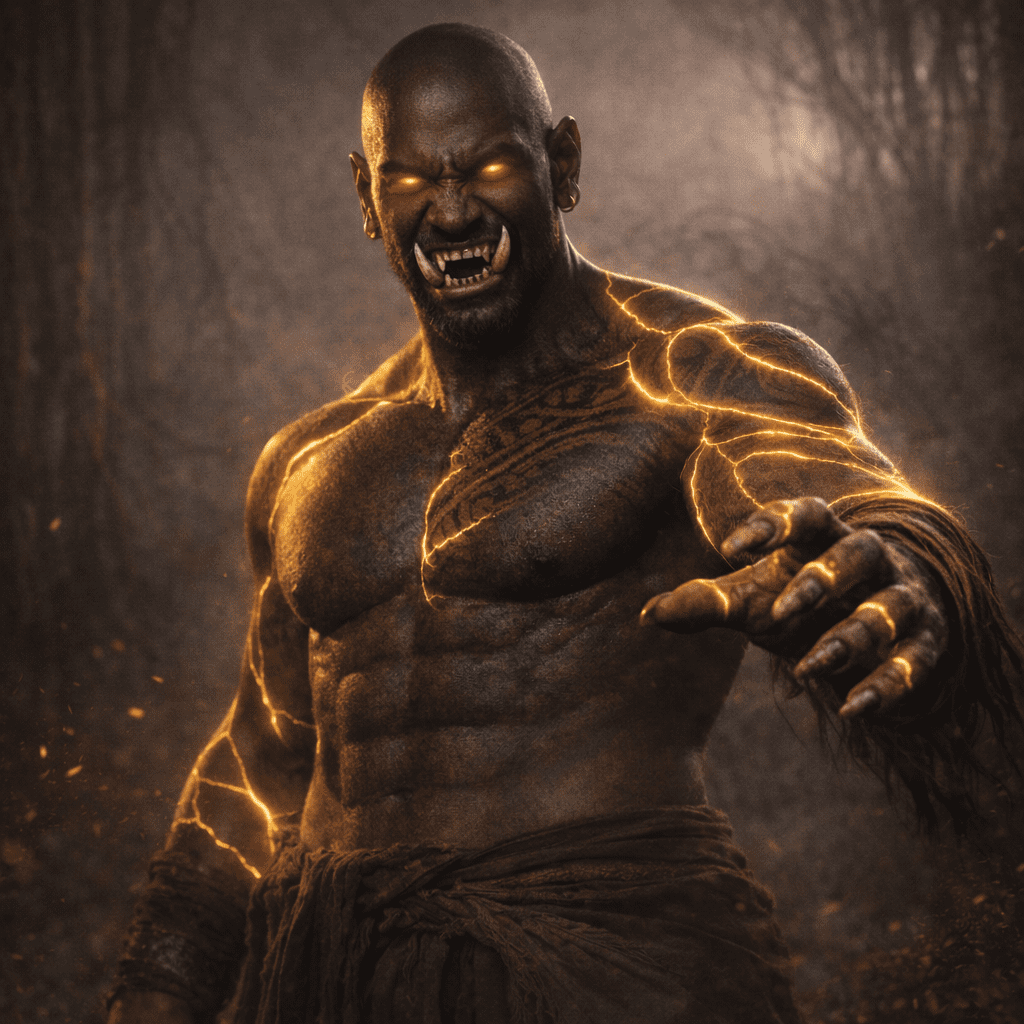
Saragnayan is portrayed as a formidable and imposing figure whose physical strength makes him a difficult opponent even for a warrior of Labaw Donggon’s abilities. In the recorded Hinilawod narrative, he is described as gigantic and towering, giving his encounters with the epic’s heroes a sense of extraordinary scale. His physical presence is reinforced by his ability to endure attacks that would destroy an ordinary opponent.
His resilience becomes apparent when Labaw Donggon submerges him underwater for seven years. When Saragnayan finally emerges, he remains alive and capable of continuing the fight. Labaw Donggon then attempts to defeat him by beating him with coconut trunks and hurling him into the sky. These attacks also fail, establishing Saragnayan as an opponent whose strength extends beyond ordinary physical endurance.
Detailed descriptions of Saragnayan’s facial features, skin colour, and hairstyle are not consistent across the available accounts. His established character is defined more clearly by his extraordinary stature, supernatural abilities, and commanding presence than by a single universally accepted physical appearance. Artistic interpretations may emphasise his intimidating features, but the epic’s central emphasis remains on his exceptional resilience and the difficulty of defeating him.
Family
Saragnayan’s most significant family relationship is his marriage to Nagmalitung Yawa Sinagmaling Diwata, whose name also appears in variant forms in retellings of the epic. She is a beautiful woman who lives with him in his domain. Their marriage becomes the source of conflict when Labaw Donggon learns of her beauty and decides to seek her as another wife.
Labaw Donggon already has two wives, Anggoy Ginbitinan and Anggoy Doronoon. After seeking their consent, he journeys to Saragnayan’s territory to pursue Nagmalitung Yawa. Saragnayan refuses to surrender his wife without a contest, declaring that Labaw Donggon may have her only if he can defeat him. Their confrontation begins as a direct challenge between two powerful figures, but its consequences extend far beyond the initial dispute.
Saragnayan’s eventual downfall brings the next generation of Labaw Donggon’s family into the narrative. Anggoy Doronoon gives birth to Buyung Baranugon, while Anggoy Ginbitinan gives birth to Asu Mangga. Despite their youth, both sons possess extraordinary abilities and undertake a journey to find their imprisoned father. Their determination leads them to Saragnayan, where they confront the powerful figure who has defeated Labaw Donggon.
The family relationships in this episode connect the struggles of the older generation with the courage of its descendants. Buyung Baranugon ultimately takes the leading role in defeating Saragnayan, while Asu Mangga supports him throughout their confrontation.
Other Names
Saragnayan is also known as Buyung Saragnayan in recorded versions of the Hinilawod. The title Buyung is used for important male figures in the epic and forms part of the way its characters are identified. Saragnayan is additionally described as the Keeper of Light in the account published by the International Information and Networking Centre for Intangible Cultural Heritage in the Asia-Pacific Region (ICHCAP).
This title is significant because some modern summaries identify him primarily as the Lord of Darkness. The two descriptions do not always align, and the terminology used for Saragnayan varies between retellings and interpretations of Philippine mythology. Rather than assuming that every title refers to an identical set of powers, it is useful to consider the context in which each description appears.
His name should also be distinguished from Sarangay, a separate creature in Philippine folklore. The similarity between the names does not establish a shared identity or common origin. Saragnayan’s best-documented role remains his appearance in the Hinilawod, where his conflict with Labaw Donggon and his eventual defeat by Buyung Baranugon form a central episode in the epic’s narrative.
Powers and Abilities
Saragnayan’s defining ability is his extraordinary resilience. In the Hinilawod, Labaw Donggon subjects him to attacks of exceptional force, including prolonged submersion underwater, beatings with coconut trunks, and being hurled into the sky. Despite these attempts, Saragnayan survives. His ability to withstand such punishment eventually exhausts Labaw Donggon, allowing Saragnayan to overpower him, bind him, and imprison him beneath his kitchen in a pigpen.
His strength is supported by a magical charm known as a pamlang. During the later confrontation with Labaw Donggon’s sons, the power of this charm becomes part of the contest between Saragnayan and Buyung Baranugon. The episode demonstrates that supernatural abilities in the Hinilawod are not limited to physical strength. Magical protection and the knowledge required to overcome it are equally important.
Saragnayan’s apparent invulnerability, however, has a hidden limitation. When Buyung Baranugon discovers that his opponent cannot be killed through ordinary combat, he seeks help from his grandmother, Abyang Alunsina. Through supernatural assistance, Baranugon learns that Saragnayan’s breath is kept within a wild pig in Paling Bukid. In this account, the animal must be killed and its heart eaten to deprive Saragnayan of the protection that sustains him.
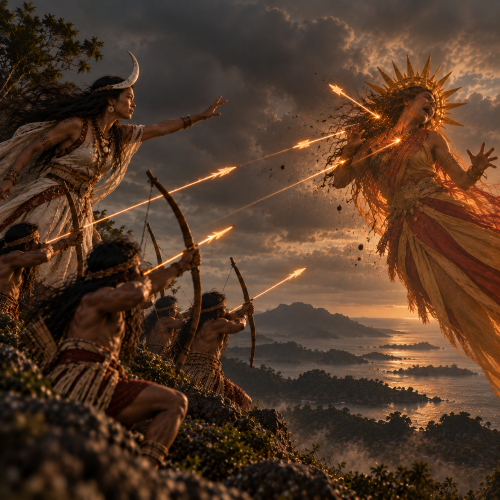
Baranugon and Asu Mangga locate the animal and complete the task. Saragnayan subsequently becomes weak, making it possible for Baranugon to defeat him with a poisoned arrow. The episode reveals the central limitation behind Saragnayan’s extraordinary power: his body can survive almost any attack, but his life remains dependent on something hidden beyond it.
This motif gives Saragnayan’s story a wider mythological significance. His defeat depends not simply on superior force but on discovering the secret that makes him vulnerable. The episode also establishes Buyung Baranugon as a hero whose intelligence and determination are as important as his physical abilities.
Modern Day Influences
Saragnayan’s continuing cultural significance is closely tied to the preservation and study of the Hinilawod. The epic belongs to the oral traditions of the Panay Bukidnon people, whose chanting practices have preserved stories, characters, and cultural knowledge across generations. Its narratives provide insight into the values, supernatural beliefs, and storytelling traditions of the communities that maintain them.
A major milestone in the preservation of this tradition came on 8 May 2024, when the Hinilawod Epic Chant Recordings were inscribed in the Memory of the World Committee for Asia and the Pacific (MOWCAP) Regional Register. The recordings were made by Filipino anthropologist Felipe Landa Jocano in 1956 and 1957, working with Panay Bukidnon chanters Rodrigo “Ulang Udig” Lebuna and Narcisa “Hugan-an” Lingaya. The collection preserves more than 35 hours of recorded epic chanting and provides an important record of indigenous oral literature.
The recognition applies to the documentary collection rather than to Saragnayan as an individual character. Nevertheless, it reinforces the importance of preserving the oral tradition in which his story survives. Recordings allow researchers and future generations to engage with the voices, language, and performance practices through which the epic was transmitted.
Saragnayan also remains relevant to comparative studies of mythology because his story centres on a recurring narrative pattern: a seemingly invincible adversary whose vulnerability can be discovered only through special knowledge. His conflict with Labaw Donggon illustrates the limits of physical strength, while his defeat by Buyung Baranugon demonstrates how determination and insight can overcome an opponent who initially appears impossible to defeat. Through the Hinilawod, Saragnayan remains an important figure in the wider study of Philippine epic traditions and indigenous storytelling.
Related Images

Source
Jocano, F. L. (2000). Hinilawod: Adventures of Humadapnon. Punlad Research House.
Visayan myths blogger. (2013, September 29). Saragnayan. https://vizayanmyths.blogspot.com/2013/09/saragnayan.html
Wikipedia contributors. (2026). Hinilawod. Wikipedia. https://en.wikipedia.org/wiki/Hinilawod
Aswang Project. (2022, October 13). Visayan deities in Philippine mythology. https://www.aswangproject.com/visayan-deities-in-philippine-mythology/
Nightskylie blogger. (2016, August 19). Saragnayan. http://nightskylie.blogspot.com/2016/08/saragnayan.html
Precolonial Philippines myths blogger. (2016, January 27). Saragnayan. http://precolonailphilippinesmyths.blogspot.com/2016/01/saragnayan.html
Juan Dela Cruz Wiki. (2026, January 8). Anito ng Saragnayan. https://juan-dela-cruz-tv.fandom.com/wiki/Anito_ng_Saragnayan
Contratto, G. S. (2025). Babaylan’s betrayal [Scholarly work]. ScholarSpace, University of Hawai’i at Mānoa. https://scholarspace.manoa.hawaii.edu/bitstreams/e5980052-97a1-4f25-b631-0471ee675999/download
Frequently Asked Questions
Who is Saragnayan in Philippine mythology?
Saragnayan is a powerful figure from the Visayan epic Hinilawod, known as the lord of darkness and ruler of the shadowy realm of Gadlum.
Is Saragnayan a god or a demon?
He is generally considered a demigod or supernatural being, born from primordial chaos and a human mother.
Why couldn’t Saragnayan be killed?
His life force was hidden outside his body, specifically inside a wild boar, making him nearly impossible to defeat in battle.
Who defeated Saragnayan?
He was ultimately defeated by Buyung Baranugon, the son of Labaw Donggon, after discovering the secret of his life force.
What does Saragnayan represent?
He represents darkness, chaos, and the opposing force necessary for balance in mythological narratives.


