


Ryangombe : Rwanda’s Legendary Hunter and Spirit Leader
At a glance
The Mythlok Perspective
In Mythlok’s Perspective, Ryangombe stands apart from many legendary heroes because his greatest legacy was not conquest but community. His transformation from mortal hunter to spirit leader reflects how many African traditions viewed exceptional humans as bridges between the earthly and spiritual worlds. Much like Odin’s role as a guide among the Norse or Guan Yu’s deification in Chinese tradition, Ryangombe demonstrates that wisdom, leadership, and service could become just as sacred as divine birth.
Ryangombe
Introduction
Ryangombe is one of the most important figures in Rwandan mythology, remembered as both a legendary hunter and the spiritual leader of the Imandwa spirits. Unlike many mythological figures who were believed to be divine from birth, Ryangombe is traditionally portrayed as a mortal whose extraordinary life and tragic death elevated him into the spiritual realm. His story became the foundation of the Kubandwa possession cult, one of the most influential religious traditions in precolonial Rwanda, Burundi, and parts of the Great Lakes region.
For centuries, followers believed that Ryangombe served as an intermediary between humanity and Imana, the supreme creator. Through spirit possession ceremonies, music, dance, and ritual initiation, devotees sought his protection, healing, fertility, and prosperity. His cult welcomed people from different social backgrounds, making it one of the few spiritual traditions that crossed ethnic and political boundaries.
The historical origins of Ryangombe remain uncertain. Oral traditions place his life sometime between the sixteenth and seventeenth centuries, with several accounts linking his rise to the reign of King Ruganzu II Ndoli. Scholars generally agree that while Ryangombe may have been inspired by a real historical leader, centuries of oral storytelling transformed him into a powerful mythological figure. His legends also share similarities with the Cwezi traditions of Uganda and Bunyoro, illustrating the cultural exchanges that shaped the mythology of the African Great Lakes.
Today, although the Kubandwa religion is no longer widely practiced, Ryangombe continues to be celebrated as one of the defining spiritual figures of Rwandan mythology and an enduring symbol of courage, leadership, and cultural identity.
Physical Traits
Unlike many gods whose appearance is carefully described in mythology, Ryangombe’s physical form receives relatively little attention in oral tradition. The stories focus far more on his actions, leadership, and spiritual significance than on his outward appearance.
He is consistently portrayed as a powerful hunter and accomplished warrior. Oral accounts describe him as physically strong, fearless, and charismatic, with the qualities expected of an exceptional leader. Rather than emphasizing supernatural beauty or divine features, Rwandan traditions present him as an ideal human whose strength came from skill, courage, and wisdom.
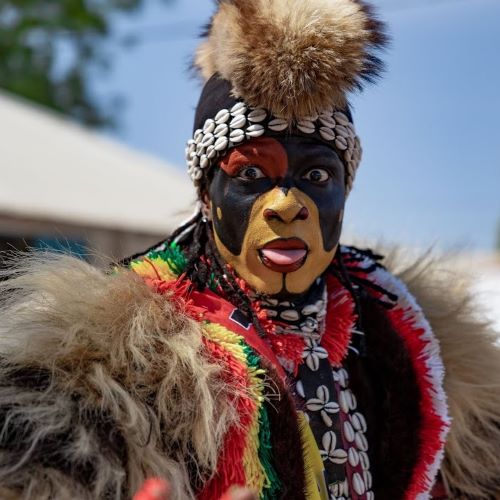
Following his death and transformation into the leader of the Imandwa spirits, Ryangombe became largely invisible to ordinary people. During Kubandwa ceremonies, however, initiated priests represented his presence by wearing ceremonial regalia and carrying ritual objects such as the umwoko, a traditional wooden cooking stick associated with his authority.
Some regional traditions, particularly among the Banyamulenge, portray Ryangombe in a female form during certain rituals. Most Rwandan and Burundian traditions, however, consistently identify him as a male spirit king. These variations reflect the flexibility of oral traditions rather than conflicting identities.
Family
Ryangombe’s genealogy survives through several oral traditions, although some details differ depending on the region and community preserving the story. Most traditions identify his father as Babinga wa Nyundo (or Babinga ba Nyundo), while his mother is known as Nyiraryangombe, who is also called Mukarwesa in some accounts. Their names remain closely connected to Ryangombe’s identity and frequently appear in ritual invocations.
His best-known child is Binego, who occupies an important position within the Imandwa spiritual hierarchy and is sometimes described as Ryangombe’s successor. Some traditions portray Binego as a powerful but fearsome spirit capable of bringing both protection and destruction.
Other oral traditions also mention Kagoro, Ruhanga, Mashira, and Nyabirungu among his children or close spiritual descendants. However, these family relationships are not consistent across all historical sources. Modern scholars generally treat these figures as members of the broader Imandwa spiritual community rather than confirmed biological descendants.
This blending of family and spiritual lineage reflects the nature of Kubandwa itself, where important spirits were often understood as belonging to one extended sacred household rather than a conventional human family.
Other names
Ryangombe appears under several names across the African Great Lakes region, reflecting the spread of his worship beyond present-day Rwanda. The most common alternative spellings are Ryang’ombe and Lyang’ombe, which result from differences in regional pronunciation and transcription.
In neighboring Burundi and parts of western Tanzania, he is widely known as Kiranga. Although some traditions distinguish Kiranga as a separate spirit, most historians consider the two figures closely related, representing regional variations of the same spiritual tradition. Ritual texts also refer to him as Ryangombe wa Babinga ba Nyundo, emphasizing his paternal lineage and reinforcing his status as the founder and leader of the Kubandwa religion.
Researchers have also noted similarities between Ryangombe and the legendary Cwezi ruler Wamara (Wamala) of Uganda and Bunyoro. While they are not identical figures, these parallels suggest that myths and religious ideas travelled extensively across the Great Lakes region long before colonial borders existed.
Powers and Abilities
After his death, Ryangombe became the supreme leader of the Imandwa spirits, transforming from a legendary hunter into one of Rwanda’s most influential spiritual beings. His most important role was serving as a mediator between humanity and Imana, the supreme creator. Rather than replacing the creator god, Ryangombe acted as an intermediary through whom blessings and guidance could reach the living.
Within the Kubandwa tradition, devotees believed he possessed the power to heal illnesses, remove spiritual afflictions, protect communities from harmful spirits, and restore harmony. Spirit possession ceremonies allowed initiates to communicate with him through trained mediums, who delivered gui<a class="wpil_keyword_link" href="https://mythlok.com/archetypes/music-dance/” title=”Music and Dance : Gods, Spirits and Legendary Figures of Rhythm” data-wpil-keyword-link=”linked” data-wpil-monitor-id=”577921″>dance and blessings during elaborate rituals involving music, dance, and chanting.
Ryangombe was also associated with fertility, prosperity, successful harvests, and abundant livestock. Families often sought his favor when hoping for healthy children, agricultural success, or protection during difficult times. As a legendary hunter, he remained closely connected to courage and leadership. His life demonstrated the qualities expected of an ideal leader, while his transformation after death reinforced the belief that exceptional individuals could continue guiding their communities from the spiritual world.
Perhaps his greatest legacy was social rather than supernatural. The Kubandwa cult accepted followers regardless of ethnicity or political affiliation, allowing Hutu, Tutsi, and Twa communities to participate in shared religious ceremonies. This made Ryangombe a powerful symbol of unity across precolonial Rwanda.
Modern Day Influence
Although colonial rule and Christian missionary activity significantly reduced the influence of the Kubandwa religion during the twentieth century, Ryangombe remains one of the most recognizable figures in Rwandan mythology. Active Kubandwa rituals survive only in limited communities today, and many scholars consider the tradition endangered. Nevertheless, its influence continues through oral storytelling, historical research, and cultural preservation initiatives that document Rwanda’s precolonial spiritual heritage.
Anthropologists regard Ryangombe as an important figure for understanding how religion shaped political authority, social organization, and community identity in the Great Lakes region. His mythology also provides valuable insight into indigenous concepts of healing, spirit possession, and the relationship between humans and the supernatural. Beyond academia, Ryangombe has become a symbol of Rwanda’s intangible cultural heritage. His story illustrates how oral traditions preserve historical memory while adapting to changing social conditions over generations.
Today, Ryangombe stands not only as the legendary king of the Imandwa spirits but also as a reminder of the rich spiritual traditions that existed in Rwanda long before colonial influences reshaped the region’s religious landscape.
Related Images

Source
Bizimana, S., & Nkulikiyinka, J. B. (2018). Le culte de Ryangombe au Rwanda. Musée royal de l’Afrique centrale. https://www.africamuseum.be/sites/default/files/media/docs/research/publications/rmca/online/documents-social-sciences-humanities/ryangombe.pdf
de Heusch, L. (1964). Mythe et société féodale: Le culte du kubandwa dans le Rwanda traditionnel. Archives de Sciences Sociales des Religions. https://www.wisdomlib.org/science/journal/archives-of-social-sciences-of-religions/d/doc1447996.html
de Heusch, L. (2009). Chapitre IV. Histoire et mythe. OpenEdition Books. https://books.openedition.org/editionsmsh/9298?lang=fr
Anonymous. (2026). Ryangombe. Wikipedia (French). https://fr.wikipedia.org/wiki/Ryangombe
Anonymous. (n.d.). The Ryangombe cult and his myth. Amateka. https://uk.amateka.net/the-ryangombe-cult-and-his-myth/
Johnston, H. H. (1902). Myths and legends of the Bantu: Heroes and demi-gods. Sacred Texts. https://sacred-texts.com/afr/mlb/mlb10.htm
Gossiaux, P. P. (2009). Mythe et pouvoir: Le culte de Ryangombe-Kiranga. Congoforum. https://www.congoforum.be/fr/2009/07/mythe-et-pouvoir-le-culte-de-ryangombe-kiranga-pol-pierre-gossiaux/
Vansina, J. (2004). Antecedents to Modern Rwanda: The Nyiginya Kingdom. Madison: University of Wisconsin Press.
Taylor, C. (1999). Sacrifice as Terror: The Rwandan Genocide of 1994. Oxford: Berg Publishers.
Frequently Asked Questions
Who is Ryangombe in Rwandan mythology?
Ryangombe is a legendary hunter who became the leader of the Imandwa spirits after his death. He is the central figure of the Kubandwa spiritual tradition in Rwanda.
Was Ryangombe a god?
No. Ryangombe was traditionally believed to have been a mortal hero who became a powerful spirit after death. He served as an intermediary between humans and Imana rather than replacing the supreme creator.
What is the Kubandwa cult?
Kubandwa is a traditional spirit-possession religion centered on Ryangombe and the Imandwa spirits. Followers sought healing, fertility, protection, and spiritual guidance through ritual ceremonies.
How did Ryangombe die?
Is Ryangombe still worshipped today?
Traditional Kubandwa practices survive only in a few communities. Today, Ryangombe is primarily remembered through folklore, cultural heritage, and academic studies of Rwandan mythology.


