

El abrazo de la serpiente (2015) : Sacred Serpent and Amazonian Myth
| Description | |
|---|---|
| Country of Origin | Argentina, Colombia, Venezuela |
| Language | Spanish |
| Genre | Adventure |
| Cast | Jan Bijvoet, Brionne Davis, Nilbio Torres, Antonio Bolívar, Yauenkü Migue |
| Directed by | Ciro Guerra |
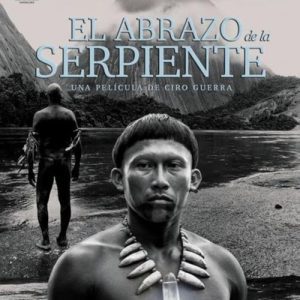
El abrazo de la serpiente
El abrazo de la serpiente (2015), directed by Ciro Guerra, is not just a historical drama set in the Amazon. It is a meditation on myth, memory, and spiritual survival. Inspired by the journals of real-life explorers Theodor Koch-Grünberg and Richard Evans Schultes, the film tells two parallel journeys along the Amazon River, separated by decades but united through one shaman: Karamakate. Yet to see El abrazo de la serpiente purely as an adventure or ethnographic narrative would be to miss its deeper power. At its core, this film is an encounter with living mythology.
Shot in luminous black and white, the Amazon in El abrazo de la serpiente feels timeless, almost primordial. The forest is not a backdrop but a sacred being. In many Indigenous Amazonian traditions, the jungle is animate and conscious, a realm of spirits, ancestors, and transformative energies. The river itself behaves like a mythic serpent, winding endlessly through the landscape. The film’s title, translated as “The Embrace of the Serpent,” carries layered symbolism. The serpent in Amazonian cosmology often represents creation, wisdom, and the cyclical nature of life. It is both cosmic and earthly, both destroyer and teacher. In this sense, the embrace is not simply physical; it is spiritual surrender to the consciousness of the forest.
Karamakate, the last survivor of his tribe, becomes the film’s mythic axis. He is not presented as a stereotype of the mystical “noble savage,” but as a complex guardian of knowledge. Over the course of the story, he guides two different white explorers in search of the sacred plant yakruna, believed to hold powerful healing and visionary properties. Yakruna is more than a botanical curiosity. It functions as a mythic threshold. Through it, the boundary between the human and the divine dissolves.
The use of sacred plant knowledge in El abrazo de la serpiente is deeply rooted in Amazonian spiritual traditions, where psychoactive plants are understood as teachers rather than intoxicants. These traditions often speak of “plant spirits” that communicate through visions. The film treats these encounters with reverence rather than sensationalism. The climactic color sequence, after an otherwise monochrome film, visually expresses the crossing into a mythic realm. It is as if the audience, like the explorers, must pass through ritual initiation to see the world as it truly is.
One of the film’s strongest mythological themes is the idea of cultural amnesia. Karamakate speaks of becoming a “chullachaqui,” a hollow shell of a man who has forgotten the songs and stories of his ancestors. In Amazonian folklore, a chullachaqui is a spirit that imitates humans but lacks a soul. Guerra uses this concept metaphorically. Colonization has not only taken land and lives; it has fractured memory itself. The shaman’s fear is not death but forgetting. Myth, in this world, is survival.
The dual timelines reinforce this theme. The first explorer, Theo, approaches the forest with romantic curiosity. The second, Evan, is colder, more scientific. Yet both are transformed by Karamakate’s worldview. Their journeys echo a familiar mythic pattern: the outsider enters the sacred wilderness, confronts spiritual trials, and emerges altered. It resembles the archetypal hero’s journey, but with a crucial inversion. The true hero is not the foreign seeker but the Indigenous guide. The film subtly critiques the colonial narrative in which Western explorers “discover” lands that already possess ancient cosmologies.
Christian missionary imagery also appears, but in distorted form. In one haunting sequence, a mission station devolves into a cult-like parody of faith, blending fragments of Christian doctrine with Indigenous trauma. The result is myth corrupted by violence. This contrast underscores a key idea in El abrazo de la serpiente: when myth is uprooted from its cultural soil, it mutates. Authentic myth connects humans to land and lineage; imposed myth fractures that connection.
The serpent as symbol deserves special attention. Across cultures, serpents represent rebirth, wisdom, and cosmic cycles. In Mesoamerican tradition, Quetzalcoatl embodies the feathered serpent as creator and civilizer. In Amazonian art, serpents often appear in visionary patterns associated with ayahuasca ceremonies. In El abrazo de la serpiente, the serpent is less a character and more a presence. The river coils like a living body. The forest pulses with hidden life. Even time moves in loops, as the past and present mirror each other. The serpent’s embrace suggests unity between opposites: life and death, memory and forgetting, colonizer and colonized.
Visually, the choice of black and white cinematography enhances the mythic tone. It strips the Amazon of exotic tourist color and transforms it into a symbolic landscape. Light and shadow create a world that feels suspended between dream and reality. When color finally bursts forth, it does so as revelation. This transition mirrors initiation rites found in many Indigenous traditions, where ordinary perception gives way to visionary truth.
The film does not romanticize Indigenous life, nor does it deny the violence of rubber exploitation and colonial brutality. Instead, it frames these historical realities within a larger spiritual crisis. The destruction of the forest is not just ecological but mythological. When the land is wounded, the stories that give it meaning begin to fade. El abrazo de la serpiente therefore becomes a warning. Without myth, humanity risks becoming chullachaqui itself.
What makes El abrazo de la serpiente profoundly powerful is its refusal to translate everything for a Western audience. Dialogue shifts between languages. Rituals are shown without explanatory narration. The viewer must sit with ambiguity. This mirrors the experience of myth itself. True myth is not always decoded; it is experienced.
As a cinematic work, El abrazo de la serpiente stands as one of the most spiritually resonant films of the 21st century. It invites viewers to reconsider how they perceive Indigenous cosmologies, not as relics of the past but as living philosophies. The Amazon here is not a resource frontier but a sacred text written in rivers and roots.
In the end, the embrace of the serpent is an embrace of interconnectedness. Human beings, plants, spirits, and stories form a single woven reality. To sever one strand is to weaken the whole. Through its mythological lens, El abrazo de la serpiente reminds us that the greatest journey is not across geography but into consciousness.
Few films manage to feel both intimate and cosmic at once. El abrazo de la serpiente does exactly that. It is not merely watched; it is undergone. And like the serpent shedding its skin, it leaves the viewer subtly transformed.