

Muso Koroni : The Mande and Bambara Primordial Goddess of Chaos
At a glance
| Description | |
|---|---|
| Origin | West African Mythology |
| Classification | Gods |
| Family Members | Pemba, Faro |
| Region | Mali |
| Associated With | Creation, Fertility, Chaos, Feminine power, Wind, Fire, Agriculture, Smithcraft |
The Mythlok Perspective
In Mythlok’s Perspective, Muso Koroni is not simply a goddess of chaos. She represents a deeper truth found in many ancient traditions: creation cannot exist without disruption. The Bambara understood that growth often emerges from conflict, uncertainty, and transformation, and Muso Koroni embodies that principle perfectly. Her role resembles that of figures such as Kali in Indian tradition and Sekhmet in Egyptian belief, both of whom combine destructive and life-giving qualities. Rather than viewing her as evil, Muso Koroni is best understood as the untamed force that prevents creation from becoming stagnant, ensuring that change remains an essential part of existence.
Muso Koroni
Introduction
Muso Koroni is one of the most fascinating and complex figures in Mande and Bambara mythology. Revered as the first woman and one of the earliest forces in creation, she occupies a unique place in the spiritual traditions of Mali and the wider Mande cultural world. Unlike many fertility goddesses who are portrayed primarily as nurturing and benevolent, Muso Koroni embodies a far more complicated reality. She represents fertility and creation, but also disorder, rebellion, and the untamed forces of nature.
Her mythology forms an essential part of Bambara cosmology, where the universe is understood through the balance of opposing forces. Muso Koroni stands at the center of this philosophy. She is both creator and destroyer, mother and rebel, source of life and bringer of disruption. Through her stories, the Bambara people explain the existence of conflict, suffering, gender roles, and the unpredictable nature of life itself.
Even today, Muso Koroni remains an important symbol in discussions about African spirituality, feminine power, and cultural identity. Her myths continue to inspire scholars, artists, and those seeking a deeper understanding of traditional West African beliefs.
Physical Traits
Descriptions of Muso Koroni vary across different Mande traditions, but nearly all portray her as a being who exists beyond ordinary human standards of beauty or appearance. Her form reflects her role as a primordial force rather than a conventional goddess.
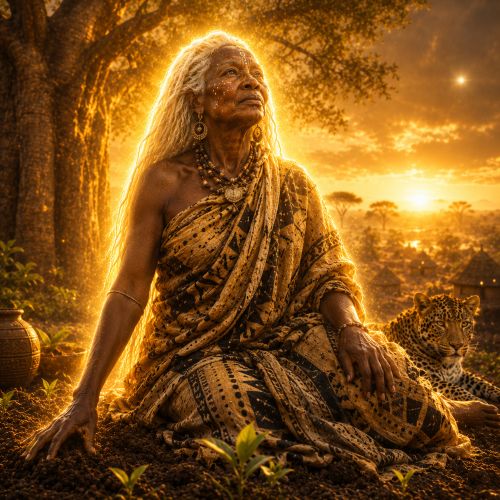
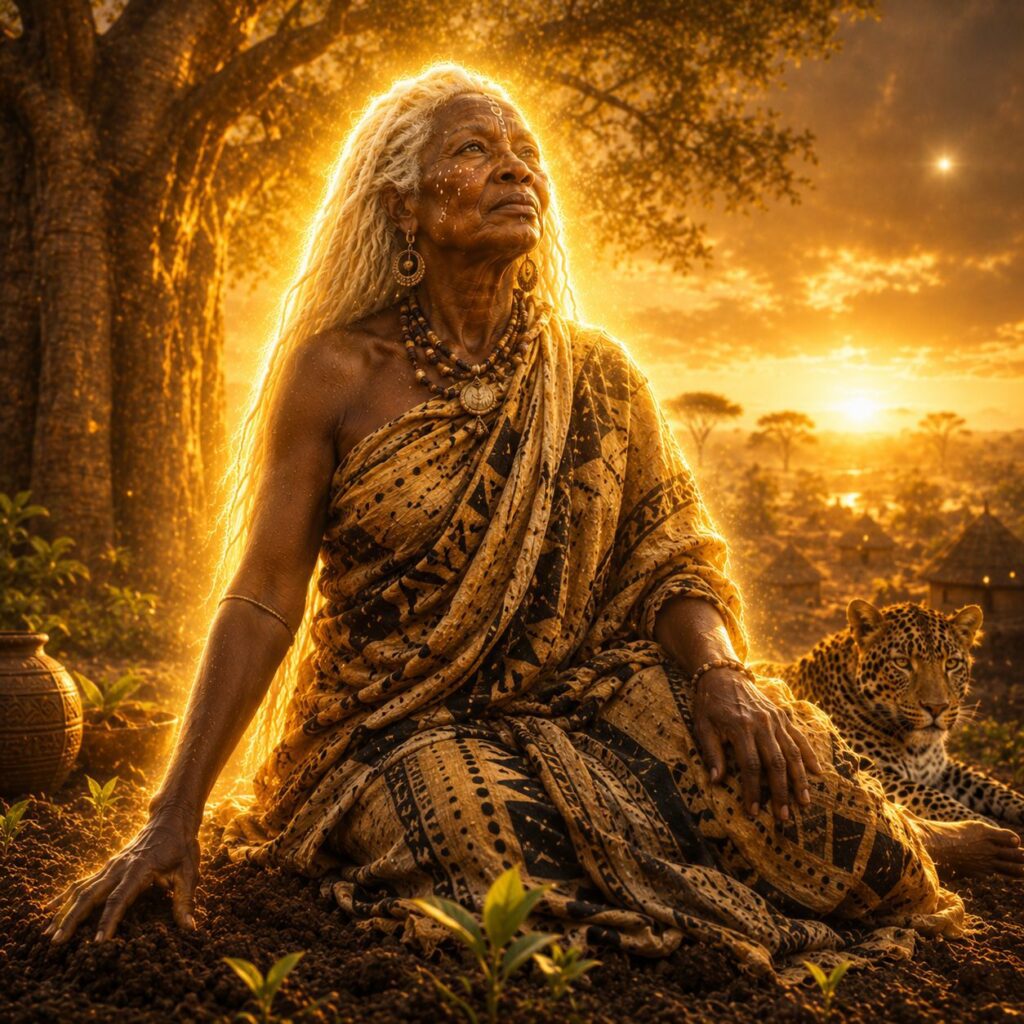
Many stories describe her as an elderly woman with white hair or a white head, a feature that gave rise to the name Muso Koroni Koundyé, often translated as “little old woman with a white head.” This appearance symbolizes ancient wisdom, age, and her existence since the beginning of creation.
Other traditions depict her with multiple breasts, emphasizing her role as a source of fertility and life. Such imagery represents abundance and the ability to nourish the countless living beings that emerged from the world she helped shape.
Animals are closely connected to her identity. Muso Koroni is frequently associated with the leopard, leading some modern writers to refer to her as the Leopard Goddess of Mali. The leopard symbolizes strength, independence, unpredictability, and mastery over the wilderness. Her connection to the planet Venus is equally important. Venus, often visible as the morning star, serves as a celestial symbol of her enduring presence and influence.
Sacred Bambara symbols sometimes represent her movements through zigzag patterns, reflecting the unpredictable path of chaos and transformation that she introduces into the cosmos.
Family
Muso Koroni’s family relationships are deeply intertwined with Bambara creation mythology and the origins of the universe itself. In many versions of the creation story, she was created by Pemba, a powerful primordial being associated with creation and cosmic order. According to traditional narratives, Pemba fashioned Muso Koroni from decaying wood mixed with his saliva, making her one of the first living beings in existence. She was intended to become his companion and partner in creation.
Her relationship with Pemba is far from harmonious. Instead of serving as an obedient counterpart, Muso Koroni challenged authority and pursued her own path. This conflict became one of the driving forces behind the development of the world and the emergence of disorder.
She is often contrasted with Faro, another important deity in Bambara cosmology. While Faro represents balance, harmony, and restoration, Muso Koroni embodies disruption and resistance. Together, they reflect the dual forces that shape existence.
Despite her association with chaos, Muso Koroni is also regarded as a universal mother. Many traditions credit her with bringing forth plants, animals, and human beings. Through these acts, she becomes both a creator and a life-giver, demonstrating that creation and chaos are not opposites but interconnected aspects of reality.
Some myths also describe unusual unions between Muso Koroni and various animals, producing additional creatures that populate the world. These stories emphasize her connection to the untamed and unpredictable aspects of nature.
Other names
Over centuries of oral transmission, Muso Koroni acquired several names and titles that highlight different aspects of her character. One of the most common variations is Muso Koroni Koundyé, referring to her appearance as the white-haired primordial woman. This title emphasizes her age and her connection to the earliest stages of creation.
In some traditions, she is identified with Nyalé, a figure associated with fire and transformative energy. This association reinforces her role as a force capable of both destruction and renewal. She is also remembered through titles that emphasize her primordial status, including descriptions that translate roughly as “The Pure Woman with the Primeval Soul.” Such names present her as a being who existed before the established order of the world.
Modern interpretations often refer to her as the Goddess of Discord or Mother of Chaos. These titles reflect her reputation for resisting control and introducing unpredictability into creation. While these names focus on her disruptive nature, they should not be understood as purely negative. In Bambara thought, chaos is a necessary component of growth, change, and renewal.
Powers and Abilities
Muso Koroni possesses a wide range of powers that make her one of the most influential figures in Mande mythology. Her greatest ability is creation itself. As a primordial force, she participated in shaping the world and bringing life into existence. Stories describe her traveling across the cosmos as a whirlwind, spreading the energies that would become plants, animals, and human beings.
She maintains strong associations with fertility and reproduction. Through her influence, life continues to emerge and flourish. This connection extends beyond biological fertility to include agricultural abundance and the growth of crops.
The elements of wind and fire are particularly linked to her power. The whirlwind symbolizes movement, transformation, and the unpredictable forces that drive creation forward. Fire represents both destruction and renewal, mirroring her dual nature.
Muso Koroni is also associated with secret knowledge and the mystical traditions of smithcraft. Among the Bambara, blacksmiths occupy an important spiritual role, and she is connected to the hidden wisdom that allows transformation of raw materials into useful forms.
A defining aspect of her character is her rebellious spirit. Unlike many divine figures who uphold cosmic order, Muso Koroni challenges established structures. This resistance makes her a powerful symbol of independence and self-determination.
Some traditions attribute the concept of wanzo to her influence. Wanzo represents an untamed force of chaos that exists within the world and within human beings. Through this idea, Muso Koroni becomes a symbol of the wild and unpredictable elements present in every aspect of life.
Modern Day Influence
Although traditional Bambara religious practices have changed over time, Muso Koroni continues to exert a significant cultural influence. In recent decades, scholars and writers have revisited her myths through feminist and decolonial perspectives. Rather than viewing her solely as a disruptive figure, many interpret her as a symbol of female autonomy and resistance against systems of control. Her refusal to conform to expectations has made her an important figure in discussions about gender and power.
Contemporary African artists frequently draw upon Muso Koroni’s imagery to explore themes of identity, history, and cultural memory. Her stories provide a powerful framework for examining the relationship between tradition and modernity.
Anthropologists and historians continue to study her role in Bambara cosmology because her myths reveal important insights into how Mande societies understand creation, morality, gender, and social order. Her story demonstrates that African mythological traditions possess sophisticated philosophical systems comparable to those found anywhere in the world.
Beyond West Africa, Muso Koroni has gained recognition among enthusiasts of comparative mythology. Her combination of creative and destructive qualities has encouraged comparisons with powerful female figures from other cultures, helping introduce Mande mythology to a global audience.
Today, Muso Koroni remains one of the most compelling examples of how ancient myths continue to shape cultural conversations. Her story reminds us that creation is rarely orderly and that chaos itself can be a source of transformation and renewal.
Related Images


Source
Bambara goddess Muso Koroni. (n.d.). In Occult World. Retrieved June 11, 2026, from https://occult-world.com/muso-koroni/
Lewicki, T. (1974). West African Islam in the Middle Ages. Warszawa: PWN.
McNaughton, P. R. (1988). The Mande blacksmiths: Knowledge, power, and art in West Africa. Bloomington, IN: Indiana University Press.
Monteil, C. (1960). Les Bambara du Ségou et du Kaarta (2nd ed.). Paris, France: Maisonneuve et Larose.
Muso Koroni: The powerful and mysterious goddess of Mali. (2025, April 6). Mystery in History. Retrieved June 11, 2026, from https://mysteryinhistory.com/muso-koroni/
Niane, D. T. (1984). Histoire, mythes et légendes du Soudan occidental. Paris, France: Présence Africaine.
Conrad, D. C., & Frank, B. E. (1995). Status and Identity in West Africa: Nyamakalaw of Mande. Indiana University Press.
McNaughton, P. R. (1988). The Mande Blacksmiths: Knowledge, Power, and Art in West Africa. Indiana University Press.
Bird, C. S., Kendall, M., & Tera, M. (1971). The Mande Hero: Texts and Contexts. Indiana University Press.
Levtzion, N. (1973). Ancient Ghana and Mali. Methuen & Co. Ltd.
Frequently Asked Questions
Who is Muso Koroni in Mande mythology?
Muso Koroni is the primordial first woman of Bambara tradition, associated with creation, fertility, rebellion, and cosmic chaos.
What does Muso Koroni represent?
She represents feminine power, fertility, transformation, disorder, independence, and the unpredictable forces of nature.
Is Muso Koroni a goddess or a spirit?
She is generally regarded as a primordial goddess or divine spirit within Bambara and wider Mande cosmology.
Why is Muso Koroni associated with the leopard?
The leopard symbolizes her wild nature, independence, strength, and connection to untamed aspects of the natural world.
How is Muso Koroni viewed today?
Modern scholars and artists often view her as a symbol of resistance, female autonomy, and the enduring power of indigenous African traditions.