Faro : Bambara Water Deity of Creation and Balance
Listen
At a glance
| Description | |
|---|---|
| Origin | Bambara Mythology |
| Classification | Gods |
| Family Members | Maa Ngala, Pemba, Koni |
| Region | Mali |
| Associated With | Water, Rivers, Rain, Creation, Fertility |
The Mythlok Perspective
In the Mythlok perspective, Faro represents a philosophy of creation rooted in correction rather than conquest. He does not dominate the world but listens to it, responding to imbalance with restoration. This places Faro closer to civilising forces than to authoritarian deities. Similar patterns appear in other cultures, such as the Nile’s personified order in ancient Egypt or river goddesses of early Mesopotamia. Yet Faro stands apart in his deep association with speech, suggesting that survival depends as much on communication and shared meaning as on physical resources.
Faro
Introduction
Faro is one of the most important divine figures in Bambara tradition, representing the forces that transform raw existence into an ordered world. Revered across Mali and the wider Mandé cultural sphere, Faro is associated with water, speech, fertility, and cosmic balance. Rather than creating the universe from nothing, Faro refines and stabilizes creation, ensuring that life can endure and society can function.
For the Bambara people, water is never merely physical. Rivers, rain, and floodwaters are living expressions of divine intelligence. The Niger River in particular is understood as Faro’s visible presence on earth, sustaining agriculture, fishing, and human settlement. Faro’s role as a giver of speech further connects him to culture itself, as language allows humans to organise, remember, and pass down knowledge. Through Faro, the natural and social worlds are woven together.
Physical Traits
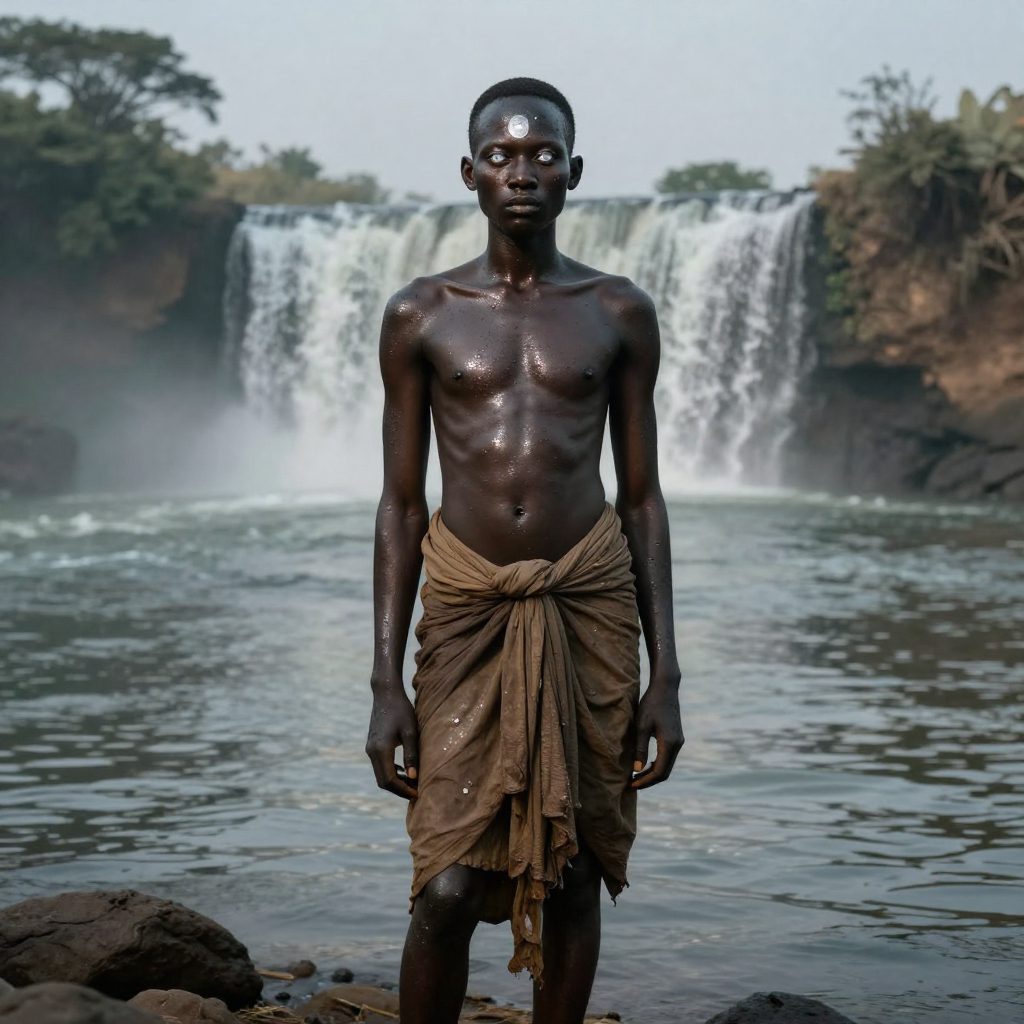
Faro is not described through fixed human features or anthropomorphic form. Instead, his presence is expressed symbolically through water, light, and movement. In Bambara cosmology, Faro’s essence flows rather than stands still, reinforcing his association with rivers and rain rather than with statues or idols.
Some traditions describe Faro as androgynous or fluid in gender, while others identify him as male. This ambiguity is intentional and symbolic. Faro embodies balance rather than physical identity, representing the harmony between complementary forces. His “appearance” is therefore perceived through natural phenomena such as flowing water, reflective surfaces, and the life-giving shimmer of rivers under sunlight.
Family
Faro’s lineage varies across Bambara and wider Mandé narratives, reflecting the layered nature of oral tradition. In several accounts, Faro is connected to Maa Ngala, the supreme creative principle who initiates existence but remains distant from daily human affairs. Faro acts as the active force that brings structure and meaning into the world created by Maa Ngala.
Faro is most frequently paired with Pemba, a powerful but disruptive creative force associated with the earth and uncontrolled generation. Where Pemba creates imbalance through excess, Faro restores harmony through purification and order. This relationship is not purely antagonistic but complementary, illustrating the Bambara belief that creation requires both energy and regulation.
Some traditions describe Faro as producing or guiding the first human beings, often linked symbolically to farmers and blacksmiths. These figures reflect essential social roles, suggesting that Faro’s creative work extends beyond nature into the foundations of human society.
Other names
Faro’s name remains largely consistent across Bambara traditions, sometimes appearing as Fâro or Farro depending on transcription. The name itself is associated with brightness, vitality, and movement, reinforcing his identity as a dynamic life force rather than a static ruler.
In broader Mandé belief systems, Faro may be referenced in relation to other divine principles rather than through alternate names. His identity is defined more by function and presence than by titles, emphasizing action over hierarchy.
Powers and Abilities
Faro’s powers are rooted in restoration, balance, and continuity. As the divine embodiment of water, he governs rivers, rainfall, and fertility, ensuring the renewal of land and life. Water under Faro’s influence is considered purifying and regenerative, capable of correcting imbalance caused by drought, chaos, or moral disorder.
Faro is also the master of the Word. He grants humans speech, language, and the ability to communicate meaningfully. In Bambara thought, speech is not merely sound but a creative force that shapes reality, establishes social order, and transmits wisdom. Through language, Faro enables culture itself.
Creation narratives credit Faro with organizing the cosmos, defining cycles such as day and night, regulating seasons, and stabilizing the world after an earlier phase of disorder. Flood myths further depict Faro as a preserver of life, safeguarding humans, animals, and seeds so that existence can begin anew after destruction.
Modern Day Influence
Faro’s influence persists in contemporary Bambara cultural values, particularly in attitudes toward water, land stewardship, and speech. Rivers remain sacred spaces, and water continues to be used symbolically in purification and blessing rituals.
Academically, Faro is increasingly studied as an example of African cosmology that integrates ecology, ethics, and social organization. His mythology offers insight into sustainable worldviews where balance is prioritised over domination. In an age of environmental crisis, Faro’s symbolism as a guardian of water and harmony has gained renewed relevance.
Related Images


Source
Bambara Religion. (2026, January 5). Encyclopedia.com. https://www.encyclopedia.com/environment/encyclopedias-almanacs-transcripts-and-maps/bambara-religion
African art Bambara, art items of the Bambara ethny (p 98). African Arts Gallery. https://www.african-arts-gallery.com/african-art/ethnicity-bambara?pn=98
AFRICA | 101 Last Tribes – Bambara people. (2022, December 31). 101 Last Tribes. https://www.101lasttribes.com/tribes/bambara.html
FARO – the Bambara God of Creation (African mythology). (2023, June 15). Godchecker.
https://www.godchecker.com/african-mythology/FARO/
Fâro (divinité). Frwiki.wiki. https://pl.frwiki.wiki/wiki/F%C3%A2ro_(divinit%C3%A9)[7]
Faro (mythology). (2024, July 27). Wikipedia. https://en.wikipedia.org/wiki/Faro_(mythology)[8]
Frequently Asked Questions
Who is Faro in Bambara tradition?
Faro is a central creator deity associated with water, speech, and cosmic order. He is responsible for stabilizing the world and enabling life to flourish through balance and renewal.
Is Faro connected to the Niger River?
Yes, the Niger River is widely regarded as a physical manifestation of Faro’s divine presence. Its life-giving waters reflect Faro’s role as a sustainer of both nature and society.
What makes Faro different from other creator gods?
Unlike creator figures who rule through force, Faro restores order through purification and communication. His power lies in correction, balance, and continuity rather than domination.
How is Faro worshipped today?
Faro is honored through water-based rituals, agricultural ceremonies, and Komo society rites. These practices emphasize harmony between humans, nature, and the spiritual world.
Is Faro male or female?
Faro’s gender varies across traditions and is often described as fluid or dual. This reflects the Bambara emphasis on balance rather than fixed identity.