
Maa Ngala : The Supreme Creator of the Mandinka World
At a glance
| Description | |
|---|---|
| Origin | West African Mythology |
| Classification | Gods |
| Family Members | N/A |
| Region | Mali, Guinea, Senegal, The Gambia, Côte d’Ivoire |
| Associated With | Creation, Wisdom |
The Mythlok Perspective
In Mythlok’s Perspective, Maa Ngala represents one of the purest examples of the distant creator archetype found across world traditions. Unlike warrior gods or trickster figures, his significance lies in the act of creation itself and in the spiritual principles that sustain existence. The Mande emphasis on sacred speech and nyama gives Maa Ngala a uniquely philosophical dimension, presenting creation as an ongoing flow of energy and meaning rather than a single event. His role shares similarities with Brahma in Indian tradition and the concept of the supreme creator found in many African cosmologies, yet Maa Ngala remains distinct because of his close association with sacred speech and spiritual force. Like the concept of the Logos in ancient philosophy, his creative power is expressed through order, knowledge, and the spoken word. This makes Maa Ngala not only a creator deity but also a profound symbol of wisdom, interconnectedness, and the invisible forces that bind the universe together.
Maa Ngala
Introduction
Maa Ngala is the supreme creator deity of the Mande peoples of West Africa, particularly among the Mandinka, Bambara, Malinke, and other Mande-speaking communities. Revered as the origin of all existence, Maa Ngala occupies the highest position within Mande cosmology and is regarded as the source of life, spiritual power, and universal order. His influence extends across a vast cultural region that includes modern-day Mali, Guinea, Senegal, The Gambia, and Côte d’Ivoire.
Unlike many mythological gods who actively intervene in human affairs, Maa Ngala is often portrayed as a distant and transcendent creator. He exists beyond the physical world and remains largely removed from everyday concerns. As a result, traditional religious practices typically focus on ancestors, spirits, and other supernatural beings that serve as intermediaries between humanity and the divine.
The mythology surrounding Maa Ngala is deeply connected to the ancient traditions of the Mali Empire and has been preserved for centuries through oral storytelling. Griots, the respected custodians of history and culture, played a crucial role in transmitting these sacred narratives from one generation to the next. Through these traditions, Maa Ngala remains one of the most important figures in Mande mythology and a powerful symbol of creation, wisdom, and cosmic harmony.
Physical Traits
Maa Ngala differs significantly from many mythological deities because he is not described as having a physical form. Traditional Mande beliefs portray him as an infinite and formless presence that exists beyond the limits of human understanding. Rather than appearing as a man, animal, or hybrid being, Maa Ngala is viewed as a spiritual force that permeates all creation.
This absence of a physical appearance reflects his status as the supreme creator. Since he existed before the formation of the universe, he cannot be confined to any earthly shape or material representation. For this reason, there are no authentic traditional statues, icons, or visual depictions of Maa Ngala comparable to those found in other religious traditions.
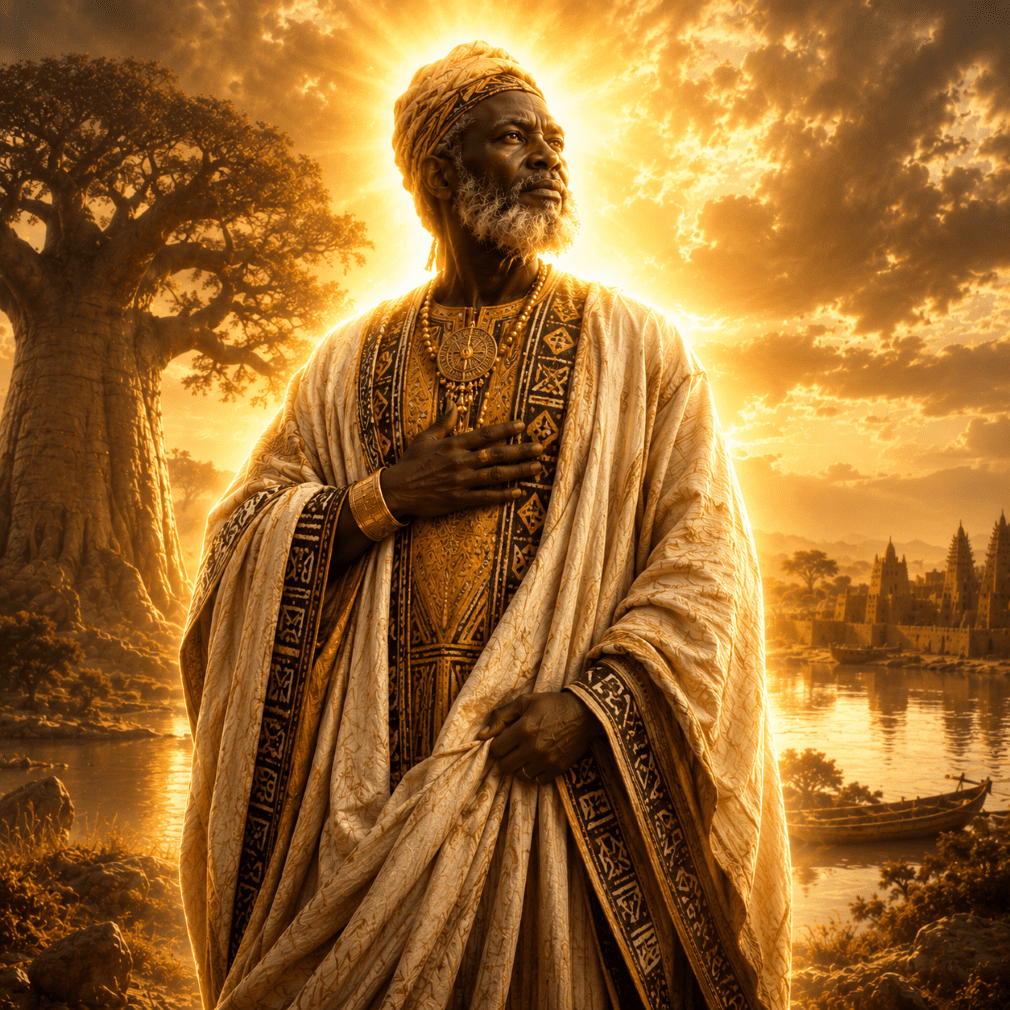
Modern artists occasionally portray him as a radiant cosmic figure surrounded by light and stars, but such representations are symbolic rather than based on historical descriptions. Within traditional belief, Maa Ngala remains an unseen divine presence whose essence is expressed through creation itself rather than through a visible body.
Family
Maa Ngala is generally not associated with a divine family in the way many mythological pantheons describe gods, spouses, and children. He is considered an eternal and uncreated being who existed before all other forms of life. Consequently, traditional accounts focus more on his role as the creator of existence than on familial relationships.
Creation narratives describe how Maa Ngala brought forth the universe through sacred seeds and cosmic forces. Some Bambara traditions explain that within the primordial creation emerged archetypal beings connected to the development of the world. Among these figures, Pemba and Faro play particularly important roles.
Pemba is often associated with disorder, impatience, and the imperfect aspects of creation. Faro, on the other hand, is linked to water, fertility, knowledge, and the restoration of balance. While these beings are sometimes described as emerging from Maa Ngala’s creative actions, they are not universally regarded as literal children. Instead, they represent aspects of the divine order established by the creator.
Because traditions vary across different Mande communities, scholars generally avoid describing Maa Ngala as having a structured divine family. His primary relationship is that of creator to creation.
Other names
Maa Ngala is known by several names and titles throughout the Mande cultural world. These variations reflect linguistic differences and regional traditions while referring to the same supreme divine being. The most common name is Maa Ngala, often translated as “Lord of All” or “Great Master.” This title emphasizes his authority over the entire universe and his role as the source of existence.
Another frequently encountered variation is Mangala, particularly in Bambara creation stories. This form appears in narratives describing the formation of the cosmos and the establishment of natural order. Masa Dembali is another important title associated with the creator. The name means “The Uncreated One,” highlighting his eternal nature and existence before the beginning of time.
In some traditions, the deity is referred to simply as Maa, a title expressing his status as the supreme being and source of sacred knowledge. Regional pronunciations and spellings such as Ma Ngala or Ma Ngalala can also be found in ethnographic accounts and oral traditions. Although the names vary, all emphasize the same central concept: a supreme creator whose power extends beyond the visible world.
Powers and Abilities
As the creator of the universe, Maa Ngala possesses unlimited power within Mande mythology. His abilities are not typically expressed through battles or heroic adventures but through acts of creation, organization, and spiritual governance.
One of his most important powers is creation itself. Traditional myths describe how he brought the universe into existence using sacred seeds. These seeds became the foundation of the elements, directions, and forces that would eventually shape the world. Through this process, order emerged from primordial chaos.
Maa Ngala is also regarded as the source of nyama, the spiritual energy that exists within all living and non-living things. Nyama is a central concept in Mande belief systems and represents the invisible force that connects every aspect of existence. Ritual specialists, healers, and spiritual leaders often work with this force, but its ultimate origin lies with Maa Ngala.
Another significant aspect of his power is Kuma, often translated as “the Word” or sacred speech. In Mande thought, speech is not merely communication but a creative force capable of shaping reality. Because Maa Ngala is the origin of this sacred word, he is also viewed as the source of wisdom, knowledge, and truth.
His influence extends to the maintenance of cosmic balance. Every natural law, spiritual principle, and moral order is believed to originate from him. Through these powers, Maa Ngala sustains the universe and ensures the continued harmony of creation.
Modern Day Influence
Although Islam is now the dominant religion among many Mande communities, the influence of Maa Ngala continues to shape cultural identity and traditional spiritual practices. Elements of ancient cosmology remain embedded in folklore, ceremonies, and oral traditions throughout West Africa.
The preservation of creation stories by griots is one of the most important ways Maa Ngala’s legacy survives today. These storytellers continue to pass down historical narratives and sacred teachings that connect modern communities to their ancestral heritage.
Traditional ceremonies in regions associated with the former Mali Empire also preserve aspects of ancient Mande spirituality. Some rituals continue to honor the forces of creation, the power of sacred speech, and the importance of maintaining harmony between humanity and the spiritual world.
Maa Ngala has also attracted scholarly attention through the works of African intellectuals such as Amadou Hampâté Bâ, who explored the significance of oral tradition and the sacred power of the spoken word in Mande culture. His writings helped introduce many aspects of Mande cosmology to global audiences.
Today, Maa Ngala remains an important symbol of African philosophical thought. His mythology continues to inspire discussions about creation, spirituality, language, and humanity’s relationship with the universe. While direct worship may be uncommon, his presence endures through stories, cultural memory, and the enduring spiritual heritage of the Mande peoples.
Related Images
Source
Conrad, D. C., & Frank, B. E. (1995). Status and Identity in West Africa: Nyamakalaw of Mande. Indiana University Press.
Niane, D. T. (1965). Sundiata: An Epic of Old Mali. Longman.
Bird, C. S., & Kendall, M. (1980). The Mande Hero: Oral Tradition and Its Meaning. Journal of African Studies, 7(1), 1–17.
McNaughton, P. (1988). The Mande Blacksmiths: Knowledge, Power, and Art in West Africa. Indiana University Press.
Encyclopedia of African Religion. (n.d.). Entry on Bamana/Bambara religion and Maa Ngala (PDF). SAGE Publications. Retrieved June 11, 2026, from https://sk.sagepub.com/ency/edvol/download/africanreligion/chpt/bamana.pdf
Joshua Project. (2025, December 31). Mandinka in Senegal: People group profile. Retrieved June 11, 2026, from https://joshuaproject.net/people_groups/13491/SG
Joshua Project. (n.d.). Mandinka in Ghana: People group profile. Retrieved June 11, 2026, from https://joshuaproject.net/people_groups/13491/GH
Namu Wiki. (2024, October 15). Mandinka. Retrieved June 11, 2026, from https://en.namu.wiki/w/%EB%A7%8C%EB%94%A9%EC%B9%B4%EC%A1%B1
Yaden Africa. (2025, March 5). The Mandinka: History, culture, and legacy. Retrieved June 11, 2026, from https://www.yaden-africa.com/mandinka/
Frequently Asked Questions
Who is Maa Ngala?
Maa Ngala is the supreme creator god of Mande tradition, revered as the source of life, order, and spiritual power.
What is Maa Ngala the god of?
Maa Ngala is associated with creation, cosmic order, sacred speech, wisdom, and the spiritual force known as nyama.
Does Maa Ngala have a physical form?
No. Traditional beliefs describe Maa Ngala as a formless and transcendent creator beyond human appearance.
What is the connection between Maa Ngala and Faro?
Faro is a divine figure linked to fertility, water, and balance who helps maintain the order established by Maa Ngala.
Is Maa Ngala still worshipped today?
While many Mande peoples follow Islam, Maa Ngala remains an important cultural and spiritual figure preserved through oral traditions and folklore.
