Troy (2004) : Greek Epic Reimagined Without the Gods
| Description | |
|---|---|
| Country of Origin | United States of America |
| Language | English |
| Genre | Fantasy |
| Cast | Brad Pitt, Eric Bana, Orlando Bloom, Diane Kruger, Brian Cox |
| Directed by | Wolfgang Petersen |
Troy
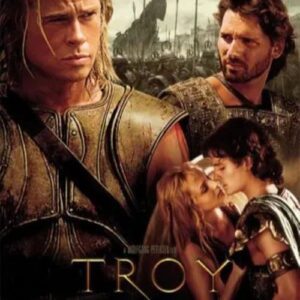
Few modern films have attempted to retell ancient epic on the scale of Troy. Released in 2004 and directed by Wolfgang Petersen, Troy draws primarily from Homer’s Iliad, though it reshapes the material into a grounded historical war drama rather than a myth-soaked epic. For viewers expecting gods descending from Olympus, prophetic riddles, and divine manipulation of fate, Troy is both fascinating and controversial. It is not the Iliad as it was sung by ancient poets; it is a reinterpretation of the Trojan War stripped almost entirely of overt divinity.
At the heart of Troy is the conflict sparked by Paris of Troy and Helen of Sparta. In Greek myth, Helen’s abduction—or elopement, depending on the version—was set in motion by the Judgement of Paris, where the goddesses Hera, Athena, and Aphrodite competed for the title of the fairest. Aphrodite’s promise of Helen’s love won Paris’s favor and ultimately doomed Troy. The film omits this mythic prologue entirely. There is no golden apple, no divine rivalry, no visible hand of Olympus. Instead, Paris falls in love, makes a reckless decision, and ignites a geopolitical war. The shift reframes the story from cosmic drama to human error.
This removal of the gods is the film’s boldest mythological alteration. In Homer’s Iliad, deities like Athena, Apollo, Hera, and Zeus constantly intervene in battle, protect favored heroes, and manipulate outcomes. Achilles’ rage, Hector’s fate, and even the fall of Troy are tied to divine will. In Troy, fate becomes psychological rather than supernatural. Characters speak of destiny, but no god confirms it. Prophecies exist only as human belief. The result is a version of the Trojan War that feels almost plausible as Bronze Age history rather than sacred legend.
Yet myth persists in symbolic form. Achilles, portrayed as nearly invincible, still carries the aura of legend. In Greek tradition, he is the son of the sea-nymph Thetis and the mortal king Peleus, dipped into the River Styx to become invulnerable except for his heel. The film removes his divine parentage and the Styx narrative, presenting him instead as an unmatched but mortal warrior. His vulnerability is not mystical; it is human. However, the famous “Achilles’ heel” is retained as a poetic echo of the myth when he is ultimately struck there. It is a cinematic nod to tradition rather than theological fact.
Hector, Prince of Troy, emerges in the film as perhaps the most mythologically faithful character in spirit. In Homer’s epic, Hector represents duty, family, and honor in contrast to Achilles’ pride and rage. The duel between Hector and Achilles is one of the defining moments of Greek myth. Troy preserves this confrontation with remarkable intensity. The choreography, dialogue, and aftermath—Achilles dragging Hector’s body—remain deeply rooted in the Iliad’s emotional core. While the gods are absent, the tragic inevitability of Hector’s fate feels mythic in scale.
Agamemnon’s portrayal also reflects a mythological reinterpretation. In the original traditions, Agamemnon is driven by pride and power, but he is also subject to divine forces and prophecy. In Troy, he becomes a more straightforward imperialist, hungry for conquest. The mythic complexity of sacrificial rituals and divine appeasement is reduced, turning him into a political tyrant rather than a tragic participant in a divinely orchestrated war.
One of the most significant deviations from myth concerns the timeline. Homer’s Iliad covers only a short period in the tenth year of the Trojan War and does not depict the Trojan Horse or the fall of the city. Those events appear in later epics such as the Aeneid and other lost works of the Epic Cycle. Troy compresses the entire saga—from the arrival of the Greeks to the destruction of Troy—into a single continuous narrative. The Trojan Horse becomes the film’s climactic device, portrayed as a brilliant military strategy rather than a divinely inspired deception. In myth, Athena often plays a role in guiding the Greeks’ cunning; here, human ingenuity takes center stage.
The absence of the gods shifts the thematic focus of Troy. In ancient Greek myth, humans are often pawns in a divine chess game. Honor, glory, and death are intertwined with the will of Olympus. In the film, mortality itself becomes the driving theme. Achilles famously declares that the gods envy humans because they are mortal. This line encapsulates the movie’s philosophy. Immortality comes not from divine blessing but from remembered glory. Kleos—the Greek concept of eternal fame—remains intact, even without Zeus watching from above.
Visually, Troy captures the grandeur expected of mythic storytelling. The city walls, the armor, the battlefield duels all evoke the Bronze Age world described in epic poetry. Yet the aesthetic remains grounded. There are no glowing auras or thunderbolts from the sky. Even the religious elements, such as temples and prayers, are treated as cultural practices rather than supernatural events. Apollo’s temple stands as a symbol of belief, not a gateway to divine intervention.
For mythology enthusiasts, Troy offers both frustration and fascination. Purists may lament the removal of Thetis, the minimization of prophecy, and the transformation of Achilles from semi-divine hero to elite soldier. However, the film invites viewers to reconsider what makes myth powerful. Is it the gods, or is it the emotional truth embedded in the story? By focusing on love, pride, revenge, loyalty, and mortality, Troy suggests that myth endures because of its human core.
The character of Helen is another example of reinterpretation. In myth, she is often depicted as both victim and catalyst, sometimes even a phantom double sent to Troy while the real Helen waits in Egypt. The film discards these variations and presents her as a woman choosing love over duty. This simplifies the narrative but makes it more accessible to modern audiences unfamiliar with the multiple strands of Greek legend.
Ultimately, Troy stands as a bridge between ancient epic and modern historical cinema. It does not attempt to be a faithful mythological adaptation in theological terms. Instead, it reimagines the Trojan War as a human tragedy shaped by ambition and desire. The gods may be silent, but the mythic structure remains visible in the archetypes: the invincible warrior with a fatal flaw, the noble defender of a doomed city, the proud king whose ambition brings ruin.
In evaluating Troy, one must decide what kind of mythological experience is desired. If one seeks a cinematic version of Homer’s divine spectacle, the film will feel incomplete. If one appreciates myth as a reflection of human psychology and timeless conflict, Troy succeeds in translating epic tradition into a form that resonates with contemporary audiences. It strips away Olympus but leaves the legend intact.
For a film named Troy, that may be its greatest achievement: it proves that even without gods, the story of the Trojan War still feels larger than life.