


Miru : The Goddess Who Ruled the Cook Islands Underworld
At a glance
| Description | |
|---|---|
| Origin | Cook Islands Mythology |
| Classification | Gods |
| Family Members | Kumutonga-i-te-pō, Karaia-i-te-ata (Daughters), Tau-Titi (Son) |
| Region | Cook Islands |
| Associated With | Underworld, Death, Souls of the dead |
The Mythlok Perspective
In Mythlok’s Perspective, Miru is more terrifying than Hades because she does not simply rule the dead; she actively torments and consumes them. While Hades generally functions as the stern ruler who maintains the order of the Greek underworld, Miru represents a far more predatory vision of death. Her use of kava, centipedes and the ever-burning oven makes Avaiki a place of active suffering rather than merely a realm of the departed. The comparison shows how different cultures can imagine underworld rulers not simply as guardians of death, but as reflections of what their societies feared most about the world beyond it.
Miru
Introduction
Miru is one of the most fearsome figures in Cook Islands mythology, particularly in the traditions of Mangaia and Aitutaki. She is associated with Avaiki, the spirit world or underworld beneath the living world, where the souls of the dead could encounter her after death. Traditional accounts portray her as a powerful female spirit who captures, torments and ultimately consumes human souls. The Polynesian Lexicon Project records Mangaian Miru as a goddess of the underworld and Rarotongan Miru as an ancient goddess of the underworld, while related traditions elsewhere in Polynesia preserve figures with the same or closely related name.
Miru’s mythology is particularly striking because death is imagined not as a simple passage into another existence but as a dangerous journey. In Mangaian traditions, souls could descend into Avaiki through a series of supernatural stages before coming under Miru’s power. Her mythology therefore connects the underworld with darkness, water, caves, the earth oven and intoxicating kava. In Aitutaki traditions, the story of the warrior Tekauae even explains how a person could deceive Miru and reach the more pleasant afterlife of Iva instead.
These traditions also reveal that Cook Islands ideas about the afterlife were not uniform. Miru appears most strongly in Mangaian traditions, while Aitutaki traditions preserve their own stories involving her. The differences between these accounts are important because they show how mythology was shaped by individual island communities rather than forming one fixed belief system.
Physical Traits
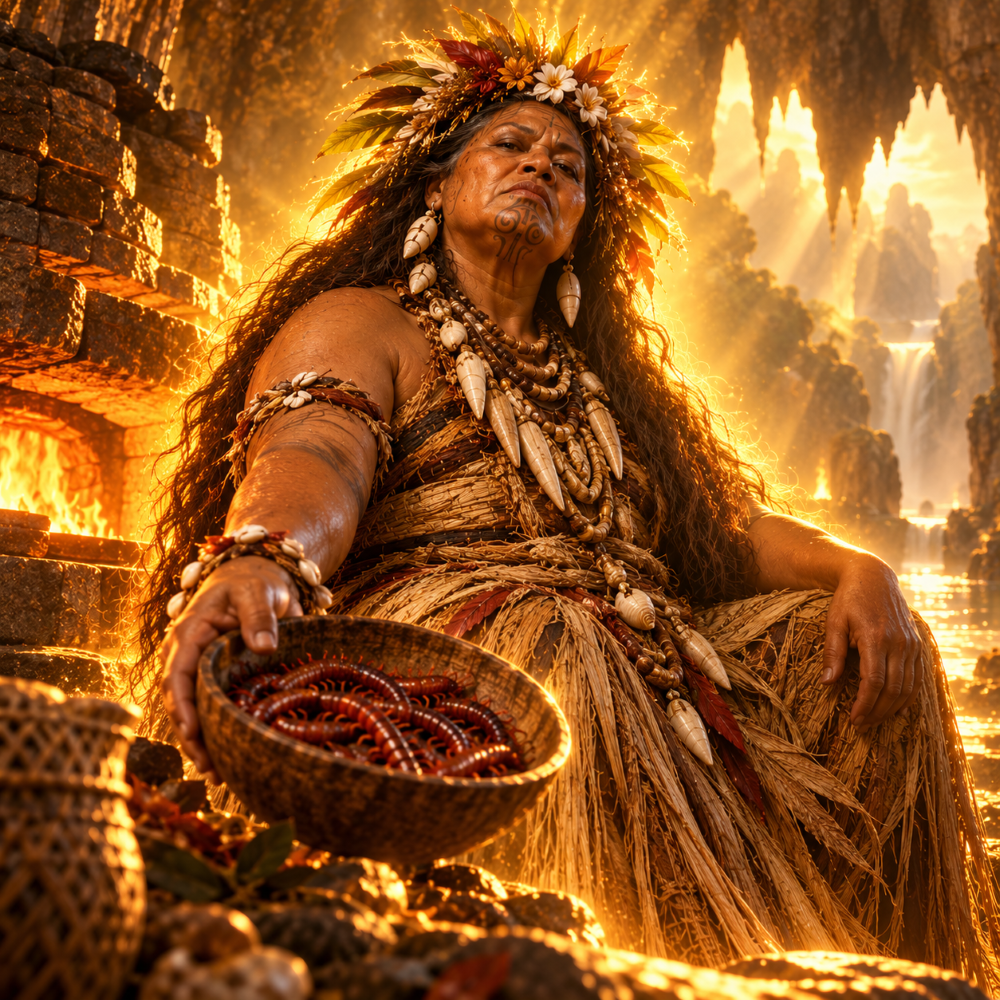
Miru is traditionally described as frightening and deformed rather than beautiful or benevolent. Nineteenth-century accounts recorded by William Wyatt Gill describe her in strongly negative terms, presenting her as a fierce female spirit with a terrifying appearance. A modern scholarly discussion of Cook Islands beliefs likewise describes Miru as a deformed and frightful being who feasted upon the spirits of the dead.
One of her most distinctive descriptions comes from the Mangaian tradition in which she is called Miru-kura, or “Red Miru.” The name is connected in later interpretation with the reddish glow of her face from the heat of her ever-burning earth oven. A recent study of the Ngaru traditions notes that Miru’s full name appears as Miru-kura and discusses the association between “kura” and the heat of her oven.
Her appearance should therefore be understood symbolically as well as literally. Miru’s frightening form reflects her position as a ruler of death, while the heat and redness associated with her oven reinforce her connection with destruction. Unlike her daughters, the Tapairu, who are described as exceptionally beautiful spirit women, Miru herself represents the threatening side of the spirit world
Family
Miru is most famously associated with the Tapairu, a group of female spirit beings connected with the underworld of Mangaia. Traditional accounts describe four Tapairu as Miru’s daughters. They were associated with nocturnal dances and could move between Avaiki and the human world. Their extraordinary beauty was also part of their supernatural character, creating a sharp contrast with their frightening mother.
Miru also has a son named Tau-Titi. He is associated with a nocturnal dance performed in his honour, and the Tapairu are described as his sisters. When dawn approached, the Tapairu returned to Avaiki. This places Miru’s family within a wider supernatural world where dancing, night, water and the boundary between the living and the dead are closely connected.
Two of Miru’s daughters are specifically named in the Ngaru traditions: Kumutonga-i-te-pō, meaning approximately “Kumutonga-of-the-night,” and Karaia-i-te-ata, “Karaia-the-shadowy.” Miru sends the two women to lure the hero Ngaru into Avaiki, intending to bring him within reach of her oven. Their role demonstrates that the Tapairu were not merely passive inhabitants of the underworld but could act as intermediaries between Miru and the human world.
Other names
The best-documented name of the Cook Islands underworld goddess is Miru. In Mangaian tradition, she is also identified as Miru-kura, or “Red Miru,” a name strongly associated with her underworld character and the heat of her oven. The Polynesian Lexicon Project separately records Miru in Mangaia as a goddess of the underworld and Miru in Rarotonga as an ancient goddess of the underworld.
The name also belongs to a wider Polynesian pattern. In Hawaiian tradition, Milu is associated with the underworld, while Māori traditions preserve Miru as a figure connected with the gates of death. These should not be treated as simple alternate names for the Cook Islands goddess because each tradition developed its own mythology around the figure. The shared name is nevertheless significant for understanding broader Polynesian ideas about death and the spirit world.
A particularly important distinction is between Miru and Muru in Rarotongan material. Comparative sources record Muru as a separate male underworld figure, showing why apparently similar names should not automatically be merged into a single mythological character.
Powers and Abilities
Miru’s primary domain is the underworld and the fate of the dead. In Mangaian tradition, souls travelling toward the spirit world could become trapped before reaching their final destination. One account describes a giant tree carrying the dead toward Avaiki, beneath which a net caught the spirits before they were submerged in the freshwater lake Vai-roto-ariki. From there, the trapped souls were eventually brought before Miru.
Miru’s treatment of the dead is particularly associated with kava, an intoxicating drink. Traditional accounts describe her using kava to stupefy her victims before subjecting them to further torment. The earth oven is another defining feature of her power. Miru’s oven is described as ever-burning, and her ability to cook and consume souls makes the oven one of the central symbols of her underworld authority.
Another tradition describes Miru giving her victims living centipedes. The suffering they experience drives them toward a freshwater lake, where they drown and are ultimately consumed. The Aitutaki story of Tekauae provides a rare example of someone successfully defeating this process. Tekauae arranged for a coconut kernel to accompany his body after death. When he reached Miru’s domain, he secretly consumed the kernel while allowing the centipedes to fall away. Miru eventually permitted him to return to the upper world.
The story of Tekauae is significant because it transforms Miru from simply a personification of death into the central obstacle in a story about escaping death’s finality. In Aitutaki tradition, placing a coconut kernel near the body at death became associated with the means of deceiving Miru and reaching Iva, a more pleasant destination for fortunate spirits. These beliefs changed considerably following the arrival of Christian missionaries in the nineteenth century.
Miru’s mythology also includes the story of Ngaru, a major culture hero of Mangaia. Miru becomes envious of Ngaru’s fame and attempts to lure him into her domain through two of her daughters. Her intention is to kill him in her oven, but Ngaru survives the encounter. The story presents Miru as a powerful adversary whose authority over death can nevertheless be challenged by a heroic figure.
Modern Day Influence
Miru remains important primarily as part of the recorded cultural memory of the Cook Islands and the wider study of Polynesian beliefs about death and the afterlife. Her stories preserve ideas about Avaiki, the spirit world, the fate of souls and the relationship between the living and supernatural realms. Modern scholarship continues to examine these traditions because they provide insight into how Mangaian and Aitutakian communities understood death before Christian ideas of heaven and hell became dominant.
Miru has also entered modern literary culture. Cook Islands-born poet Alistair Te Ariki Campbell explored Polynesian ancestral traditions in his 1980 collection The Dark Lord of Savaiki. His work drew deeply on Cook Islands heritage and adapted oral traditions into modern poetry. The collection is therefore an important example of how older Polynesian ideas of spirits, ancestors and the otherworld could be carried into contemporary literature.
At the same time, Miru is increasingly encountered through online mythology resources and comparative studies of Polynesian religion. These modern presentations can sometimes flatten differences between Mangaian, Aitutakian, Māori, Hawaiian and other traditions. Her story is better understood when these traditions are kept distinct while recognising their broader linguistic and cultural relationships.
Miru ultimately remains one of the most memorable underworld figures of the Cook Islands because her mythology combines death, deception, fear and survival. She is not simply a Polynesian equivalent of a generic “goddess of death.” Her stories are rooted in particular island traditions and in a complex vision of the spirit world, where the dead could be captured, tested, rescued or destroyed. Her mythology preserves an older Cook Islands understanding of what might await a person beyond the boundary between life and death.
Related Images

Source
Buckovská, Z. (n.d.). A comparison and analysis of eschatological themes in Hawaiian, Māori and Cook Islands mythologies. Slovak Academy of Sciences. https://www.sav.sk/journals/uploads/091911126_Buckov%C3%A1.pdf
Craig, R. D. (1989). Dictionary of Polynesian mythology. Greenwood Press.
https://www.scribd.com/document/731520056/Robert-D-Craig-Dictionary-of-Polynesian-Mythology-1989
Gill, W. W. (1876). Myths and songs from the South Pacific. H. S. King & Company. https://archive.org/details/mythsandsongsfr02mlgoog
Gill, W. W. (1876). Myths and songs from the South Pacific [PDF]. https://dn720407.ca.archive.org/0/items/mythssongsfromso00gill/mythssongsfromso00gill.pdf
Gill, W. W. (1876). The South Pacific and New Guinea, past and present; with notes on the Hervey group, an illustrative song and various myths. https://upload.wikimedia.org/wikipedia/commons/6/60/The_south_Pacific_and_New_Guinea,past_and_present;_with_notes_on_the_Hervey_group,_an_illustrative_song_and_various_myths(IA_southpacificnewg00gill).pdf
Polynesian Lexicon Project Online. (n.d.). Entries for MIRU [CE]: Goddess of the underworld. Max Planck Institute for Evolutionary Anthropology. https://pollex.eva.mpg.de/entry/miru/
Reber, J. S. (n.d.). Heaven and hell in the eyes of Cook Islands Māori: A comparative review of three time periods. In Pioneers in the Pacific. Brigham Young University Religious Studies Center.
https://rsc.byu.edu/pioneers-pacific/heaven-hell-eyes-cook-islands-maori-comparative-review-three-time-periods
Siikala, J. (n.d.). The Journal of the Polynesian Society, articles on Mangaian mythology and Miru. The Polynesian Society. https://thepolynesiansociety.org/jps/index.php/JPS/article/download/163/156/605
Frequently Asked Questions
Who is Miru in Cook Islands mythology?
Miru is an underworld goddess associated especially with Mangaia and Aitutaki. She rules Avaiki and is feared for capturing, tormenting and consuming the souls of the dead.
What is Miru known for?
Miru is known for ruling the underworld, using kava to stupefy souls, tormenting them with centipedes and consuming them in her ever-burning earth oven.
Who are Miru's children?
Miru is described as the mother of the Tapairu, four female spirit beings, and Tau-Titi, her son. Two daughters, Kumutonga-i-te-pō and Karaia-i-te-ata, are named in Mangaian traditions.
How did Tekauae escape Miru?
Tekauae carried a coconut kernel with him after death. He secretly ate it instead of being overcome by Miru’s centipedes, allowing him to escape the underworld and return to the living.
Is Miru the same as Milu in Hawaiian mythology?
Miru and Hawaiian Milu are related through wider Polynesian traditions about underworld figures, but they belong to different cultural traditions and should not be treated as identical characters.


