
Tapairu : Sacred Fairy Spirits of Cook Islands Tradition
| Description | |
|---|---|
| Origin | Cook Islands Mythology |
| Nature | Benevolent |
| Notable Members | Tau-Titi |
| Symbolism | Ritual sanctity, Femininity, Intermediary between mortals and gods |
| Epics | Appear in dances honoring Tau-Titi |
Mythlok Perspective
In Mythlok’s View, the Tapairu represent a rare balance between beauty and the unknown, where the spirit world does not dominate but quietly coexists with human life. They are less like commanding deities and more like echoes of presence, revealing themselves only through harmony and ritual precision. This places them close to the Japanese yūrei in their subtlety, yet their role in dance aligns more with the Greek nymphs, who inhabit natural rhythms rather than haunt them. Unlike both, however, the Tapairu remain deeply tied to community ritual, making them uniquely Polynesian expressions of living spirituality.
Tapairu
Introduction
The Tapairu are a fascinating class of spirit beings rooted in the traditions of Mangaia, one of the southern islands of the Cook Islands. Neither fully divine nor simply ghostly, the Tapairu occupy a delicate middle ground between worlds. They are often described as fairy-like entities, yet their presence carries a deeper sacred weight tied to ritual, ancestry, and the unseen forces that shape human life.
In Cook Islands cosmology, where the universe is imagined as layered realms with Avaiki as the underworld, beings like the Tapairu help explain how the spiritual world interacts with the living. They are most often associated with ceremonial dance and sacred gatherings, appearing—whether visibly or invisibly—when rituals are performed correctly. Their stories are not just mythological curiosities; they reflect a worldview where every movement, chant, and offering has the power to invite the supernatural into human experience.
Physical Description
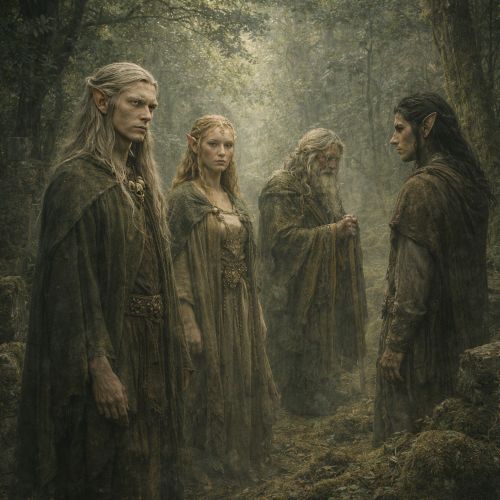
Descriptions of the Tapairu are intentionally elusive, reflecting their nature as beings that are felt more than clearly seen. They are typically imagined as graceful, luminous figures with an almost weightless presence. Unlike clearly defined gods or spirits, the Tapairu do not have a fixed visual identity. Instead, they are perceived through atmosphere—subtle shifts in light, silence, or movement during sacred moments.
Their form is often compared to fairies or elves, suggesting elegance, fluidity, and an otherworldly beauty. They are associated with soft, flowing motion, much like the rhythm of traditional Polynesian dance. Their connection to natural forces, especially through the god Tane, implies a form that feels organic and harmonious rather than rigid or human-like. Rather than appearing as individuals, the Tapairu are sensed collectively, reinforcing their role as a unified spiritual presence rather than distinct personalities.
Mythological Context
Within the broader mythology of Mangaia, the Tapairu exist as part of a complex spiritual hierarchy that includes primordial beings, gods, and ancestral spirits. Their story is closely tied to Miru, the powerful goddess of the underworld, and her domain in Avaiki.
The Tapairu are most commonly linked to ritual performance, particularly dances held in honor of their brother, Tau-Titi. It is during these ceremonies that their presence is believed to manifest. They do not intervene directly in human affairs; instead, they act as silent witnesses or subtle enhancers of sacred acts.
This role highlights a key principle in Polynesian belief systems: the idea that the spiritual world responds to proper ritual behavior. The Tapairu are not random apparitions but are drawn by respect, rhythm, and tradition. Their presence transforms ordinary human activity into something sacred and charged with meaning.
Origins
The origins of the Tapairu are deeply embedded in genealogical mythology. They are named after the four daughters of Miru, the underworld goddess, placing them firmly within a lineage connected to death, ancestry, and the hidden layers of existence. At the same time, their association with Tane, a god linked to forests, growth, and light, creates a dual identity. They are both underworld beings and participants in the living world’s cycles of fertility and renewal.
This dual origin reflects a broader Polynesian worldview where life and death are not opposites but interconnected states. The Tapairu embody this connection, carrying the mystery of the underworld while also participating in the vitality of the natural world.
Notable Members
The Tapairu are remembered as a collective rather than as individually named figures. Their identity is tied to the four daughters of Miru, but their individual names are not preserved in most traditions. Instead, the focus shifts to their relationship with Tau-Titi, their brother, whose ceremonial dances serve as the primary context in which the Tapairu appear. This emphasis on collective identity reflects Polynesian cultural values, where lineage and community often take precedence over individual distinction. The Tapairu, therefore, are not characters in the conventional sense but a shared spiritual presence that emerges in specific cultural and ritual contexts.
Relationship with Other Beings
The Tapairu exist within a network of relationships that define their role in mythology. Their connection to Miru anchors them in the underworld, linking them to themes of death and ancestral power. At the same time, their association with Tane connects them to life, growth, and the natural environment.
Their bond with Tau-Titi is particularly important, as it ties them directly to human ritual. Through dance, humans create a bridge that allows the Tapairu to enter their world. This interaction is not casual; it depends on maintaining the correct forms and traditions. In relation to mortals, the Tapairu are neither hostile nor benevolent in a simple sense. They respond to respect and ritual accuracy, reinforcing the idea that human behavior can influence spiritual presence.
Similar Beings
Across Polynesian traditions, the Tapairu share similarities with other liminal spirit beings. The Māori Patupaiarehe, for example, are fairy-like entities associated with forests and mist, known for their elusive nature and connection to music and ritual.
In Hawaiian traditions, the Menehune are small supernatural beings linked to hidden activity and ancient knowledge. While different in function, they share the idea of a parallel population existing just beyond human perception.
These parallels suggest a shared cultural motif across Polynesia: the existence of beings who inhabit the edges of reality, interacting with humans only under specific conditions. The Tapairu fit neatly into this pattern, representing Mangaia’s unique expression of this broader belief.
Symbolism and Interpretations
The Tapairu symbolize the fragile boundary between the visible and invisible worlds. Their presence at rituals highlights the importance of ceremony as a bridge between humans and the divine. They also embody a balance between opposing forces. Through their connection to both Miru and Tane, they represent the coexistence of death and life, mystery and beauty. This duality is central to their meaning.
From a cultural perspective, the Tapairu can be seen as expressions of ancestral memory. Their appearance during dances suggests that important communal events are not just social gatherings but moments when the past and present converge. Their symbolism reinforces the idea that tradition is not static but alive, constantly renewed through performance and belief.
Modern Influence
In modern times, the Tapairu continue to hold cultural significance, particularly in the preservation of Cook Islands heritage. While traditional belief systems have evolved, stories of the Tapairu remain part of oral storytelling, educational materials, and cultural performances.
They are often used as symbols of identity, representing a connection to ancestral traditions and the spiritual depth of Polynesian culture. In contemporary interpretations, they also serve as a bridge between academic study and creative storytelling, appearing in literature, digital content, and folklore collections.
Their enduring presence demonstrates how ancient beliefs adapt to modern contexts while retaining their core meaning. The Tapairu remain a reminder that the unseen world still shapes cultural identity and collective memory.

Sources
Wikipedia contributors. (n.d.). Tapairu. In Wikipedia. https://en.wikipedia.org/wiki/Tapairu
Wikipedia contributors. (n.d.). Cook Islands mythology. In Wikipedia. https://en.wikipedia.org/wiki/Cook_Islands_mythology
Gods & Monsters. (n.d.). Tapairu: The mystical elves of Cook Islands Polynesian mythology. Gods & Monsters. https://godsandmonsters.info/tapairu/
Pantheon World. (n.d.). Tapairu. Pantheon World. https://pantheon.org/articles/t/tapairu2.html
Cook Islands Library and Museum Society. (2024). Exploring the unique mythology and legendary tales of the Cook Islands. Cook Islands Library and Museum Society. https://cook-islands-library-museum.org/exploring-the-unique-mythology-and-legendary-tales-of-the-cook-islands/
Reilly, M. P. J. (1985). Tuārangi, evil spirits and foreign beings in Mangaian tradition. Journal of the Polynesian Society, 94(2), 183–199. https://www.jstor.org/stable/25169151
Handy, E. S. C., & Handy, E. G. (1972). Cook Islands customs. Bishop Museum Press.
Wharton, G. M. Q. (Ed.). (1967). Mangaian legends: Versions of the myths and legends of Mangaia. Government of the Cook Islands. [
Frequently Asked Questions
Who are the Tapairu?
The Tapairu are fairy-like spirit beings from Mangaia in the Cook Islands, associated with ritual dance, the underworld, and ancestral spirituality.
Are the Tapairu gods or spirits?
They are neither full gods nor simple ghosts. The Tapairu are considered semi-divine beings that exist between the human and spiritual realms.
What is the origin of the Tapairu?
They originate from the four daughters of Miru, the underworld goddess, linking them to Avaiki, the spiritual underworld.
When do the Tapairu appear?
They are believed to appear during ceremonial dances, especially those performed in honor of their brother Tau-Titi.
What do the Tapairu symbolize?
They symbolize the connection between life and death, the sacredness of ritual, and the presence of ancestral spirits in human life.