
How Mythology Shaped New Guinea, the Island Shared by Indonesia and PNG
New Guinea is one of the most extraordinary places on Earth. Stretching across the western Pacific just north of Australia, it is the world’s second-largest island and home to an astonishing diversity of cultures, languages, and traditions. Today, the island is politically divided between the Indonesian provinces of Papua and Central Papua in the west and the independent nation of Papua New Guinea in the east. Yet long before modern borders were drawn, the peoples of New Guinea shared a mythological landscape shaped by mountains, forests, rivers, and ancestral memory.
Unlike the mythologies of Greece, Egypt, or Scandinavia, New Guinea mythology is not centered around a single pantheon of gods. Instead, it consists of thousands of stories passed down through generations by hundreds of different communities. Each valley, river basin, and coastal region developed its own traditions, yet many share common themes: the power of ancestors, the sacredness of nature, the presence of spirits, and the belief that the visible and invisible worlds are deeply intertwined.
To explore the mythology of New Guinea is to enter a world where the land itself remembers the past, where animals carry ancient wisdom, and where the spirits of ancestors continue to guide the living.
One Island, Thousands of Stories
New Guinea is often described as one of the most culturally diverse places on the planet. More than 800 languages are spoken across the island, representing an incredible variety of peoples and traditions. This diversity naturally produced an equally rich collection of myths, legends, and spiritual beliefs.
Despite their differences, many of these traditions view the world as a living, interconnected system. Mountains, rivers, forests, animals, and people are not separate entities but part of a greater cosmic network. Human beings are often seen as descendants of ancestral beings who shaped the landscape and established the customs that govern society.
Rather than serving merely as entertainment, myths provide explanations for the origins of communities, the formation of natural landmarks, and the responsibilities people have toward each other and the environment. Through storytelling, each generation inherits not only knowledge but also a sense of identity and belonging.
Creation Stories Born from the Land
Across New Guinea, creation myths frequently emphasize emergence and transformation rather than creation from nothing. In many traditions, the first humans emerge from caves, rocks, trees, or sacred places hidden within the earth. The land itself often plays an active role in the birth of humanity.
Some stories describe powerful ancestral beings traveling across the landscape, creating rivers, mountains, forests, and settlements through their actions. Others tell of primordial spirits who separated earth and sky, making the world suitable for human life. These myths often portray creation as an ongoing process rather than a single event that occurred in the distant past.
The island’s dramatic geography has undoubtedly influenced these stories. Towering mountain ranges, dense rainforests, and vast river systems create an environment that feels both mysterious and alive. It is easy to see how generations of storytellers came to view these natural features as the work of powerful ancestral forces.
In many communities, creation stories are inseparable from the landscape itself. Specific mountains, lakes, or caves may be regarded as the birthplace of a clan or the resting place of a legendary ancestor. The land becomes both a physical and spiritual map of history.
The Ancestors Never Truly Leave
Perhaps no theme is more important in New Guinea mythology than the enduring presence of ancestors. Death is rarely viewed as a complete departure from the world. Instead, ancestors continue to exist in a spiritual form, maintaining a close relationship with the living.
Throughout the island, stories tell of ancestral spirits appearing in dreams, offering guidance during times of uncertainty, and protecting communities from harm. Important rituals often seek to maintain harmony between the living and the dead, ensuring that ancestral blessings continue to flow through the community.
Many legendary figures occupy a fascinating space between history and mythology. They may have once been real individuals whose achievements became magnified over generations of storytelling. Over time, these ancestors transformed into culture heroes credited with teaching hunting techniques, agricultural practices, social customs, or sacred rituals.
This deep connection to ancestry gives New Guinea mythology a distinctly personal character. The stories are not solely about distant supernatural beings but about family, lineage, and the continuation of community across generations.
Spirits Hidden Within the Rainforest
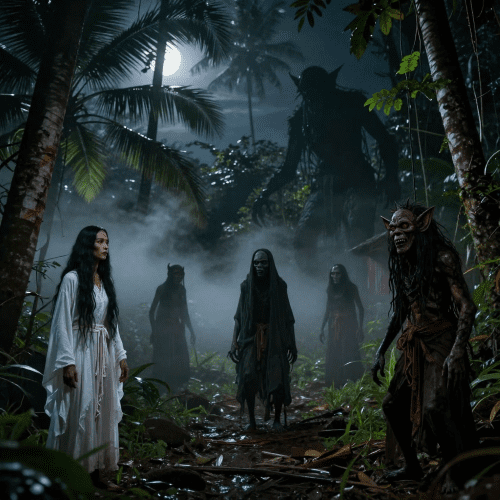
The vast rainforests of New Guinea are among the oldest and most biodiverse ecosystems on Earth. It is therefore unsurprising that they play a central role in the island’s mythology. Many traditions describe forests as inhabited by powerful spirits who exist alongside humans but remain largely unseen.
These beings may act as guardians of sacred places, protectors of animals, or enforcers of spiritual laws. Some are benevolent and helpful, while others can be dangerous if disrespected or disturbed. Hunters, travelers, and villagers often observe specific customs when entering certain areas to avoid offending the spirits believed to dwell there.
Rivers, lakes, and mountains are similarly associated with supernatural inhabitants. A river may be regarded as the domain of a powerful spirit capable of influencing fishing success or weather patterns. A mountain peak may be seen as the home of ancestral beings watching over the surrounding lands.
This spiritual understanding of the environment encourages a profound respect for nature. The forest is not simply a resource to be exploited but a living realm shared with unseen powers.
Crocodiles, Cassowaries, and Sacred Animals
Animals occupy an important place within the mythology of New Guinea, often serving as ancestors, teachers, or spiritual messengers. Many communities believe that certain animals possess special knowledge or maintain connections to the spirit world.
Among the most significant creatures is the crocodile. In several regions of Papua New Guinea, crocodiles are regarded as ancestral beings and cultural heroes. Some traditions describe humans descending from crocodilian ancestors, while others credit crocodiles with teaching important survival skills and social practices. This reverence is reflected in ceremonies and artistic traditions that continue to this day.
The cassowary, a large flightless bird native to New Guinea, also appears prominently in local mythology. Its impressive size, striking appearance, and powerful presence have inspired stories linking it to ancestral spirits and creation narratives. In some traditions, cassowaries are viewed as relatives of humans, reinforcing the close relationship between people and the natural world.
Birds-of-paradise hold a special place in the imagination of many communities. Their extraordinary plumage and elaborate displays make them natural symbols of beauty, transformation, and spiritual power. Stories often associate these birds with the heavens, ancestral realms, or the invisible world beyond ordinary human perception.
Rivers That Carry Ancient Memories
Among New Guinea’s most important mythological landscapes are its rivers. The mighty Sepik River in Papua New Guinea, one of the largest river systems in the Pacific, is particularly rich in mythology and spiritual significance.
Communities along the Sepik tell stories of ancestral beings who traveled through the waterways shaping the landscape and establishing the customs that define society. Carvings, ceremonial houses, and rituals frequently depict these ancestral narratives, preserving them for future generations.
Similar traditions can be found throughout the island. Rivers are often viewed as pathways connecting different realms of existence. They carry not only water but also memory, history, and spiritual power. Many myths describe journeys along rivers as transformative experiences that bring individuals into contact with supernatural forces.
The importance of rivers reflects their central role in daily life. They provide transportation, food, and connection between communities while simultaneously serving as sacred spaces within the mythological imagination.
A Mythological World Beyond Borders
Modern political boundaries divide New Guinea into Indonesian and Papua New Guinean territories, but mythology rarely conforms to national borders. Long before these divisions existed, communities exchanged stories, goods, and cultural practices across the island.
Many themes found in western New Guinea also appear in eastern traditions. The reverence for ancestors, the importance of sacred landscapes, and the belief in spirit-filled environments can be found throughout the island despite linguistic and cultural differences.
This shared mythological heritage reminds us that New Guinea’s cultural history extends far beyond contemporary political arrangements. The mountains and rivers that connect communities have shaped stories for thousands of years, creating a spiritual landscape that transcends borders.
Why New Guinea’s Myths Still Matter
The mythology of New Guinea offers a remarkable perspective on humanity’s relationship with the natural world. These stories emphasize connection rather than separation, reminding us that people, animals, landscapes, and spirits all belong to a larger web of existence.
In a rapidly changing world, many traditional communities face pressures from modernization, environmental challenges, and cultural transformation. Yet myths continue to serve as repositories of knowledge, preserving values, histories, and identities that might otherwise be lost.
For mythology enthusiasts, New Guinea represents one of the world’s richest and least explored mythological frontiers. Its stories reveal a universe alive with ancestral presence, sacred geography, and spiritual meaning. They remind us that mythology is not simply a collection of ancient tales but a living tradition that continues to shape how people understand themselves and the world around them.
On an island where mountains touch the clouds, rivers carve pathways through ancient forests, and hundreds of cultures preserve their own unique visions of reality, mythology remains as vibrant as the landscape itself. New Guinea stands as a testament to the enduring power of storytelling and the human desire to find meaning within the mysteries of the world.
No posts were found.