


Kalu Kumara : The Black Prince of Sri Lankan Folklore
At a glance
The Mythlok Perspective
In Mythlok’s Perspective, Kalu Kumara is fascinating because he sits at the uncomfortable boundary between desire and danger. He can be compared with the incubus of European folklore, another supernatural male figure associated with nocturnal encounters and sexual desire. Yet Kalu Kumara’s connection to fertility, childbirth, illness and Sri Lankan ritual healing gives him a distinctly local identity. While the incubus primarily represents the fear of sexual intrusion, Kalu Kumara also embodies wider anxieties surrounding reproduction and women’s vulnerability. His legend shows how different cultures can create remarkably similar supernatural figures while giving them very different cultural meanings.
Kalu Kumara
Introduction
Kalu Kumara, also known as Kalu Kumaraya, is one of the most intriguing supernatural figures in Sri Lankan folklore. His name is commonly translated as “Black Prince” or “Dark Prince,” and traditional accounts portray him as a dangerous male spirit associated with desire, illness, fertility and the affliction of women. Rather than belonging to a single fixed mythology with one canonical story, Kalu Kumara appears across Sinhala folk traditions, ritual practices and oral narratives in several different forms.
Kalu Kumara belongs to the wider world of Sri Lankan yaka or yakku traditions, a category of supernatural beings that can be associated with illness, misfortune and ritual healing. Historical ethnographic accounts describe Kalu Kumara Yakā as a young, dark-complexioned supernatural being who embraces women and is believed to interfere with conception, childbirth and the health of women after delivery. Another longstanding tradition presents him as a former holy man who lost his supernatural abilities after falling in love with a beautiful woman and subsequently became a demon.
His importance is particularly visible in Low Country ritual traditions. Kalu Kumara is associated with ceremonies concerned with fertility, childbirth and protection, including the Rata Yakuma tradition. In these rituals, the supernatural threat represented by Kalu Kumara is not simply feared; it is addressed through performance, offerings, music and ritual negotiation. This makes Kalu Kumara more than a conventional monster. His stories reveal how traditional Sri Lankan communities used supernatural narratives to explain experiences involving sexuality, fertility, illness and social expectations.
Physical Traits
ethnographic accounts describe Kalu Kumara Yakā as a young, dark-complexioned supernatural being who embraces women and is believed to interfere with conception, childbirth and the health of women after delivery. Another longstanding tradition presents him as a former holy man who lost his supernatural abilities after falling in love with a beautiful woman and subsequently became a demon.
His importance is particularly visible in Low Country ritual traditions. Kalu Kumara is associated with ceremonies concerned with fertility, childbirth and protection, including the Rata Yakuma tradition. In these rituals, the supernatural threat represented by Kalu Kumara is not simply feared; it is addressed through performance, offerings, music and ritual negotiation.
This makes Kalu Kumara more than a conventional monster. His stories reveal how traditional Sri Lankan communities used supernatural narratives to explain experiences involving sexuality, fertility, illness and social expectations.
Physical Traits
There is no single canonical physical description of Kalu Kumara. His appearance changes considerably between written folklore, ritual performances, masks and later artistic representations. One early ethnographic description portrays him as a young devil with a dark complexion who is seen embracing a woman. This representation emphasizes his role as a seductive and potentially harmful supernatural figure rather than giving him a fixed monstrous anatomy.
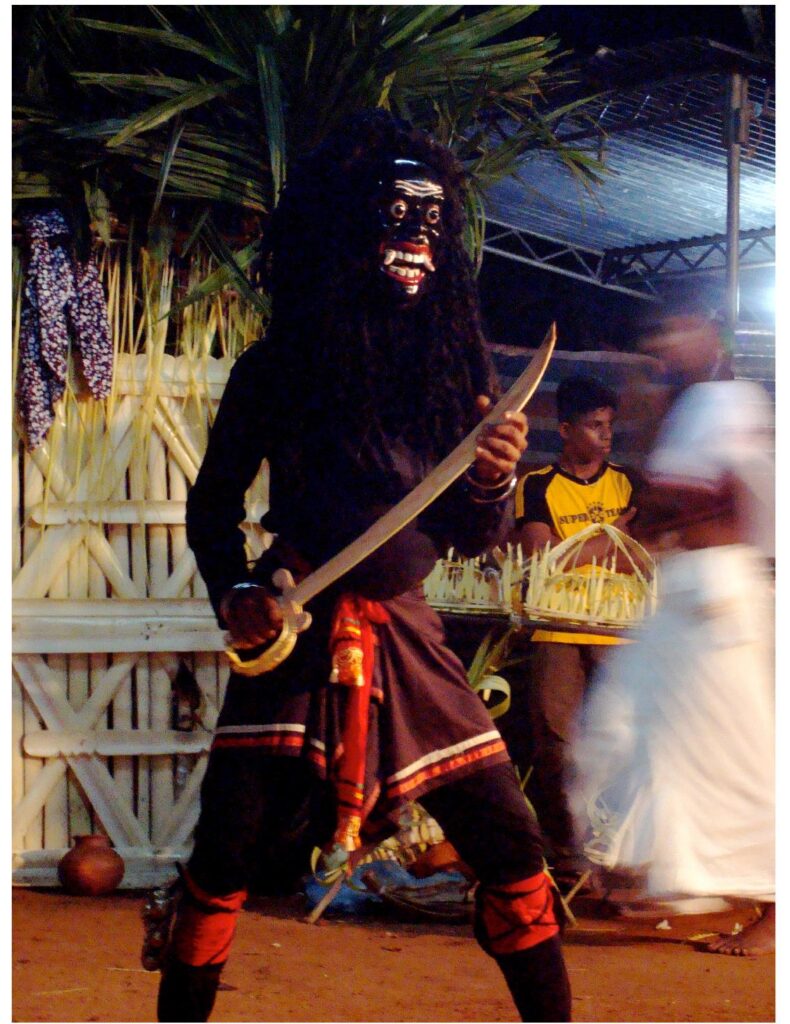
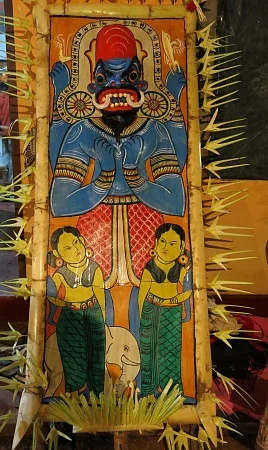
The visual tradition surrounding Kalu Kumara is particularly striking. A Kalu Kumara devil-dance mask preserved in the Smithsonian collections represents the figure with a green face, large bulging eyes, prominent fangs, a colourful crown and a large red mouth. A human head appears to emerge from the demon’s mouth, with blood depicted around it. The museum record identifies the mask as “Kula Kumara” or “The Black Prince” and notes its association with illness in women, including barrenness.
These ritual masks should not be treated as evidence of one universally accepted appearance. Sri Lankan demon traditions are highly regional, and researchers have documented considerable variation in the names, characteristics and representations of supernatural beings. Kalu Kumara can therefore be understood more reliably through his recurring symbolism: darkness, male desire, supernatural attraction and the capacity to cause harm.
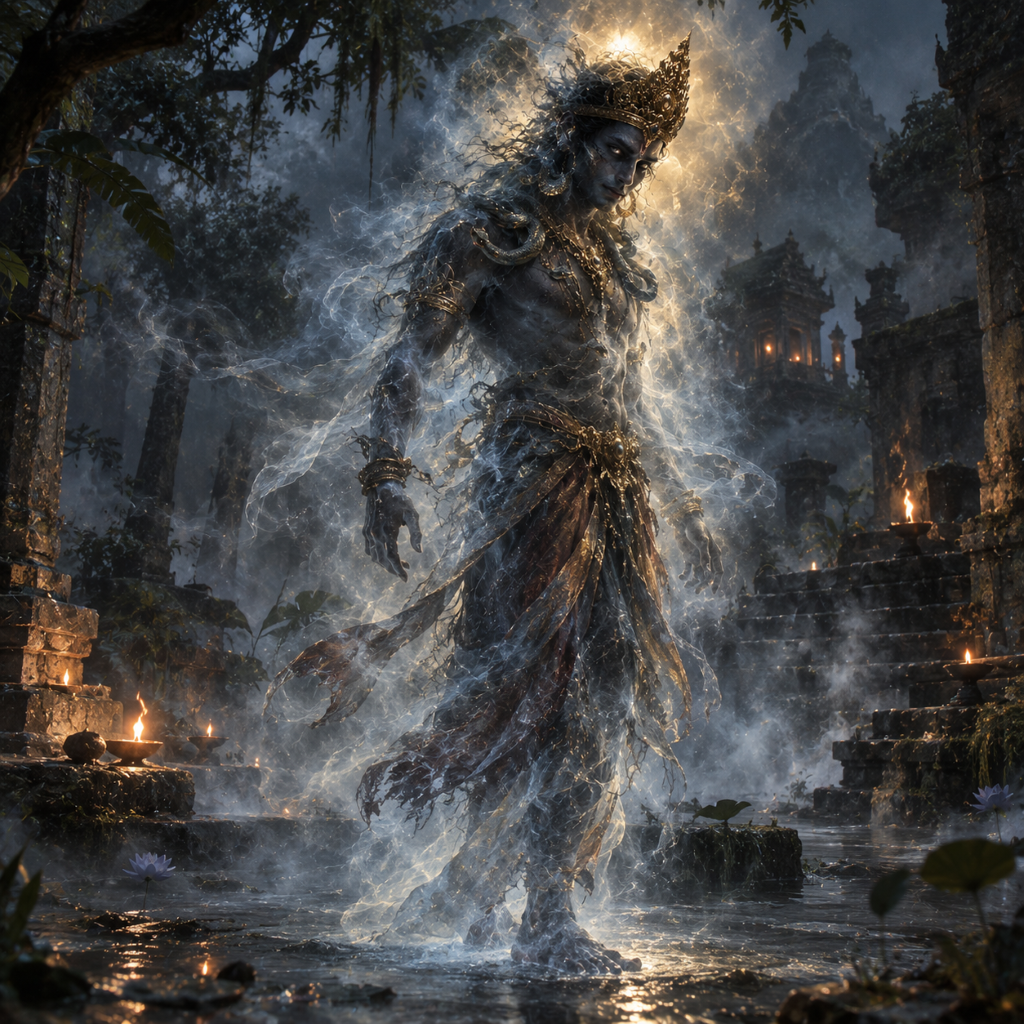
Modern descriptions sometimes portray him as exceptionally handsome, reinforcing the contrast between attraction and danger. This is particularly important to his role as an incubus-like figure. In folklore, his threat does not necessarily come from looking monstrous. Instead, his supernatural appeal is part of what makes him dangerous.
Family
Kalu Kumara does not have a universally accepted family tree. Several stories attempt to explain his origins, but these accounts should be kept separate rather than combined into one biography. One early Sinhala folklore account presents Kalu Kumara as a Buddhist arhat who possessed the supernatural ability to travel through the air. During one journey, he saw a beautiful princess and fell in love with her. According to this version, his desire caused him to lose his supernatural powers, after which he fell to his death and became the demon Kalu Kumara Yakā. His transformation explains the connection between the figure’s former spiritual status and his later identity as a dangerous spirit associated with sexual desire.
Other traditions provide different accounts of a cursed or fallen prince. Some modern retellings connect Kalu Kumara with royal intrigue and rebellion, while other narratives identify him with different legendary princes. These versions are not sufficiently consistent to establish a single historical identity.
Kalu Kumara’s ritual relationships are more clearly documented than his genealogy. In Rata Yakuma traditions, he is connected with the Riddi or Rata Yakku and with seven barren queens. The ritual focuses on fertility, safe childbirth and protection of mothers and children, placing Kalu Kumara within a larger supernatural framework rather than presenting him as an isolated demon. Historical studies of Sri Lankan ritual also record the use of a Kalu Kumara effigy and offerings during ceremonies concerned with conception and childbirth. For this reason, Kalu Kumara’s “family” is best understood as a collection of relationships within different ritual and legendary traditions rather than a fixed genealogy.
Other names
Kalu Kumara is commonly written as Kalu Kumara, Kalu Kumaraya or Kalu-Kumara. The name is generally translated into English as “Black Prince,” although “Dark Prince” is also used. The term “Kalu Kumara Yaka” identifies him specifically within the Sinhala yaka tradition, where yaka refers to a class of supernatural beings or demons in Sri Lankan folk belief. Older ethnographic writing uses the form “Kalu Kumara Yakā.”
He is sometimes described as a Sri Lankan “incubus,” but this should be understood as a comparative description rather than a traditional Sinhala name. The comparison comes from his association with nighttime encounters, sexual desire and women, particularly in stories where he appears during sleep or approaches women in vulnerable circumstances.
Kalu Kumara should also be distinguished from Kalu Yaka. Although their names are similar and both occur within Sri Lankan demon traditions, they are treated as separate figures in ritual sources. Kalu Kumara is specifically identified as the “Black Prince,” while Kalu Yaka is a different supernatural being. The distinction is important because Sri Lankan ritual traditions contain numerous yaka figures whose names and functions can overlap in modern retellings.
Kalu Kumara is also encountered in discussions of Sri Lankan devil dances and healing traditions. In descriptions of the Ata Paliya section of the Sanni Yakuma, Kalu Kumara appears alongside figures including Kalu Yaka and Vatha Kumara. This demonstrates his place within the wider ritual landscape, although he should not simply be equated with the eighteen disease demons of the Daha Ata Sanniya.
Powers and Abilities
Kalu Kumara’s principal supernatural power is his ability to afflict women through desire, dreams, supernatural encounters and what traditional belief describes as an evil or harmful gaze. Older folklore identifies him as a spirit capable of preventing conception, delaying childbirth and causing puerperal madness.
His association with fertility is particularly important. The Rata Yakuma ceremony was traditionally performed in connection with safe childbirth, protection of a child in the womb, the health of infants and helping a woman believed to be barren conceive. Kalu Kumara was among the supernatural beings addressed within this ritual context, and an effigy could be made and offerings presented to him.
Stories also give Kalu Kumara a strong connection with sexual desire. He is portrayed as a supernatural seducer who targets young women, and modern ethnographic discussions have interpreted the legend partly through the social anxieties surrounding female sexuality and adolescence. A contemporary Sri Lankan Medical Association article describes traditions in which Kalu Kumaraya appears to young women, particularly around puberty, either when they are alone in darkness or in dreams.
Some folklore sources attribute shape-shifting to Kalu Kumara, while other popular accounts give him additional supernatural abilities. These details are not consistent enough to treat as universal characteristics. What remains constant is the underlying role: Kalu Kumara represents a supernatural danger connected with attraction, sexuality, illness and fertility.
The rituals associated with him demonstrate another important aspect of his supposed power. In traditional belief, supernatural affliction could be addressed through ritual rather than physical confrontation. Exorcists, known in different contexts as yakaduras or eduras, used dance, drumming, chants, offerings and symbolic performances to negotiate with or drive away the offending spirit. Sri Lankan tovil traditions are therefore not merely stories about demons; they are ritual systems through which communities historically interpreted and responded to suffering.
Modern Day Influence
Kalu Kumara continues to survive in Sri Lankan cultural memory through ritual performance, traditional masks, folklore, scholarship and contemporary art. His presence is particularly significant because the traditions surrounding him connect supernatural belief with subjects that remain culturally sensitive: sexuality, fertility, childbirth, illness and gender.
The visual legacy of Kalu Kumara is preserved through Sri Lankan devil-dance masks. The Smithsonian collection includes a mask identified specifically as Kalu Kumara or “The Black Prince,” providing tangible evidence of his representation within Sri Lankan ritual culture.
His relationship with Low Country ritual traditions is equally important. Rata Yakuma, also known as Riddhi Yāgaya in some contexts, is a major southern Sri Lankan ritual tradition associated with fertility and childbirth. Contemporary performances continue to reinterpret its characters and stories. A 2025 production titled Riddhi-Ma drew on Riddhi Yāgaya and the mythology surrounding Kalu Kumara to explore the material through contemporary dance and theatre.
Kalu Kumara also remains part of wider discussions of Sri Lankan demonology and healing traditions. The Sanni Yakuma, one of the best-known Sri Lankan exorcistic traditions, uses masked performers to represent supernatural causes of illness. Researchers have documented substantial variation between different traditions and regional lists of demons, highlighting why figures such as Kalu Kumara should be studied within their specific ritual contexts rather than forced into a single standardized mythology.
Ultimately, Kalu Kumara represents one of the darker and more psychologically complex figures in Sri Lankan folklore. His stories transform fears surrounding desire, infertility, childbirth and social vulnerability into the image of a supernatural prince who moves between attraction and danger. Whether encountered through an ancient folklore account, a carved mask or a modern stage performance, the Black Prince remains a powerful example of how Sri Lankan traditions turn human anxieties into living myth.
Related Images
Source
Callaway, J. (Trans.). (1829). Yakun natana va: Or, The rites and ceremonies performed at the expulsion of a demon. Printed for the Oriental Translation Fund, sold by J. Murray. https://archive.org/details/yakunnatannav00call
Roar Media. (2021, October 30). A Sri Lankan horror story. https://archive.roar.media/english/life/history/sri-lankan-horror-story
Samarasinghe, S. G. (n.d.). A methodology for the collection of the Sinhala ritual. Asian Ethnology.
https://asianethnology.org/downloads/ae/pdf/a312.pdf
Sarachchandra, E. R. (1966). The folk drama of Ceylon. Department of Cultural Affairs, Ceylon.
Sheppard, M. (2023). Kalu-kumara and his demons. https://www.sheppard.me.uk/sri-lanka/demons/kalukumara.html
Subasinghe, A. (2023). When kōlam becomes: Mask, performance and the politics of representation in Sri Lanka [Doctoral thesis, Victoria University]. https://vuir.vu.edu.au/39514/
The International Institute of Knowledge Management. (2016). ICOSS 2016 conference proceedings.
https://proceedings.tiikmpublishing.com/data/conferences/doi/icoss/icoss.2016.3108.pdf
Wirz, P. (1954). Exorcism and the art of healing in Ceylon. E. J. Brill.
Frequently Asked Questions
Who is Kalu Kumara in Sri Lankan mythology?
Kalu Kumara is a supernatural yaka known as the Black Prince in Sri Lankan folklore. He is associated with women, sexual desire, fertility, illness and nighttime supernatural encounters.
What does Kalu Kumara mean?
Kalu Kumara is generally translated as “Black Prince” or “Dark Prince.” Kalu Kumaraya is another common Sinhala form of his name in Sri Lankan folklore.
Is Kalu Kumara a demon or a god?
Kalu Kumara is traditionally described as a yaka or demon rather than a god. His folklore connects him with supernatural affliction, fertility and ritual practices.
Why is Kalu Kumara associated with women?
Sri Lankan folklore portrays Kalu Kumara as a dangerous male spirit who targets women through desire, dreams or supernatural encounters and may cause illness or infertility.
What rituals are associated with Kalu Kumara?
Kalu Kumara appears in Sri Lankan ritual traditions including Rata Yakuma, which historically addressed fertility, childbirth, infant protection and supernatural affliction.


