


Doondari : The Fulani Creator Who Confronted the Mystery of Death
At a glance
| Description | |
|---|---|
| Origin | Fulani Mythology |
| Classification | Gods |
| Family Members | N/A |
| Region | Nigeria, Mali, Guinea, Senegal, and Niger |
| Associated With | Creation |
Mythlok Perspective
From the Mythlok perspective, Doondari represents creation as a continuous struggle between human limitations and forces greater than humanity. Like the Egyptian creator god Atum, who brings order to existence, Doondari establishes the foundations of life and confronts the forces that threaten its balance. However, while Atum’s creation centres on cosmic order, the Fulani narrative culminates in Gueno defeating death, making the triumph over mortality its defining philosophical statement.
Doondari
Introduction
Doondari is the primordial creator in a traditional Fulani creation narrative that explains the origins of the world, humanity, and the forces that shape human existence. The Fulani, also known as the Fula or Fulbe, are a people whose communities extend across West and Central Africa. Their oral traditions preserve stories that explore creation, human nature, mortality, and the relationship between humanity and the greater forces governing existence. In the creation narrative associated with Doondari, the universe emerges through a sequence of transformations, beginning with fundamental elements and culminating in the creation of humanity.
The story presents Doondari as a powerful creative force capable of bringing existence into being and shaping the conditions under which life unfolds. Its narrative extends beyond the physical creation of the world to examine the limitations of human beings. Blindness, sleep, worry, and death emerge in succession, each overcoming the preceding force. The story eventually introduces Gueno, identified with the eternal one, whose appearance brings the sequence to its ultimate resolution.
Unlike mythological accounts that concentrate primarily on battles between gods or the establishment of divine kingdoms, the Fulani creation narrative explores the relationship between creation, human limitations, and eternity. Doondari’s significance lies in the ability to initiate existence and establish the forces through which life acquires meaning.
Physical Traits
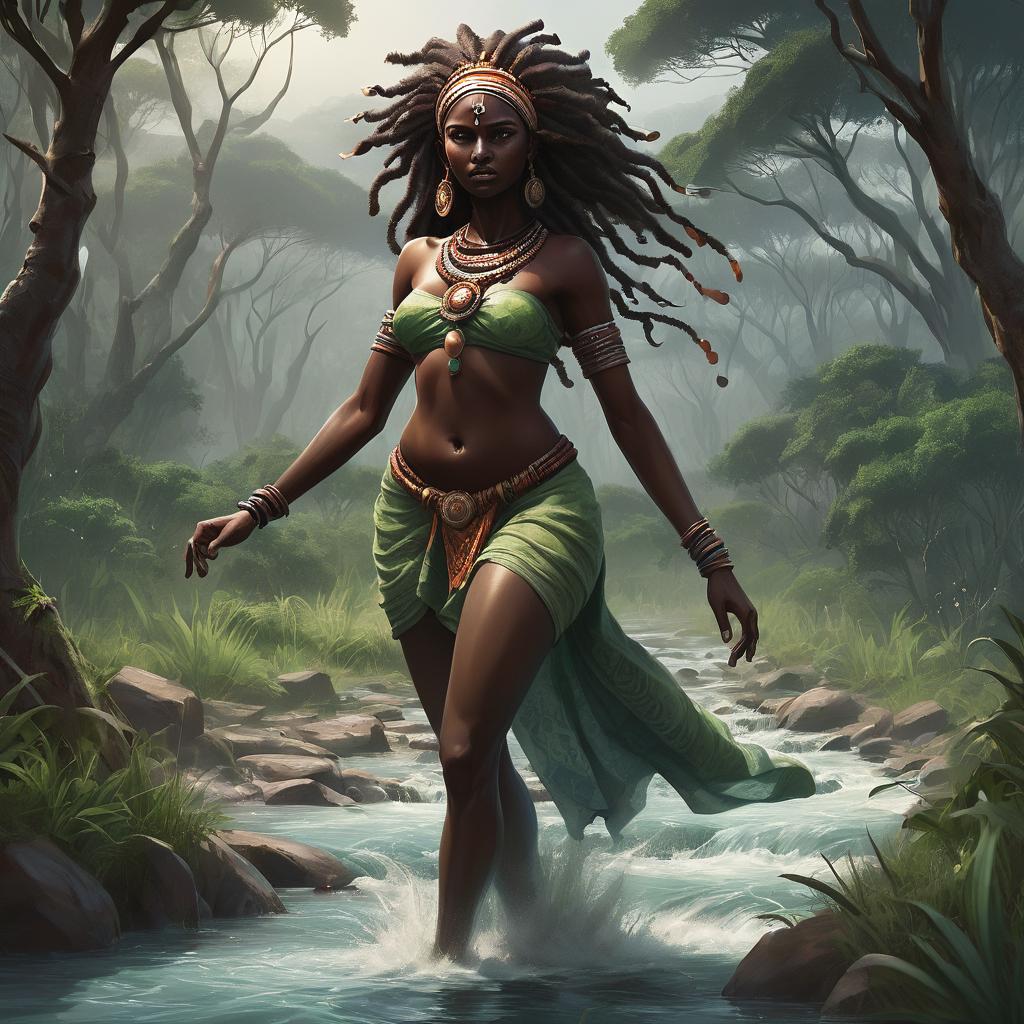
The traditional creation narrative does not provide a detailed physical description of Doondari. Its emphasis rests on the creator’s actions and the transformation of the world rather than on a particular bodily appearance. Consequently, Doondari is best understood through the character’s creative authority rather than through specific physical features, clothing, or identifying attributes.
This absence of a detailed description leaves room for artistic interpretation, although any visual representation should distinguish creative choices from documented tradition. Doondari may be portrayed as a commanding, primordial presence whose appearance communicates the power associated with the origins of existence. Such an interpretation can convey the scale of the creator’s role without suggesting that a particular appearance is prescribed by Fulani tradition.
The narrative itself offers a more reliable way to understand Doondari’s nature. The creator’s identity emerges through the successive acts that establish the world and give rise to humanity. The transformations associated with creation carry greater significance than any imagined physical characteristics.
For a culturally grounded representation, the surrounding environment could evoke the earliest stages of creation, using elemental forms and a restrained landscape to suggest the emergence of existence. This approach would communicate Doondari’s creative role without introducing unsupported symbols or attributes.
Family
Doondari’s family relationships are not established in the commonly documented creation narrative. The story focuses on the origin of the world and humanity rather than providing a genealogy of divine parents, spouses, or descendants. Doondari therefore occupies a distinct position as the creator at the beginning of the narrative’s account of existence.
The absence of a documented family structure is important when examining Doondari’s place in Fulani mythology. Unlike traditions in which divine authority is explained through elaborate genealogies, rival divine households, or inherited kingdoms, this account concentrates on the creative process itself. Doondari’s importance derives from the ability to initiate the sequence through which the world and its inhabitants come into being.
The narrative subsequently introduces Gueno, the eternal one, as Doondari’s final appearance in the sequence of creative acts. This association connects the beginning of existence with the ultimate overcoming of death. Rather than presenting a conventional family relationship, the story establishes a narrative connection between creation and eternity.
Doondari’s role is therefore best understood through the relationship between the creator, humanity, and the forces that govern existence. The available account does not establish additional divine relatives or a consort, making the creative process itself the central feature of Doondari’s mythological identity.
Other names
Gueno is the name most closely associated with Doondari in the traditional creation narrative discussed in published accounts. Gueno is identified as the eternal one and appears at the culmination of the story, following the emergence of the forces that shape human existence.
The narrative describes a sequence in which Doondari creates the world and humanity before introducing a succession of conditions that overcome one another. Blindness overcomes human pride, sleep overcomes blindness, worry overcomes sleep, and death overcomes worry. Gueno subsequently appears and defeats death, bringing the narrative to its decisive conclusion.
The relationship between Doondari and Gueno is therefore central to understanding the story. Doondari represents the creative beginning, while Gueno’s appearance establishes the ultimate triumph over the force that appears to place a limit on existence. The connection between the names should be understood within this narrative context rather than treated as evidence that every Fulani community uses them interchangeably.
The meaning attributed to Gueno as the eternal one reinforces the narrative’s movement from the creation of the world towards the question of what lies beyond mortality. This association makes the name particularly significant when interpreting the story’s understanding of creation and the enduring power of the creator.
Powers and Abilities
Doondari’s principal power is the ability to create the world and establish the conditions from which life emerges. In the traditional narrative, creation unfolds through a sequence of transformations rather than through a single, instantaneous act. This process establishes the elemental foundations of existence and demonstrates the creator’s authority over the formation of the world.
The story begins with a stone, from which iron emerges. Fire follows iron, water follows fire, and air follows water. These five elements form the basis for the subsequent creation of humanity. The sequence presents the world as an ordered progression in which one fundamental substance gives rise to another, ultimately providing the materials from which human beings are formed.
Doondari’s creative power extends beyond producing physical existence. The narrative also explores the forces that influence human behaviour and determine the limits of human experience. When human pride becomes a problem, blindness emerges to overcome it. Sleep subsequently overcomes blindness, followed by worry, which overcomes sleep. Death then overcomes worry, establishing mortality as a powerful force within the created world.
This progression gives the story a philosophical dimension. Each force changes the conditions established by the preceding one, demonstrating that no single condition dominates human existence indefinitely. The sequence also introduces a relationship between human limitations and the broader order established through creation.
The narrative reaches its conclusion with Gueno, the eternal one, who defeats death. This final act establishes a distinction between the forces that govern ordinary human experience and the enduring power associated with the creator. The story’s treatment of death is particularly important because mortality appears to be the final force in the sequence before Gueno brings about its defeat.
Together, these abilities establish Doondari as a creator whose authority encompasses the origins of the world, the formation of humanity, and the conditions that shape human existence. The narrative’s central emphasis is not on a catalogue of supernatural powers but on the relationship between creation, transformation, limitation, and eternity.
Modern Day Influence
Doondari remains an important subject for understanding the traditional oral literature of the Fulani people. The creation narrative preserves a distinctive account of how the world emerged, how humanity came into being, and how the forces governing human life interact. Its continued availability through published collections allows readers to examine these ideas within the wider context of African oral traditions.
The narrative also provides material for comparative studies of creation stories across cultures. Like other traditions that explain the emergence of the universe through successive stages, the Fulani account presents creation as a process in which fundamental substances establish the conditions for life. Its distinctive sequence of blindness, sleep, worry, and death adds a further dimension by exploring how human limitations emerge and how each condition is overcome by another.
The appearance of Gueno at the conclusion also makes the narrative significant for comparative discussions of eternity and mortality. Creation stories from different cultures often address the relationship between life and death, but they do so through different narrative structures and cultural concepts. The Fulani account connects these themes directly to the original creative process, bringing the story to a conclusion in which death itself is overcome.
The historical and cultural significance of Doondari is also connected to the preservation of Fulani oral heritage. Oral narratives transmit ideas about the origins of existence and humanity across generations, providing material through which researchers and readers can explore the intellectual traditions of African societies. Published versions of the Doondari narrative help make this tradition accessible beyond the communities in which such stories have circulated.
Contemporary interpretations can draw on the story’s themes of creation, human limitations, and eternity in literature, education, and cultural discussion. Such interpretations are most meaningful when they distinguish the traditional narrative from modern artistic adaptations and avoid assuming that the existence of a preserved story necessarily indicates continued religious worship.
Doondari’s significance therefore extends beyond the question of how the world began. The narrative offers a framework for considering the origins of life, the forces that shape human experience, and the relationship between mortality and the eternal. Through its preservation and study, the story continues to provide insight into the richness and diversity of Fulani oral tradition.
Doondari stands as a compelling creator figure whose story connects the emergence of the universe with the fundamental questions of human existence. From the formation of the elements to the creation of humanity and the final appearance of Gueno, the narrative presents creation as a sequence of transformations governed by a power that ultimately transcends death.
Related Images


Sources
African Poems. (n.d.). Creation: The Fulani creation myth from northern Nigeria. https://africanpoems.net/gods-ancestors/creation/
Beier, U. (Ed.). (1966). Black Orpheus (No. 19). Mbari Publications.
Encyclopedia.com. (n.d.). Creation stories and foundation myths. https://www.encyclopedia.com/religion/encyclopedias-almanacs-transcripts-and-maps/creation-stories-and-foundation-myths
Eguchi, P. K. (1993). ‘Fulbe-ness’ in Fulbe oral literature of Cameroon. Senri Ethnological Studies, 35, 181–200. https://www.africabib.org/rec.php?RID=110130944
Kane, M., & Robinson, D. (1984). The Islamic regime of Fuuta Tooro: An anthology of oral tradition. African Studies Center, Michigan State University. https://ci.nii.ac.jp/ncid/BA54196737
Scheub, H. (2000). A dictionary of African mythology: The mythmaker as storyteller. Oxford University Press. https://global.oup.com/academic/
VerEecke, C. (1985). Towards an ethnohistory of the Adamawa Fulbe in the 19th century. Annals of Borno, 2, 163–179. https://www.africabib.org/rec.php?DB=p&RID=119526581
Encyclopedia.com. (n.d.). African creation stories. https://www.encyclopedia.com/religion/encyclopedias-almanacs-transcripts-and-maps/creation-stories-and-foundation-myths
Frequently Asked Questions
Who is Doondari in Fulani mythology?
Doondari is the creator figure in a Fulani creation narrative. Doondari creates the elements and shapes humanity from them, beginning a story that explores pride, human limitations and death.
How did Doondari create humanity?
In the Fulani creation story, Doondari creates stone, iron, fire, water and air in succession. Doondari then uses these five elements to shape the first human being.
What are Doondari’s powers and abilities?
Doondari’s powers include creating the elements and shaping humanity. In the narrative, Doondari also returns as Gueno, the eternal one, who overcomes death.
Is Doondari the same as Gueno?
In the recorded Fulani creation narrative, Doondari descends a third time as Gueno, described as the eternal one. Gueno defeats death, completing the story’s progression beyond human limitations.
What does the Doondari creation story teach?
The Doondari narrative explores pride and the limits of human existence. Blindness, sleep, worry and death successively overcome one another before Gueno, the eternal one, defeats death.


