


Dokanikani : The Cannibal Ogre of Trobriand Folklore
At a glance
| Description | |
|---|---|
| Origin | Trobriand Islanders Mythology |
| Classification | Hybrids |
| Family Members | N/A |
| Region | Papua New Guinea |
| Associated With | Cannibalism, Human predation, Giant strength, Danger |
The Mythlok Perspective
In Mythlok’s Perspective, Dokanikani can be compared with Polyphemus from Greek mythology, as both are giant man-eating figures who embody a threat to human communities and are ultimately overcome through cunning rather than superior physical strength. The difference is in their narrative roles: Polyphemus is one individual encountered by Odysseus, while Dokanikani’s threat extends across Trobriand communities, making his defeat a story about the restoration of an entire social world.
Dokanikani
Introduction
Dokanikani is a giant man-eating ogre in the traditional narratives of the Trobriand Islanders of Papua New Guinea. His story is most closely associated with Tudava, a heroic figure who eventually kills the cannibal and enables people who had fled the monster to return to the Trobriand Islands. The story is particularly associated with Kiriwina and forms part of a broader body of Trobriand oral literature known as kukwanebu, or traditional tales.
Dokanikani appears under several spellings, including Dokonikani, Dokinikani and Dokhonikani. These forms occur in different ethnographic, linguistic and folklore records and should not automatically be interpreted as different beings. Gunter Senft, for example, includes Dokonikani narratives in his study of tales told by both Trobriand children and adults, while Bernard Baldwin devoted an extensive manuscript to Dokinikani and Trobriand cannibal tales.
The best-known version presents Dokanikani as a threat so severe that people abandon their settlements. In one recorded tradition, he begins eating humans after killing and consuming his niece. His sister leaves him and takes refuge in a cave, while another version describes the survivors fleeing by canoe. Tudava eventually grows up, receives magical knowledge from his mother, finds Dokanikani and kills him. The story is therefore more than a simple monster tale. Dokanikani stands at the centre of a narrative about danger, survival, kinship, heroism and the restoration of community.
Physical Traits
Dokanikani is consistently described as a giant man-eater or cannibal ogre, making enormous size and physical danger his most reliable physical characteristics. A Trobriand folklore index identifies Dokinikani, or Dokhonikani, as a giant ogre associated with cannibal tales. A Cambridge Museum record similarly describes him as the giant man-eater defeated by Tudava.
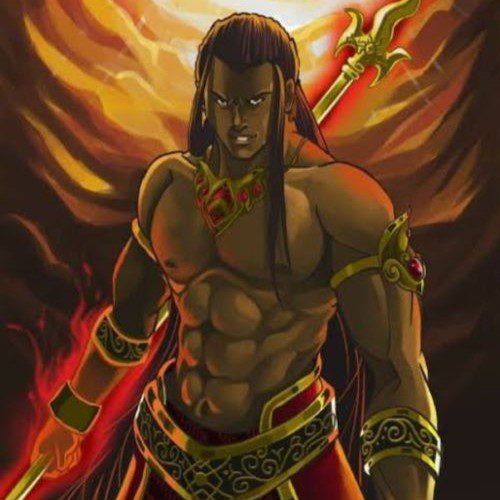
Beyond his size, however, the traditional sources do not provide one universally accepted physical portrait. His face, skin, clothing, hair and exact body proportions are not consistently documented. This is important when depicting Dokanikani because later illustrations can easily introduce visual characteristics that belong to modern monster imagery rather than to the Trobriand tradition.
Some narratives give him an especially frightening physical presence through his behaviour rather than through anatomy. In the oral material collected by Jerry Leach, for example, Dokanikani is depicted as becoming physically weakened after consuming so much food, creating an opportunity for Tudava to outwit him. The story develops through movement, deception and physical confrontation rather than through a catalogue of supernatural features.
The surviving traditions also connect Dokanikani with particular places in the Trobriand landscape. Archaeological research documenting numerous versions of the legend records caves, beaches and settlements associated with events in the story. In this sense, Dokanikani is not simply an imaginary creature existing outside geography; his narrative is tied to remembered places across Kiriwina and the surrounding Massim region.
Family
Dokanikani does not have a clearly established genealogy in the surviving sources. His family relationships are therefore best understood through individual versions of the story rather than through a fixed mythological family tree. One detailed Trobriand account recorded by the Cambridge Museum describes Dokanikani living with his unnamed sister outside a village. The two eventually move into the village after being invited by its inhabitants. Dokanikani later kills his sister’s daughter, his niece, and eats her flesh. The experience turns him toward cannibalism, after which he begins preying on other people. His sister becomes horrified by what he has done and leaves him, taking refuge in a cave.
The same narrative introduces Bolitukwa, also identified as Mitigisi in other versions, who shelters in the cave. She eventually becomes the mother of Tudava. The circumstances of Tudava’s birth vary between traditions, with the Cambridge account describing water dripping from a stalactite as the cause of her pregnancy. Tudava subsequently receives magical knowledge and becomes the hero who confronts Dokanikani.
Because Trobriand oral traditions exist in multiple versions, these relationships should not be treated as a single canonical genealogy. What remains consistent is the narrative opposition between Dokanikani and Tudava, with Tudava emerging as the figure who ultimately removes the cannibal threat.
Other names
Dokanikani is known by several recorded forms. These include Dokonikani, Dokinikani and Dokhonikani, with spelling varying between ethnographic publications, linguistic records and English-language transcriptions. Baldwin’s extensive work uses the form Dokinikani, while Senft uses Dokonikani in his study of Trobriand narratives.
The variation is partly a consequence of recording an oral tradition through different researchers, languages and transcription systems. The names should therefore be treated as variants belonging to the same narrative tradition rather than automatically as separate monsters. Baldwin’s work is particularly significant because his manuscript, Dokinikani: Cannibal Tales of the Wild Western Pacific, contains extensive material on Trobriand cannibal narratives. The manuscript is listed in bibliographic records as a substantial unpublished work dating to 1971.
The word “cannibal” is also important in interpreting the character. Dokanikani is not simply a generic giant from a European-style fairy tale. Trobriand narratives use the figure within a cultural storytelling tradition that connects monsters, morality, social behaviour and threats to community life. Contemporary analysis of children’s Dokonikani stories likewise describes the ogres as beings treated as fundamentally non-human, despite their resemblance to people.
Powers and Abilities
Dokanikani’s defining characteristic is his ability to hunt and consume human beings. Cannibalism is not merely one feature of his character; it is the central threat around which the stories are constructed. His enormous physical strength and size make him difficult for ordinary people to confront. In several versions, communities cannot simply defeat him and instead flee the area. Archaeological research documenting multiple versions of the story records traditions in which Dokanikani consumes people across several settlements, leaving only a small number of survivors.
The stories also portray Dokanikani as vulnerable to cleverness. Tudava does not defeat him simply through superior strength. In one Leach recording, Tudava uses deception and carefully manipulates Dokanikani’s movements before eventually overcoming him. Another recorded version explains that Tudava could interpret signs from plants and birds and use magical knowledge to locate the giant and lead him into a disadvantageous position.
This makes intelligence and strategy important parts of the hero’s victory. Dokanikani represents overwhelming physical danger, while Tudava’s response combines knowledge, magic and cunning. His defeat also has a broader social meaning within the story. Once Dokanikani is killed, the people who had escaped can return. The monster’s destruction therefore marks the restoration of human settlement and community life. The narrative is consequently less about supernatural spectacle than about the removal of a threat that has disrupted an entire social world.
Modern Day Influence
Dokanikani remains an important subject in the documentation and study of Trobriand oral tradition. His stories have been recorded by researchers, missionaries, linguists and anthropologists, providing material for the study of Trobriand language, storytelling, cultural knowledge and social organisation. Gunter Senft’s Tales from the Trobriand Islands of Papua New Guinea includes both children’s and adults’ Dokonikani narratives. His research examines how such stories reveal narrative skills and cultural knowledge, demonstrating that Dokanikani belongs to a continuing storytelling tradition rather than existing only in early twentieth-century ethnographic accounts.
The story also survives through local cultural and material representations. A Cambridge Museum collection includes contemporary carvings depicting Tudava and his mother, explicitly identifying Tudava as the hero who killed the giant man-eater Dokanikani. The museum record notes that different versions of the foundation myth exist in different parts of the Massim while the name Dokanikani remains consistent in the version recorded there.
Modern archaeological work has further shown how closely the narrative is connected with landscape. Researchers encountered numerous versions of the Dokanikani and Tudava story while working in northern Kiriwina and were able to identify locations associated with episodes from the legend. Dokanikani therefore survives primarily through oral literature, cultural memory, ethnographic documentation and contemporary interpretation. There is not strong evidence for claiming a major modern film, television adaptation or commercial entertainment franchise centred specifically on Dokanikani, so such associations should not be presented as established facts.
Related Images

Source
Baldwin, B. (1971). Dokinikani: Cannibal tales of the Wild Western Pacific. Author.
https://trobriandsindepth.com/PDFs/Baldwin%20Dokinikani%20Final.pdf
Leach, E. R. (Ed.). (1981). Trobriand folklore index. London School of Economics. https://trobriandsindepth.com/PDFs/leach_folktales.pdf
Malinowski, B. (1922). Argonauts of the Western Pacific. George Routledge & Sons. https://archive.org/details/argonautsofthewe00mali
Malinowski, B. (1926). Myth in primitive psychology. W. W. Norton. https://archive.org/details/mythinprimitivep00mali
Mosko, M. S. (2014). Malinowski’s magical puzzles: Toward a new theory of magic and procreation in Trobriand society. HAU: Journal of Ethnographic Theory, 4(1). https://doi.org/10.14318/hau4.1.001
Senft, G. (2015). Tales from the Trobriand Islands of Papua New Guinea: Psycholinguistic and anthropological linguistic analyses of tales told by Trobriand children and adults. John Benjamins. https://doi.org/10.1075/clu.16
Senft, G. (2010). The Trobriand Islanders’ ways of speaking. De Gruyter Mouton. https://doi.org/10.1515/9783110227994
Trobriand Islands DEP. (2011). Trobriand myths and tales. https://trobriandsindepth.com/myths.html
Frequently Asked Questions
Who is Dokanikani in Trobriand mythology?
Dokanikani is a giant man-eating ogre in Trobriand oral tradition. He becomes a major threat to communities before the hero Tudava eventually defeats and kills him.
What is Dokanikani known for?
Dokanikani is best known for cannibalism and his enormous physical presence. Traditional narratives portray him as a dangerous ogre whose actions force communities to flee.
Who defeated Dokanikani?
Tudava defeats Dokanikani in the best-known Trobriand narratives. He uses knowledge, strategy and, in some versions, magic to locate and overcome the giant man-eater.
Is Dokanikani a god or a demon?
Are Dokanikani and Dokonikani the same figure?
Yes, the names Dokanikani, Dokonikani, Dokinikani and Dokhonikani occur as variant forms in different Trobriand records and generally refer to the same cannibal figure.


