

Daucina : The Fijian God Who Carried Fire Across the Sea
At a glance
| Description | |
|---|---|
| Origin | Fijian Mythology |
| Classification | Gods |
| Family Members | N/A |
| Region | Fiji |
| Associated With | Light, Fire, Seafaring, Fishing, Trickster, Seduction |
The Mythlok Perspective
In Mythlok’s Perspective, Daucina embodies the duality of light, capable of guiding travellers while concealing danger and deception. His character shares similarities with Loki from Norse mythology, whose trickster nature also blurs the boundaries between assistance and mischief. However, while Loki’s stories explore disruption across the divine world, Daucina’s associations with luminous waters and seafaring root his character in Fiji’s maritime traditions. Both demonstrate how supernatural figures can embody contradictory aspects of human experience.
Daucina
Introduction
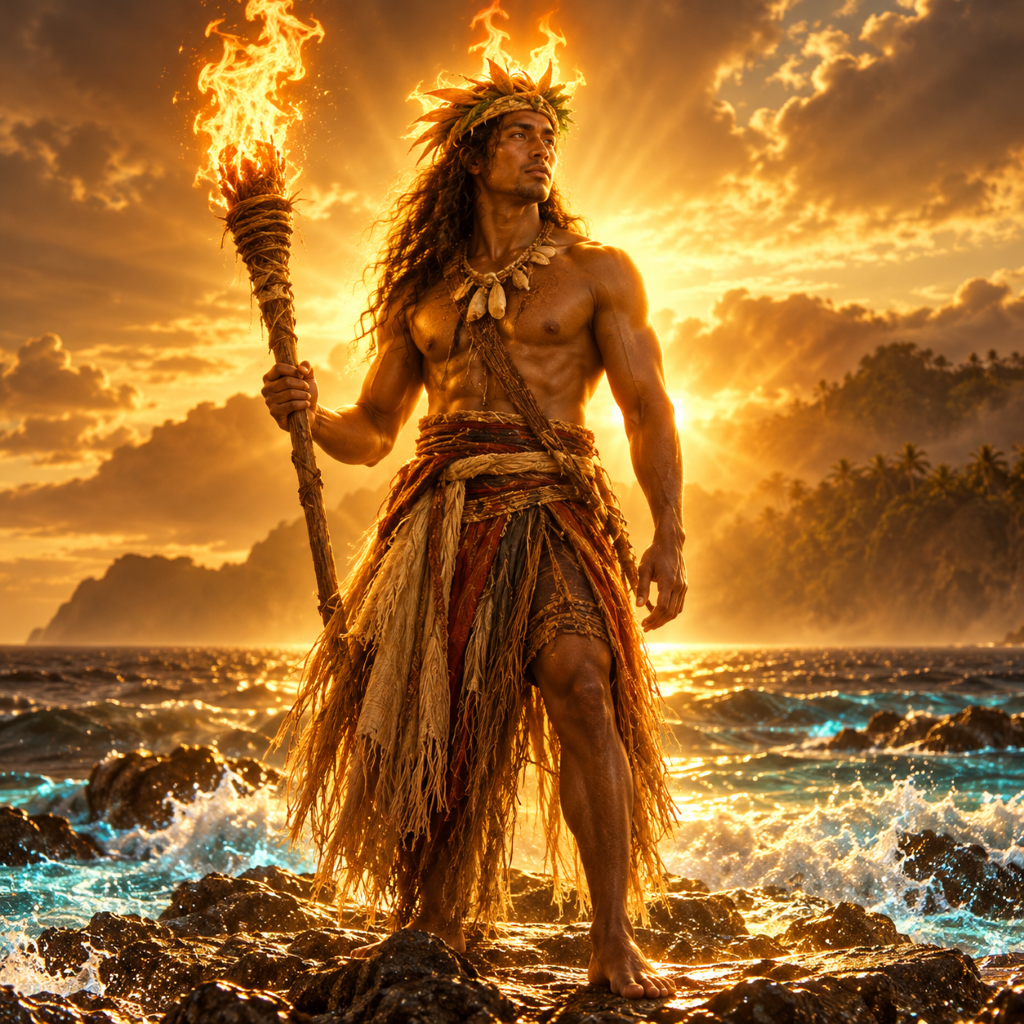
Daucina is a deity associated with light, fire, and seafaring in traditional Fijian religion. Also known as Ndauthina in historical accounts, he is remembered as a torch-bearing figure whose supernatural presence connects the mysteries of the ocean with the spiritual beliefs of Fiji’s Indigenous communities. His mythology combines maritime associations with a more mischievous character, making him a distinctive figure in the islands’ traditional stories.
The name Daucina is commonly translated as “Torchbearer” or “Expert Light”, although these translations appear in different regional and historical contexts. In Levuka and Kadavu, the name is associated with the phosphorescent glow attributed to his passage through the sea. Historical accounts also identify Ndauthina as a deity of fishing and seafaring communities, linking his worship to the maritime life of the Fijian islands.
The ocean occupies a central place in Indigenous Fijian culture. It has historically provided food, connected distant communities, and shaped navigation, social relationships, and spiritual traditions. Within this setting, Daucina represents a supernatural presence associated with the sea’s luminous mysteries.
Unlike deities whose identities centre primarily on creation or political authority, Daucina’s traditional character combines light, maritime associations, and human temptation. His stories also illustrate why Fijian mythology should be understood through regional oral traditions rather than treated as a single, unchanging system of beliefs.
Physical Traits
Daucina does not have one universally established physical appearance across the surviving accounts. His identity is expressed primarily through the imagery of fire, illumination, and his presence around the sea at night.
One traditional account describes Daucina as a child who could be soothed by the sight of a lamp. His mother reportedly attached burning reeds to his head to keep him calm. As the story continues, this unusual childhood association becomes a defining feature of his supernatural identity. He is subsequently described as travelling around coral reefs at night with his head covered and a flaming brazier illuminating his surroundings. This imagery connects the deity’s origins with the torch-bearing symbolism that characterises his name.
Another important feature of Daucina’s mythology is the luminous appearance associated with his movement through the ocean. In accounts from Levuka and Kadavu, his presence is connected with phosphorescence in the water. The resulting glow gives the deity a distinctive relationship with the marine environment, where light becomes an expression of supernatural presence rather than merely a practical source of illumination.
Some retellings also describe Daucina appearing as a bright light or taking human form. These manifestations reinforce his association with concealment and deception. However, descriptions of his appearance should be treated as elements of particular narratives rather than a definitive visual canon. The available historical accounts do not establish a consistent set of facial features, clothing, body proportions, or other physical characteristics.
Family
The surviving accounts considered here do not establish a complete genealogy for Daucina. His mother appears in the traditional story about his childhood fascination with light, but her name and wider family relationships are not consistently documented.
The absence of a detailed genealogy is important when placing Daucina within the wider Fijian pantheon. Traditional Fijian religious beliefs include ancestral deities, regional spiritual figures, and supernatural beings associated with particular communities. Their relationships can vary according to local traditions and historical interpretations.
Daucina is sometimes discussed alongside Degei, the serpent deity associated with creation in several Fijian traditions, and Dakuwaqa, the powerful shark deity associated with the sea. However, these associations do not establish that Degei was Daucina’s father or that Dakuwaqa was his sibling. Such relationships should not be presented as established facts without a specific traditional account supporting them.
Regional differences are particularly significant. One historical account identifies Daucina with a form of Dakuwaqa worshipped in Levuka and Kadavu, where the name refers to the luminous effects attributed to the deity’s passage through the sea. Other accounts distinguish Daucina’s identity as a kalou yalo, a spirit associated with the dead or deified ancestors, in other parts of Fiji. Consequently, Daucina’s place in Fijian religious tradition is better understood through his regional associations and attributed characteristics than through an assumed family tree.
Other names
Daucina is known through several names and historical variations that reflect the diversity of Fijian religious traditions and the ways these traditions have been recorded. Ndauthina is an important alternative name found in historical literature. In his account of Fijian religious beliefs, Basil Thomson describes Ndauthina as the torch-bearing deity associated with fishing and seafaring communities. His description connects the figure with fire, light, and supernatural activity after dark. This historical material provides a useful foundation for understanding the deity’s traditional associations.
Torchbearer is the most familiar English rendering associated with Daucina. It captures the imagery of fire and illumination that appears in accounts of his character. Expert Light is another translation associated with the name in Levuka and Kadavu. In these regional accounts, the designation refers to the phosphorescence attributed to his movement through the ocean. The expression therefore emphasises the deity’s luminous nature and his connection with the sea.
Other names, including Kanakana-da and Saroni, have appeared in secondary descriptions of regional Fijian traditions. However, their precise relationship to Daucina requires further verification from primary ethnographic or oral sources. These variations demonstrate why names in Indigenous mythology should be examined in their cultural and geographical contexts. They may reflect local identities, translations, historical spellings, or different interpretations rather than interchangeable names used throughout Fiji.
Powers and Abilities
Daucina’s attributed powers revolve around light, fire, maritime associations, and the ability to influence human behaviour. His mythology combines these characteristics rather than presenting him solely as a protective sea deity. His connection with light and fire is central to his identity. The story of the burning reeds attached to his head establishes an association between the deity and visible flames, while the image of a torch-bearing figure travelling at night reinforces this symbolism. Fire becomes an identifying feature of his supernatural presence.
His relationship with the ocean and seafaring is equally significant. Historical accounts describe Ndauthina as a deity associated with fishing and maritime communities. Regional traditions connect Daucina with phosphorescence in the sea, giving him a distinctive place in stories about the ocean’s mysterious appearances. A modern account published by The Fiji Times also describes Daucina as the ancient patron of seafaring who guided lost sailors with a bright light. This guiding role is documented in contemporary cultural writing, although it should not automatically be attributed to every historical version of the tradition.
Daucina also possesses a trickster-like and sexually transgressive character in historical descriptions. These accounts portray him as a seducer and a patron of adulterers. He is said to approach women in human form, sometimes appearing as a familiar man. This ability to deceive connects his luminous identity with the more dangerous aspects of his mythology. The contrast is striking. Light can suggest guidance and revelation, but it can also conceal intentions and lure people into unfamiliar situations. Daucina’s stories therefore resist a simple division between benevolent protector and malicious spirit.
Modern Day Influence
Daucina continues to appear in modern writing about Fijian mythology, Indigenous knowledge, and the spiritual significance of the Pacific Ocean. Although the available evidence does not establish the extent of contemporary worship dedicated specifically to him, his name and stories remain part of the wider discussion of Fiji’s traditional religious heritage.
In March 2025, The Fiji Times published an article about Indigenous knowledge and the relationship between mythology, environmental understanding, and maritime traditions. It identified Daucina as the ancient patron of seafaring and presented his story within a broader account of how traditional narratives expressed the importance of the ocean to Indigenous Fijian communities.
This perspective offers a useful way to understand his continuing cultural relevance. Traditional accounts of supernatural beings were not necessarily isolated tales about extraordinary characters. They existed within broader systems of knowledge through which communities understood their environment, relationships, responsibilities, and place in the world.
Daucina’s association with light also makes him a memorable figure in contemporary retellings of Pacific mythology. His imagery provides a distinctive way to explore the relationship between natural phenomena and spiritual interpretation without reducing the original stories to simple explanations of physical events. At the same time, modern representations should distinguish documented traditions from imaginative adaptations. Claims about his worship, regional identity, appearance, and powers should be supported by reliable historical or cultural sources wherever possible.
Related Images

Source
Becker, A. E. (1995). Body, self, and society: The view from Fiji. University of Pennsylvania Press.
https://dokumen.pub/body-self-and-society-the-view-from-fiji-9780812290240.html
Books LLC. (2010). Fijian mythology: Daucina, Cibaciba and Drakulu, Dakuwaqa, Nabangatai, Burotu. Books LLC. https://www.abebooks.com/9781157095804/Fijian-Mythology-Daucina-Cibaciba-Drakulu-1157095801/plp
Gatty, R. (2009). Fijian–English dictionary: With notes on Fijian culture and natural history. R. Gatty.
https://dokumen.pub/fijian-english-dictionary-with-notes-on-fijian-culture-and-natural-history-9789829804716.html
7SEASjewelryBoutique. (2026, January 20). Daucina silver bead with clear cubic zirconia crystals, Tales of the [Product listing]. Etsy. https://www.etsy.com/nz/listing/710053765/daucina-silver-bead-with-clear-cubic
Fiji Travel. (2025, March 3). Firewalking in Fiji: The ancient tradition explained. Fiji Travel.
https://www.fijitravel.org/posts/firewalking-in-fiji/
Fiji Times. (2025, March 2). Heritage | Rediscovering indigenous science. The Fiji Times. https://www.fijitimes.com.fj/heritage-rediscovering-indigenous-science/
Wikipedia contributors. (2002, September 30). Daucina. In Wikipedia. https://en.wikipedia.org/wiki/Daucina
Frequently Asked Questions
Who is Daucina in Fijian mythology?
Daucina is a deity associated with light, fire, and seafaring in Fijian mythology, known for his torch-bearing imagery and connections with the ocean.
What does the name Daucina mean?
Daucina is commonly translated as Torchbearer or Expert Light, with the latter description associated with regional traditions in Fiji.
Is Daucina the same as Ndauthina?
Daucina and Ndauthina are names associated with the torch-bearing deity in Fijian mythology, although historical and regional accounts vary.
What powers does Daucina have?
Daucina is associated with light, fire, marine phosphorescence, and deception. Some traditions also connect him with guiding seafarers.
Is Daucina related to Dakuwaqa?
Some regional accounts identify Daucina with a form of Dakuwaqa, but their relationship varies across Fijian traditions and is not universally established.
