

Jangsan Beom : The Terrifying Cryptid of South Korea’s Mountains
| Description | |
|---|---|
| Origin | South Korea |
| Classification | Cryptid |
| Demeanour | Hostile |
| Habitat | Mountains, Forests, Remote Hiking Trails |
| Status | Not Proven |
Mythlok Perspective
In Mythlok’s Perspective, the Jangsan Beom represents a modern evolution of one of mythology’s oldest fears: the deceptive voice that leads people away from safety. Across cultures, legends frequently warn of entities that imitate loved ones, cries for help, or familiar sounds to lure victims into danger. The Jangsan Beom adapts this timeless motif to the forests and mountains of modern South Korea, replacing ancient spirits with a cryptid-like predator born from contemporary folklore. The creature also reflects the enduring role of wilderness in human storytelling. Like the Wendigo of Algonquian traditions or the many mountain spirits found throughout East Asian folklore, the Jangsan Beom embodies the fear that nature conceals forces beyond human understanding. Its ability to mimic human voices adds a uniquely psychological dimension, turning trust itself into a vulnerability. This combination of ancient folkloric themes and modern urban legend storytelling helps explain why the Jangsan Beom has become one of South Korea’s most recognizable contemporary monsters.
Jangsan Beom
Introduction
The Jangsan Beom is one of the most famous modern cryptids to emerge from South Korea. Unlike creatures rooted in centuries-old mythology, the Jangsan Beom is largely a product of contemporary folklore, gaining popularity through internet communities, horror stories, webtoons, and films. The creature is closely associated with Jangsan Mountain in Busan, from which it takes its name. The word beom (범) traditionally refers to a tiger, leading many people to translate the creature’s name as the “Jangsan Tiger.”
What makes the Jangsan Beom particularly unsettling is its ability to imitate human voices. According to numerous stories, it uses cries for help, the voices of loved ones, or the sounds of children to lure unsuspecting victims deeper into isolated mountain areas. This combination of predatory behavior and psychological manipulation has made it one of Korea’s most chilling urban legends. Although there is no scientific evidence supporting its existence, the Jangsan Beom continues to thrive in popular culture and remains one of the best-known examples of modern Korean digital folklore.
Physical Attributes
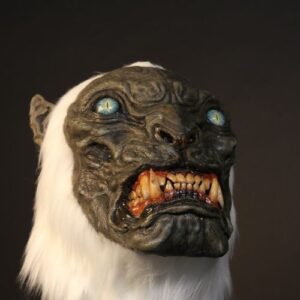
Descriptions of the Jangsan Beom vary, but certain characteristics appear consistently across most accounts. Witnesses typically describe it as a large quadrupedal creature covered in long, white fur that gives it a ghostly appearance, especially when seen through mountain fog or dense forest vegetation.
The creature is often said to be slightly larger than an adult human when standing on all fours. One of its most unusual features is its disproportionate body structure. Reports frequently describe longer forelimbs and shorter hind limbs, allowing it to move with surprising speed and agility across steep mountain terrain. This unusual anatomy contributes to its unsettling appearance and distinguishes it from ordinary animals.
Its face is rarely described in detail, partly because the long fur often obscures its features. Some witnesses claim it possesses a vaguely human-like face hidden beneath the white hair, while others describe it as resembling a large feline. Sharp claws and predatory teeth are also common elements of the legend, reinforcing its reputation as a dangerous hunter. The creature’s eerie appearance has become a defining part of its identity, helping it stand out among modern cryptids and urban legends.
First Sighting/Reporting
The Jangsan Beom differs from many traditional folkloric creatures because its rise can be traced relatively clearly through online communities. The legend began attracting widespread attention around 2010 when stories started appearing on South Korean internet forums dedicated to ghost stories, unexplained phenomena, and local mysteries.
One of the most frequently repeated early accounts involves hikers on Jangsan Mountain encountering a strange white figure moving rapidly through the forest. According to the story, the creature briefly appeared upright before dropping to all fours and disappearing into the surrounding wilderness. Similar reports soon followed, creating a growing collection of alleged sightings.
By 2012 and 2013, the legend had spread well beyond Busan. Internet users claimed encounters in other mountainous regions, helping transform the Jangsan Beom from a local rumor into a nationwide phenomenon. Unlike traditional folklore that evolves through generations of oral storytelling, the Jangsan Beom demonstrates how modern myths can develop rapidly through digital communication.
Researchers generally view the creature as a modern urban legend rather than an ancient folkloric being, though some commentators note similarities to older Korean stories involving dangerous mountain spirits and deceptive supernatural entities.
Other Names
The most common name for the creature is Jangsan Beom, meaning “Jangsan Tiger” or “Jangsan Beast.” The name reflects both its connection to Jangsan Mountain and Korea’s long cultural association with tigers. Some stories refer to it as Baekbeom, meaning “White Tiger,” although the creature is not considered an actual white tiger. This name emphasizes its distinctive pale coloration and feline characteristics.
Other less common names include Gaeyeosi, sometimes translated as “Dog Fox,” and Huhon, a term occasionally associated with its ability to call out to people and lure them away. In certain online communities, it has also been nicknamed White Lightning because of the incredible speed attributed to it in eyewitness accounts. While these alternative names are not universally used, they demonstrate how the legend has evolved through regional retellings and internet culture.
Modus Operandi
The most frightening aspect of the Jangsan Beom legend is not its appearance but its method of hunting. Nearly every version of the story focuses on its extraordinary ability to imitate sounds. According to the legend, the creature can perfectly replicate human voices. Victims may hear a child crying, a woman calling for help, or even the voice of a friend or family member. Some stories claim it can also mimic animal calls or environmental sounds such as flowing water.
The creature allegedly waits until a person follows the sound into an isolated area. Once the victim moves away from safe paths or populated locations, the Jangsan Beom attacks. Different versions of the legend describe different outcomes. Some portray it as a flesh-eating predator, while others suggest that victims simply disappear without explanation.
This emphasis on deception sets the Jangsan Beom apart from many other cryptids. Rather than relying solely on physical strength, it weaponizes trust, empathy, and curiosity. The legend taps into a universal fear: the possibility that something familiar and comforting may actually be dangerous. As a result, many people interpret the story as a cautionary tale warning hikers against wandering alone or responding to mysterious voices in remote wilderness areas.
Pop Culture References
The Jangsan Beom has become one of the most recognizable creatures in contemporary Korean horror culture. Its popularity increased significantly through webtoons during the early 2010s. These digital comics helped establish many of the creature’s modern visual traits, including its white fur, elongated limbs, and voice-mimicking abilities. The success of these adaptations introduced the legend to audiences far beyond the original online forums where it first gained attention.
The creature achieved even greater recognition through the 2017 South Korean horror film The Mimic (original title Jangsanbeom). The movie centers on a mysterious entity capable of perfectly imitating human voices and uses the legend as the foundation for a psychological horror story. Following the film’s release, interest in the cryptid surged both within South Korea and internationally.
Today, the Jangsan Beom regularly appears in YouTube documentaries, paranormal investigations, horror podcasts, social media videos, and online discussions about cryptids. Its growing popularity demonstrates how modern folklore can spread globally through digital platforms.
Current Status
Despite numerous stories and alleged sightings, there is no credible evidence that the Jangsan Beom exists as a real animal or supernatural being. No physical specimens, verified photographs, or scientifically documented encounters have ever been produced.
Most researchers classify it as a modern urban legend that emerged through a combination of local rumors, internet storytelling, and creative media adaptations. The creature’s rapid rise closely resembles other digitally born legends that gained popularity through online communities.
Nevertheless, the Jangsan Beom remains culturally significant. It reflects enduring Korean themes involving dangerous mountains, mysterious wilderness, and the symbolic power of tiger-like creatures. At the same time, it embodies contemporary fears surrounding deception, isolation, and the inability to distinguish reality from illusion. Today, hikers visiting Jangsan Mountain occasionally reference the legend as part of local culture, while horror enthusiasts continue to keep the story alive through new interpretations and retellings.




Source
Cryptid Atlas. (2022, November 2). Jangsan Beom: The mystery behind South Korea’s sinister mountain tiger. The Cryptid Atlas. https://thecryptidatlas.com/jangsan-beom-the-mystery-behind-south-koreas-sinister-mountain-tiger/
Huh, J. (Director). (2017). Jang-san-beom [The Mimic] [Film]. South Korea. Synopsis retrieved from MovieMeter. https://www.moviemeter.com/movies/horror/jang-san-beom
Korea Times. (2013, July 29). Reanimated legendary man-eating freak, “creepy as hell”. The Korea Times. https://www.koreatimes.co.kr/www/nation/2024/12/113_140177.html
POGO. (2013). Jangsanbeom [Webtoon series referenced in article “Reanimated legendary man-eating freak, ‘creepy as hell’”]. The Korea Times coverage. https://www.koreatimes.co.kr/www/nation/2024/12/113_140177.html
Busan Local News. (2013, July). Webtoon sparks Jangsan Beom craze. Retrieved June 17, 2026, from https://busanlocal.kr/jangsanbeom
Korean Horror Cinema. (2017). The Mimic (장산범). Retrieved June 17, 2026, from https://koreanfilm.or.kr/the-mimic
Strange Story of a Sleepless Night Forum. (2010). Unidentified Creature Reports. Retrieved June 17, 2026, from https://occultforum.kr/jangsanbeom
Frequently Asked Questions
Is Jangsan Beom part of traditional Korean mythology?
No. Jangsan Beom is generally considered a modern urban legend that gained popularity through internet forums and digital media during the 2010s rather than ancient Korean folklore.
What does Jangsan Beom look like?
It is typically described as a large white-furred beast with elongated limbs, sharp claws, and a tiger-like appearance adapted for moving through mountainous terrain.
Where is Jangsan Beom said to live?
The creature is most strongly associated with Jangsan Mountain in Busan, South Korea, though later stories place it in other mountain regions as well.
What is the most famous ability of Jangsan Beom?
Its signature ability is voice mimicry. According to legend, it can imitate human voices, cries for help, and animal sounds to lure victims.
Is there any proof that Jangsan Beom exists?
No verified scientific evidence supports the existence of Jangsan Beom. It is widely regarded as a cryptid and modern urban legend.