

Curse of the Thousand Deaths : Izanami’s Revenge on Humanity
At a glance
| Description | |
|---|---|
| Mythology | Japanese Mythology |
| Cursed Individual(s) | Humanity |
| Cursed By | Izanami |
| Primary Consequence | Mortality (1,000 deaths daily) |
| Symbolism | Balance of life and death, Inevitability of mortality |
Mythlok Perspective
In Mythlok’s Perspective, Izanami’s Revenge is not simply a story about divine anger but about the irreversible transformation caused by death and abandonment. Izanami does not become terrifying merely because she rules Yomi. The myth presents death as emotionally painful rather than morally evil. The story also reflects a universal fear found across cultures: the terror of seeing someone once loved transformed into something unrecognizable. Similar themes appear in the Greek tale of Persephone and the Mesopotamian descent of Inanna, where journeys into death permanently alter divine beings. Unlike many myths where heroes conquer death, Japanese mythology accepts mortality as unavoidable. The balance between Izanami’s curse and Izanagi’s promise suggests that life survives not by defeating death, but by continuing despite it. That quiet acceptance gives the myth its enduring emotional power.
Izanami’s Revenge
Introduction
In Japanese tradition, few stories are as haunting and philosophically profound as Izanami’s Revenge. Preserved in ancient chronicles such as the Kojiki and the Nihon Shoki, the myth explains how death first entered the human world. Before this event, the cosmos was shaped by divine creation and sacred harmony. However, a tragic encounter between the primordial deities Izanami and Izanagi transformed existence forever.
The story revolves around grief, betrayal, and divine fury. After Izanagi abandoned his wife in the underworld, Izanami unleashed a terrible curse upon humanity, promising that one thousand people would die every day. Izanagi answered by declaring that fifteen hundred new lives would be born daily, creating the eternal balance between death and birth. This myth became one of the foundational explanations for mortality in Japanese belief and continues to influence religion, literature, and popular culture even today.
Mythological Background
In the earliest age of creation, the gods entrusted the divine siblings Izanagi and Izanami with shaping the world. Standing upon the Heavenly Floating Bridge, the pair stirred the chaotic sea below using a jeweled spear. Drops falling from the spear formed the island of Onogoro, where the two descended to begin the creation of the land.
Together, they gave birth to the islands of Japan and numerous kami associated with natural forces such as mountains, rivers, wind, forests, and oceans. In Shinto belief, these kami were not distant gods but sacred spirits deeply connected to nature and existence itself. Izanagi and Izanami therefore became central creator figures within Japanese cosmology.
Their harmony ended during the birth of Kagutsuchi, the god of fire. The flames surrounding the newborn deity burned Izanami so severely that she died from her injuries. Her death shattered the divine order and introduced sorrow into the world for the first time. Consumed by grief, Izanagi refused to accept her loss and journeyed into Yomi, the land of the dead, hoping to bring her back. This descent into Yomi marked the turning point of the myth. What began as a story of creation became a story about decay, mortality, and irreversible separation.
Origin of the Curse
When Izanagi entered Yomi, he searched desperately for Izanami in the darkness of the underworld. Izanami told him that she had already eaten the food of Yomi, meaning she could no longer easily return to the world of the living. Still, she promised to consult the rulers of the underworld and asked Izanagi not to look at her until she returned.
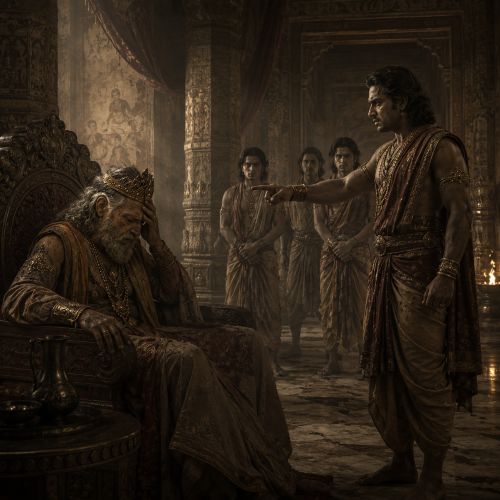
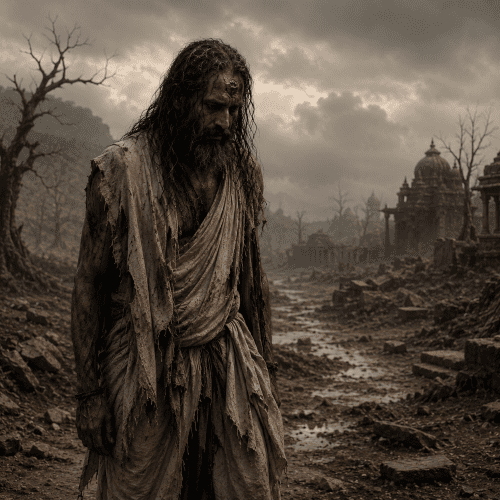
Unable to control his impatience, Izanagi broke his promise. He lit a tooth from his comb as a torch and gazed upon Izanami. Instead of the beautiful goddess he remembered, he saw a decaying corpse crawling with maggots and covered in rot. Terrifying thunder deities emerged from her body, revealing how deeply she had become tied to death and corruption. Humiliated and enraged by Izanagi’s reaction, Izanami pursued him through Yomi with demonic forces and the Eight Thunder Gods. Izanagi barely escaped and sealed the entrance to the underworld with a gigantic boulder.
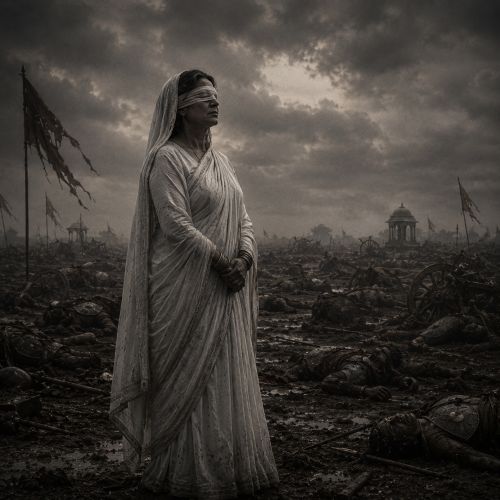
Standing on opposite sides of the barrier, Izanami pronounced her revenge. She swore that every day she would kill one thousand people from the land of the living. Izanagi answered by vowing to create one thousand five hundred new lives each day. Through this exchange, mortality became a permanent condition of human existence.
Nature of the Curse
The Curse of the Thousand Deaths is not portrayed as a temporary punishment. Instead, it functions as a cosmic law that governs the balance between life and death. Unlike many curses aimed at individuals or bloodlines, Izanami’s Revenge affects all humanity equally.
The curse represents the inevitability of mortality. Every human life is destined to end because death itself has become woven into the structure of the universe. In Shinto thought, this also connects to the concept of kegare, or spiritual impurity associated with death and decay. Izanami’s transformation from creator goddess into ruler of Yomi symbolizes the frightening power of corruption once life enters the realm of death.
At the same time, Izanagi’s response prevents total destruction. His promise of greater births than deaths establishes a natural equilibrium. Humanity survives and expands, but only under the shadow of inevitable mortality. This balance between opposing forces became one of the defining themes of Japanese spiritual philosophy.
Victims and Key Figures
The central figures of the myth are Izanami and Izanagi themselves, whose broken relationship shapes the destiny of humanity. Izanami begins as a life-giving creator deity responsible for forming the islands and kami of Japan. After her death and abandonment, she becomes associated with darkness, decay, and the underworld. Her transformation reflects both grief and rage, turning maternal creation into destructive vengeance.
Izanagi represents both love and fear. His descent into Yomi is motivated by devotion, yet his horror upon seeing Izanami’s corpse causes him to reject her. His actions ultimately trigger the curse, but he also restores balance through his vow to create new life. Kagutsuchi, the fire god, acts as the catalyst for the tragedy. His birth causes Izanami’s death and indirectly leads to the separation between life and death.
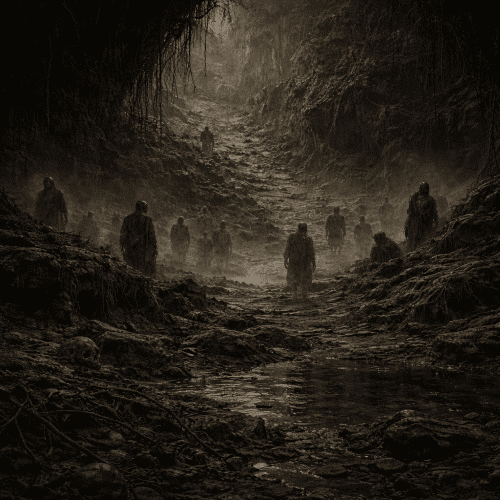
The Eight Thunder Gods and the demonic spirits of Yomi symbolize the terrifying forces hidden within the underworld. Their pursuit of Izanagi emphasizes the danger of crossing sacred boundaries between worlds. The ultimate victims, however, are humanity itself. Every person becomes subject to mortality because of the conflict between the two primordial deities.
Consequences and Resolution
The immediate consequence of Izanami’s Revenge was the permanent division between the living world and Yomi. Death could no longer be reversed, and the dead could not safely return to life. After escaping the underworld, Izanagi purified himself through a ritual bath known as misogi. This act became one of the foundational purification rituals within Shinto tradition. According to the myth, several important deities were born during this cleansing, including the sun goddess Amaterasu, the moon god Tsukuyomi, and the storm god Susanoo.
Although the curse itself was never lifted, Izanagi’s counter-vow created a stable cosmic order. Life would continue to flourish despite death’s constant presence. The myth therefore does not end with victory over mortality but with acceptance of balance. This idea deeply shaped Japanese spiritual thought. Death is not portrayed as evil in itself but as a necessary part of existence that exists alongside birth, renewal, and purification.
Symbolism and Moral Lessons
Izanami’s Revenge carries multiple symbolic meanings that continue to resonate in Japanese culture. The myth primarily explains the origin of death and humanity’s finite lifespan. Mortality is presented not as random misfortune but as a consequence of divine conflict and cosmic law.
The story also warns against breaking sacred promises. Izanagi’s impatience and inability to trust Izanami directly lead to disaster. His forbidden gaze into Yomi reflects the danger of violating spiritual boundaries that should remain respected.
Another important theme is the coexistence of beauty and terror. Izanami is both creator and destroyer, mother and goddess of death. This duality reflects the broader Japanese understanding that creation and destruction are inseparable parts of nature.
Finally, the myth explores grief and transformation. Izanami’s rage emerges from humiliation and abandonment, making her revenge emotionally complex rather than purely monstrous. Her tragedy reflects how love can become fury when trust is broken.
Cultural Impact and Legacy
The story of Izanami’s Revenge remains one of the most influential myths in Japan. Shinto purification rituals, especially misogi, trace their origins directly to Izanagi’s cleansing after escaping Yomi. Even today, purification before entering shrines reflects ancient beliefs about spiritual pollution and renewal. The myth also shaped Japanese ideas surrounding death, ancestors, and the afterlife. Yomi became a lasting symbol of decay and separation, influencing later folklore involving spirits, ghosts, and vengeful entities known as onryo.
Modern Japanese media continues to reinterpret Izanami and Izanagi in anime, manga, novels, films, and video games. Their story often appears as a metaphor for loss, forbidden knowledge, and the fragile boundary between life and death. Despite these modern adaptations, the original myth still retains its spiritual and philosophical significance. More than a simple tale of revenge, Izanami’s Revenge remains a profound explanation for why humanity lives under the constant rhythm of birth and death.



Source
Kojiki.co. (n.d.). Slope to Hades‘ from Japanese mythology KOJIKI. https://kojiki.co/en/mythology/episode05.html
Encyclopaedia Britannica. (n.d.). Izanagi and Izanami | Japanese mythology, creation myth, Kami. https://www.britannica.com/topic/Izanagi
Yokai.com. (2023, January 8). Tatarigami – Yokai.com. https://yokai.com/tatarigami/
Wikipedia. (2003, December 14). Izanagi. https://en.wikipedia.org/wiki/Izanagi
Wikipedia. (2006, September 8). Hyakki Yagyō. https://en.wikipedia.org/wiki/Hyakki_Yagy%C5%8D
Philippi, D. L. (1969). Kojiki. Princeton University Press.
Bocking, B. (1996). A Popular Dictionary of Shinto. Routledge.
Picken, S. D. B. (2004). Essentials of Shinto: An Analytical Guide to Principal Teachings. Greenwood Press.
Ono, S. (1962). Shinto: The Kami Way. Charles E. Tuttle Company.
Hardacre, H. (2017). Shinto: A History. Oxford University Press.
Frequently Asked Questions
What is Izanami’s Revenge in Japanese mythology?
Izanami’s Revenge refers to the curse placed upon humanity after Izanagi abandoned Izanami in the underworld of Yomi.
Why did Izanami curse humanity?
Izanami cursed humanity because she felt humiliated and betrayed after Izanagi looked upon her decayed form in Yomi.
What is the Curse of the Thousand Deaths?
The curse states that one thousand people will die every day, introducing mortality into the human world.
How did Izanagi respond to Izanami’s curse?
Izanagi vowed that fifteen hundred new lives would be born daily to maintain balance against death.
What does Izanami symbolize in Japanese mythology?
Izanami symbolizes both creation and death, representing the dual nature of life, decay, and cosmic balance.