

Curse of Borrowed Youth : Yayati’s Struggle Against Time
Listen
At a glance
| Description | |
|---|---|
| Mythology | Indian Mythology |
| Cursed Individual(s) | Yayati |
| Cursed By | Shukracharya |
| Primary Consequence | Premature old age |
| Symbolism | Consequences of lust and betrayal |
Mythlok Perspective
In Mythlok’s Perspective, the Curse of Yayati is less about moral punishment and more about elemental imbalance. Yayati embodies fire without containment, desire without discipline. His borrowed youth represents humanity’s illusion that time can be negotiated. Across cultures, similar motifs appear. The Greek figure Tithonus gains immortality but not youth, decaying endlessly. In Mesopotamian epic, Gilgamesh seeks eternal life and fails. Yayati stands among these archetypes. The lesson is universal: civilizations may vary, but the hunger to outrun mortality remains constant. The wisdom lies not in conquest of time, but in harmony with it.
Curse of Yayati
Introduction
The Curse of Yayati is one of the most psychologically layered episodes in Indian epic tradition. Preserved in the Mahabharata and echoed in the Bhagavata Purana, the story goes far beyond royal scandal. It explores the insatiability of desire, the inevitability of aging, and the burden of karma across generations.
King Yayati’s fall from youthful vigor to instant old age is not merely divine punishment. It becomes a philosophical meditation on human craving. His attempt to escape decay by borrowing youth from his own son transforms the narrative into a profound allegory about indulgence, responsibility, and eventual renunciation.
In the grand arc of Indian epic history, the Curse of Yayati also determines the political future of the Lunar dynasty. Through this single moral crisis, the lineage that eventually leads to the Pandavas and Kauravas is shaped.
Mythological Background
Yayati belonged to the Chandravansha, the Lunar dynasty descending from Soma, the moon deity. He was the son of King Nahusha, whose own fall from heaven due to arrogance foreshadowed the moral instability that would haunt his lineage.
Yayati married Devayani, daughter of the powerful sage Shukracharya, preceptor of the Asuras. Their union was politically and spiritually significant. Yet circumstances grew complicated when Yayati also formed a relationship with Sharmishtha, the daughter of the Asura king Vrishaparva.
This triangle of royalty, sage authority, and wounded pride created the foundation for catastrophe. Devayani’s status as a Brahmin sage’s daughter elevated the moral stakes. Any violation of trust was not merely personal; it was cosmic. Yayati’s sons—Yadu, Turvasu, Druhyu, Anu, and Puru—would later become founders of important dynastic branches. Among them, Puru’s line would become central to epic history.
Origin of the Curse
The origin of the Curse of Yayati lies in betrayal. After marrying Devayani, Yayati had agreed to honor the sanctity of that bond. However, he secretly fathered children with Sharmishtha. When Devayani discovered this, she returned to her father Shukracharya and demanded justice.
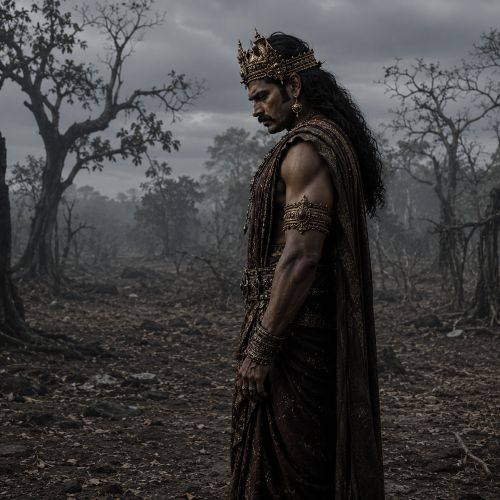
Shukracharya’s fury was not driven merely by paternal anger. As a spiritual authority, he saw Yayati’s act as a violation of dharma. The punishment was swift and symbolic: Yayati was cursed with premature old age. His youthful body, once strong and radiant, became instantly frail and wrinkled.
In some versions, Devayani’s pleas soften the severity of the sentence. Shukracharya allows a conditional reprieve: Yayati may transfer his old age to one of his sons if any agree to exchange their youth for his decrepitude. Thus the curse becomes more than retribution. It becomes a moral test.
Nature of the Curse
The Curse of Yayati is unique because it is both immediate and transferable. Unlike natural aging, this transformation is supernatural and instantaneous. The king loses vitality, strength, and sensory power in a single moment. Symbolically, the curse represents existential inversion. A ruler accustomed to command and pleasure is reduced to helplessness. The body becomes a prison.
Yet its transferability adds complexity. By allowing another to bear his old age, the curse shifts from divine judgment to intergenerational burden. It suggests that while consequences may be delayed or displaced, they are never erased. Yayati’s desperation reveals the depth of his attachment to sensual life. Even stripped of youth, he is unwilling to relinquish desire.
Victims and Key Figures
The primary victim is Yayati himself. But the ripple effects expand outward. When he asks his sons to exchange youth for old age, four of them refuse. Yadu, Turvasu, Druhyu, and Anu decline to sacrifice their prime years. In response, Yayati curses their lineages, reducing their political prominence.
Only Puru agrees. His willingness to bear his father’s burden elevates him morally and historically. Yayati blesses Puru and declares him rightful heir. Through Puru emerges the lineage that eventually produces the heroes and rivals of the Mahabharata.
Devayani also stands as an emotional victim. Betrayed and humiliated, she catalyzes justice. Sharmishtha represents desire and social complexity rather than simple villainy. Shukracharya functions as the moral enforcer. Bound by dharma, he cannot retract his curse completely, yet he tempers justice with conditional mercy.
Consequences and Resolution
With Puru’s youth restored to him, Yayati resumes indulgence. The texts describe him enjoying pleasures for a thousand years. Yet satisfaction never arrives. Desire multiplies rather than diminishes. At last, realization dawns. Yayati understands that craving cannot be extinguished through gratification. He returns Puru’s youth, accepts old age willingly, and renounces worldly life.
In some traditions, he retires to the forest and practices austerities. His spiritual awakening resolves what indulgence could not. The curse thus ends not through magic, but through insight. Politically, the decision shapes dynastic history. Puru’s line becomes dominant. The foundation of later epic conflicts is laid through this act of filial sacrifice.
Symbolism and Moral Lessons
The Curse of Yayati symbolizes the fire of desire. One famous line from the epic compares desire to fire fed with clarified butter; the more it is nourished, the more it grows. The exchange of youth represents karmic inheritance. Children often bear the consequences of parental choices. Puru’s sacrifice exemplifies dharma and filial devotion.
Aging itself becomes teacher rather than punishment. The story affirms that decay is inevitable, and attempts to escape it only deepen suffering. True liberation lies in acceptance and self-restraint. The narrative also critiques entitlement. Even kings are subject to cosmic law. Power does not exempt one from consequence.
Cultural Impact and Legacy
The Curse of Yayati has inspired philosophical commentary, theatrical adaptations, and modern reinterpretations. Most notably, Yayati by V. S. Khandekar reimagines the tale as an existential study of guilt and longing, earning the Jnanpith Award.
In contemporary discourse, “Yayati’s curse” is sometimes invoked metaphorically to describe generational imbalance or unending ambition. The story continues to resonate because its central tension remains universal. Youth fades. Desire persists. Wisdom comes late. Within epic tradition, the episode stands as a moral prologue to the vast conflicts of the Mahabharata. A single act of indulgence alters the trajectory of history.



Source
Bhāgavata Purāṇa, 9th Canto, 18–19. (n.d.). In A. C. Bhaktivedanta Swami Prabhupāda (Trans.), Śrīmad‑Bhāgavatam (Vol. 5). Los Angeles, CA: Bhaktivedanta Book Trust.
Ganguli, K. M. (Trans.). (1883–1896). The Mahābhārata of Krishna‑Dwaipayana Vyasa: Adi Parva and Udyoga Parva. Calcutta: Bharata Press.
Shastri, J. L. (Trans.). (1950). Vishnu Purana: A System of Hindu Mythology and Tradition. Allahabad: Government Press.
Khandekar, V. S. (2018). Yayati: A classic tale of lust (M. Patil, Trans.). New Delhi, India: Penguin Random House India. (Original work published 1959)
“The Curse of Yayati.” (2024, December 17). WisdomLib. https://www.wisdomlib.org/concept/yayatis-curse
“Yayati – Story of the King and His Insatiable Desire.” (2021, June 10). J.K. Yog India. https://jkyog.in/en/wisdom/blog/yayati-story-of-the-king-and-his-insatiable-desire
“Lost Tales of Vedic India: Tale of King Yayati’s Curse.” (2024). The Jaipur Dialogues. https://www.thejaipurdialogues.com/itihasa/tale-of-king-yayatis-curse/
“The Curse of Yayati: A Tale of Desire, Detachment, and Dharma.” (2024, November 19). Mythoholics.
https://mythoholics.com/curse-of-yayati-desire-detachment/
Frequently Asked Questions
What is the Curse of Yayati in Indian epic tradition?
The Curse of Yayati is a divine punishment imposed by Shukracharya that turned King Yayati prematurely old after he betrayed Devayani.
Why was Yayati cursed with old age?
He violated marital and moral boundaries by secretly fathering children with Sharmishtha despite promising loyalty to Devayani.
How did Yayati regain his youth?
He borrowed youth from his youngest son Puru, who agreed to exchange his vitality for his father’s old age.
What is the main moral of the Curse of Yayati?
The central lesson is that desire cannot be satisfied by indulgence; it only grows stronger. Acceptance and renunciation lead to wisdom.
How did the curse affect the Mahabharata lineage?
Because Puru accepted the burden, his lineage became dominant, eventually producing the Pandavas and Kauravas.