

Khajuraho : The Sacred Temples of Desire and Divine Expression
At a glance
| Description | |
|---|---|
| Mythology | Indian Mythology |
| Country | India |
| Closest airport | Khajuraho Airport (HJR) |
| Type | Constructed |
| Accessibility | 10/10 |
Mythlok Perspective
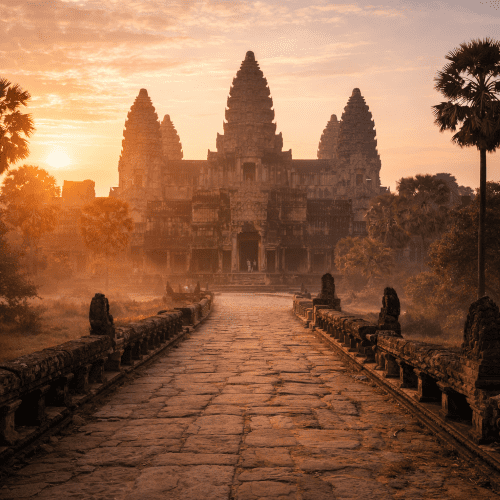
In Mythlok’s View, Khajuraho dissolves the boundary between the sacred and the sensual, presenting existence as a continuum rather than a contradiction. It transforms desire into a doorway, suggesting that human experience is not separate from spiritual realization, but a path toward it. The temples act as a visual philosophy, where every carving becomes part of a larger cosmic narrative. This resonates with the tantric traditions of Indian thought, where energy and consciousness are unified, and finds parallels in the sacred art of Angkor in Cambodia, where divine and human realms coexist within temple walls. Like these spaces, Khajuraho is not merely observed—it is interpreted, layer by layer.
Khajuraho
Introduction
Khajuraho, a UNESCO World Heritage Site in Madhya Pradesh, India, is celebrated for its breathtaking temples and masterfully carved sculptures. Built by the Chandela dynasty between 950 and 1050 AD, these architectural wonders reflect India’s artistic brilliance and deep-rooted mythology. Nestled in the Chhatarpur district, this historic town offers a glimpse into a bygone era, where every intricate carving tells a tale of devotion, culture, and tradition. A visit to Khajuraho is more than just sightseeing—it’s an immersive journey through India’s artistic and spiritual legacy.
Connection with Mythology
Khajuraho’s mythology is as enchanting as its architecture. One of the most well-known legends tells the story of Hemavati, a beautiful maiden who caught the attention of the Moon God while bathing under the night sky. Their union led to the birth of Chandravarman, who later became the founder of the Chandela dynasty. Inspired by his mother’s tale, he is said to have initiated the construction of the temples, embedding them with intricate carvings that explore themes of devotion, human desires, and spiritual transcendence.
The name “Khajuraho” is thought to originate from the Sanskrit Kharjuravāhaka, meaning “bearer of date palms,” referencing the once-abundant palm trees surrounding the area. The temples, built between the 9th and 11th centuries, are a testament to the synthesis of Hindu and Jain traditions, with most structures dedicated to Hindu deities while some honor Jain Tirthankaras. The sculptural panels, though widely known for their erotic imagery, primarily depict divine beings, celestial dancers, and mythological narratives, serving as a visual representation of India’s spiritual and artistic heritage.
Scholars interpret the sensual carvings in multiple ways—some see them as symbols of tantric practices, others as an educational guide to human relationships, and some as a metaphor for renouncing worldly pleasures before entering a sacred space. Beyond their artistic brilliance, these temples stand as a reflection of India’s medieval cultural ethos, seamlessly blending religious devotion with an appreciation for human experiences.
Ways to Get There
Reaching Khajuraho Group of Monuments is relatively straightforward, with multiple travel options connecting it to major cities across India. By air, Khajuraho Airport, located just 5 km from the town, receives regular flights from Delhi, Mumbai, and Varanasi. Airlines such as IndiGo and Air India operate here, and once you arrive, taxis, auto-rickshaws, and hotel transfers provide easy access to the temple complex.
Rail connectivity further strengthens access to Khajuraho, with the Khajuraho Railway Station situated about 6 km from the town center. It is linked to key cities like Delhi, Jhansi, and Varanasi, with trains such as the Vande Bharat Express and Khajuraho Express offering convenient options. For those seeking broader connectivity, Jhansi Junction, a major railway hub around 175 km away, serves as an alternative entry point, with onward travel available by road.
For travelers who prefer road journeys, Khajuraho is well connected through an extensive network of highways. Buses and taxis operate from nearby cities like Satna, Jhansi, and Bhopal, while longer routes, such as the drive from Delhi via Agra and Gwalior, offer a scenic but time-intensive experience of around 10 to 13 hours. Whether by bus, private vehicle, or self-drive, the journey to Khajuraho gradually transitions from urban movement to a quieter landscape, setting the tone for the experience ahead.
What to Look For
Khajuraho is best known for its extraordinary temple complexes, which are divided into three main groups—Western, Eastern, and Southern—each offering a distinct perspective on the region’s architectural brilliance and cultural depth. These temples are not just structures, but layered expressions of philosophy, devotion, and artistic mastery, revealing how form and meaning were seamlessly intertwined in their creation.
The Western Group is the most prominent and best preserved, forming the heart of Khajuraho’s visual and cultural identity. Here stands the Kandariya Mahadeva Temple, the largest and most intricately carved shrine, dedicated to Lord Shiva, rising like a sculpted mountain of stone. Nearby, the Lakshmana Temple honors Lord Vishnu with detailed panels depicting mythological narratives, while the Chitragupta Temple, dedicated to Surya, and the Devi Jagdamba Temple add further depth with their refined carvings and symbolic richness.
The Eastern Group shifts the focus toward Jain traditions, highlighting the spiritual diversity of Khajuraho. Temples such as Parsvanath, the largest in this cluster, showcase delicate and highly detailed carvings, while the Adinath Temple stands out with its striking idol and ornate design. The Shantinath Temple further reinforces the presence of Jain philosophy within the region, creating a quieter yet equally profound experience compared to the grandeur of the Western Group.
The Southern Group, though less visited, offers a more intimate encounter with Khajuraho’s artistry. The Duladeo Temple is known for its graceful depictions of celestial dancers, capturing movement within stone, while the Chaturbhuj Temple presents a contrasting simplicity, housing a powerful four-armed image of Vishnu without the elaborate erotic imagery seen elsewhere. Beyond the temples, Khajuraho comes alive during the annual Dance Festival in February, where classical Indian dance forms are performed against the illuminated temple backdrop, transforming the site into a living stage where heritage and performance converge.
Importance in cultural history
Khajuraho stands as a remarkable testament to India’s rich artistic and architectural heritage. Constructed during the rule of the Chandela dynasty in the 10th and 11th centuries CE, these temples epitomize the finest examples of Nagara-style architecture. Despite the destruction of several structures over time, around 20 temples remain, reflecting a society that embraced both Hinduism and Jainism.
The temples’ intricate carvings depict deities, celestial beings, musicians, dancers, and scenes from everyday life, offering insights into the cultural and spiritual practices of the era. Among their most famous features are the sensuous sculptures, which, rather than being solely erotic, symbolize the integration of human desires within a broader spiritual framework. Rooted in Tantric philosophy, they illustrate the belief that physical love can be a means of attaining higher consciousness.
Beyond their artistic grandeur, these temples serve as a cultural landmark, showcasing the creativity and craftsmanship of medieval India. Now a UNESCO World Heritage site, Khajuraho continues to inspire historians, artists, and visitors, preserving its legacy for generations to come.
Best time to travel
The ideal time to visit Khajuraho is during the winter months, from October to March, when the weather is cool and comfortable for sightseeing. Temperatures range between 9°C and 32°C, making it the best season to explore the temples and attend the renowned Khajuraho Dance Festival in February.
The monsoon season, from July to September, brings moderate to heavy rainfall, transforming the landscape into a lush green paradise. While travel can be slightly challenging due to humidity, nature enthusiasts may enjoy the serene atmosphere and off-season discounts on accommodations.
Summers, from April to June, are intensely hot, with temperatures soaring up to 47°C, making outdoor exploration difficult. If visiting during this time, early morning and late evening temple visits are advisable.
Khajuraho is more than just a historical site; it is a gateway to India’s artistic and mythological heritage. Whether you’re drawn to its architectural brilliance, cultural significance, or spiritual essence, a visit to this UNESCO World Heritage site promises an unforgettable experience. Plan your trip wisely to make the most of this extraordinary destination.




Source
UNESCO. (n.d.). Khajuraho Group of Monuments. Retrieved March 29, 2026, from https://whc.unesco.org/en/list/240/
Archaeological Survey of India. (n.d.). Khajuraho Temples. Retrieved March 29, 2026, from https://asi.nic.in/khajuraho-group-of-monuments/
Encyclopaedia Britannica. (n.d.). Khajuraho. Retrieved March 29, 2026, from https://www.britannica.com/place/Khajuraho
Madhya Pradesh Tourism. (n.d.). Khajuraho. Retrieved March 29, 2026, from https://www.mptourism.com/destination-khajuraho.php
Dehejia, Vidya. (1997). Indian art. London: Phaidon Press.
Michell, George. (1989). The Hindu temple: An introduction to its meaning and forms. Chicago: University of Chicago Press.
Desai, Devangana. (1996). The religious imagery of Khajuraho. Mumbai: Franco-Indian Research.
Desai, D. (1987). Erotic sculpture at Khajuraho. Artibus Asiae, 48(1/2), 57–74. https://www.jstor.org/stable/3249875
Frequently Asked Questions
Why is Khajuraho famous?
Khajuraho is famous for its intricately carved temples that depict a wide range of human and divine experiences, including symbolic erotic art.
What do the Khajuraho sculptures represent?
The sculptures represent life in its entirety—daily activities, divine beings, and symbolic expressions of desire and spirituality.
Is Khajuraho only about erotic temples?
No, the erotic carvings form only a small part of the overall artwork, which primarily focuses on spirituality, culture, and cosmic balance.
Can you visit Khajuraho today?
Yes, Khajuraho is a UNESCO World Heritage Site open to visitors, with well-preserved temples and guided tours available.
Who built the Khajuraho temples?
The temples were built by the Chandela dynasty between the 9th and 12th centuries in central India.