

Soma : The Sacred Drink of the Vedas
| Description | |
|---|---|
| Origin | Indian Mythology |
| Availability | Ritual-only, Rare plant |
| Associated Characters | Indra, Agni, Rudra |
| Symbolism | Immortality, Vitality, Cosmic order |
| Source Texts | Rigveda (Mandala 9), Atharvaveda |
Mythlok Perspective
In Mythlok’s Perspective, Soma represents far more than a sacred drink or a lost botanical mystery. It embodies the enduring human belief that divine wisdom can be experienced through ritual rather than simply understood through knowledge. Across cultures, sacred beverages often serve as bridges between the mortal and divine worlds, from the Iranian Haoma to the Greek ambrosia, reflecting a shared desire to transcend ordinary existence. Whether Soma was a specific mountain plant or a symbolic ritual substance ultimately matters less than its role within Vedic tradition. Its mythology reminds us that ancient civilizations viewed communion with the divine as an active, sacred practice, where nature, ceremony, and spiritual transformation were inseparably connected.
Soma
Introduction
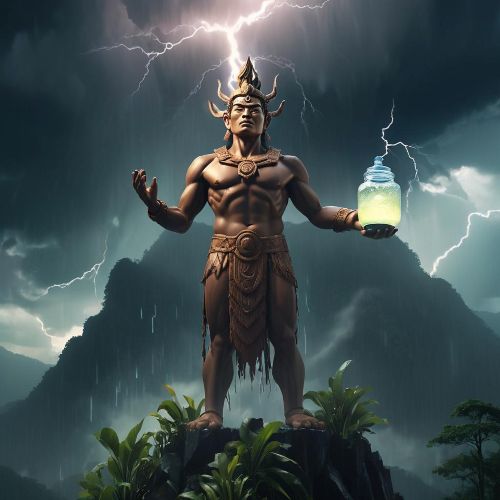
Soma occupies a unique place in Indian mythology because it is both a sacred drink and a divine being. Few figures in ancient religious traditions blur the line between ritual object and deity so completely. Throughout the Rigveda, Soma is praised as a source of vitality, inspiration, wisdom, and divine power. Entire hymns celebrate its preparation, while others describe the extraordinary strength and spiritual insight it bestows upon those who partake in it.
Unlike later mythical substances that exist only in legend, Soma was an essential part of early Vedic religious practice. During elaborate sacrificial ceremonies, priests carefully prepared the drink before offering it to the gods and consuming the sanctified remainder themselves. Although the original plant used to prepare Soma has never been identified with certainty, its importance extends far beyond its physical ingredients. In Vedic thought, Soma represented the living connection between humanity and the divine, making it one of the most revered ritual substances in Indian tradition.
Mythological Context
Soma appears throughout the Vedic corpus as both a deity and the sacred essence of sacrifice. The Ninth Mandala of the Rigveda is devoted almost entirely to hymns praising Soma, reflecting its immense religious significance in early Indo-Aryan society. Rather than being treated as an ordinary offering, Soma itself is invoked as a divine power capable of purifying, healing, and sustaining both gods and humans.
Among the Vedic gods, Indra shares the closest association with Soma. Numerous hymns describe him drinking vast quantities of the sacred juice before confronting the serpent Vritra, whose defeat released the world’s rivers and restored cosmic order. Soma therefore becomes more than a ceremonial beverage; it is portrayed as the source of divine courage and victorious strength. Other deities, including Agni, the fire god, and the Ashvins, also receive Soma during sacrifices, reinforcing its role as the spiritual nourishment of the gods.
Later Hindu literature gradually strengthened Soma’s association with Chandra, the Moon. Rather than replacing the earlier Vedic understanding, this identification expanded Soma’s symbolism. The waxing and waning of the moon came to represent the cyclical consumption and replenishment of the celestial Soma by the gods, linking ritual sacrifice with the rhythms of the cosmos.
Symbolism
Soma symbolizes far more than ritual intoxication. Across Vedic literature, it represents immortality, divine knowledge, purification, and the life-giving energy that sustains the universe. Drinking Soma was believed to elevate the mind, sharpen perception, and allow the sacrificer to participate, however briefly, in the realm of the gods.
Its connection with the Moon deepens this symbolism. Just as the moon continually waxes after waning, Soma embodies renewal, regeneration, and the eternal rhythm of creation. It also represents the flow of cosmic vitality through nature, nourishing plants, animals, gods, and humanity alike.
Many hymns describe Soma as the “King of Plants,” emphasizing its role as the supreme medicinal herb. Rather than simply healing physical ailments, it restores spiritual balance and inspires sacred speech. The famous Vedic declaration, “We have drunk Soma; we have become immortal,” should not be interpreted literally. Instead, it reflects the profound spiritual transformation experienced during the ritual, where participants believed they had momentarily crossed the boundary separating mortals from the divine.
Origin and Source
The true identity of the Soma plant remains one of the greatest unresolved mysteries in the study of ancient religions. The Rigveda consistently describes it as a mountain plant gathered from distant highlands, particularly the legendary Mount Mujavat. These references suggest that the original source likely grew in regions beyond the northwestern frontiers of the Indian subcontinent.
Over the centuries, scholars have proposed numerous candidates, including Ephedra, Sarcostemma acidum (now Cynanchum viminale subsp. stocksii), Peganum harmala, and even the mushroom Amanita muscaria. None of these theories has gained universal acceptance because no surviving description perfectly matches the Vedic texts.
Mythology offers an equally fascinating explanation for Soma’s origin. Several hymns recount how the divine eagle Syena retrieved Soma from heaven and brought it to Earth for the benefit of gods and humanity. This celestial origin reinforces the belief that Soma was never considered an ordinary plant but a sacred gift descending from the divine realm.
Maker or Provider
Although Soma itself is personified as a god, its preparation on Earth belonged to trained Vedic priests. During the Somayajna, ritual specialists followed carefully prescribed procedures to transform the harvested plant into a sacred offering worthy of the gods. Every stage of preparation carried religious significance, and ritual purity was considered essential throughout the process.
Mythologically, Soma is guarded by celestial beings before becoming available to humanity. Some traditions describe the Gandharvas as its heavenly custodians, while others attribute its protection to divine guardians until Syena’s daring retrieval. Rather than presenting a single creator, Indian mythology portrays Soma as a sacred substance entrusted to worthy intermediaries who preserve its sanctity before sharing it through ritual sacrifice.
Recipe and Content
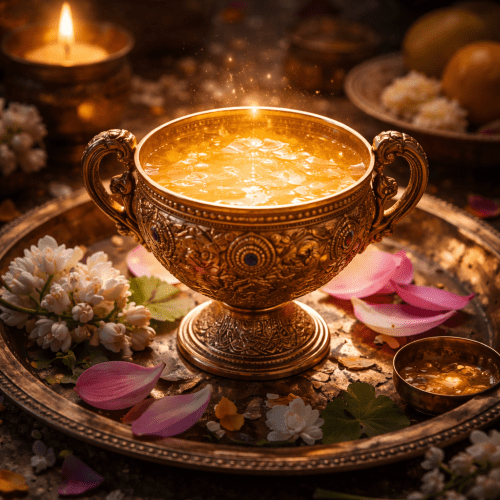
Ancient Vedic texts describe the preparation of Soma in remarkable detail, even though the identity of the original plant remains uncertain. The harvested stalks were first crushed between specially selected stones to extract their juice. This liquid was then filtered through sheep’s wool to remove plant fibres before being collected in ritual vessels.
Depending on the ceremony, the purified juice could be mixed with water, milk, curds, clarified butter, or roasted barley. These additions varied according to the specific sacrifice being performed and were intended to enhance the drink before it was offered to the gods. Contrary to some popular claims, the Vedic texts do not clearly describe Soma as a fermented alcoholic beverage. Most evidence suggests it was prepared and consumed fresh during the ritual itself.
Because the original plant disappeared from regular use, later Vedic traditions substituted locally available species while preserving the ritual procedures. As a result, modern scholars distinguish between the ancient Soma praised in the Rigveda and the substitute plants used in later sacrificial practices.
Instances of Serving and Procurement
Soma stood at the heart of major Vedic sacrifices, where it functioned as both an offering and a sacramental drink. After its careful preparation, portions were dedicated to different deities according to the sequence of the ritual. Indra received the most prominent share because of his close association with the drink, while other gods also received offerings accompanied by Vedic chants.
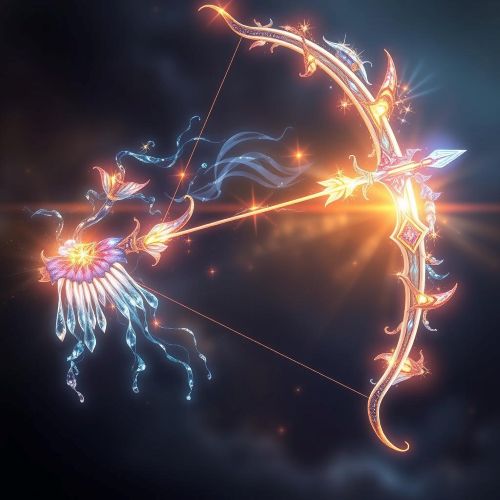
Outside ritual practice, mythology preserves memorable stories explaining how Soma reached humanity. The best known tells of the divine falcon Syena, who risked death to steal Soma from heaven. As the bird escaped, the celestial archer Kṛśānu shot an arrow that struck its feathers but failed to prevent the sacred plant from reaching Earth. This episode highlights Soma’s immense value, portraying it as a treasure worthy of heroic sacrifice.
The frequency with which Soma appears throughout Vedic literature demonstrates that it was not reserved for rare occasions. Instead, it formed an essential component of the sacrificial tradition that shaped early Indian religious life.
Effects
The Vedic hymns describe Soma as producing remarkable physical, mental, and spiritual effects. It invigorated warriors before battle, inspired poets to compose hymns, and gave priests the clarity needed to perform complex rituals. Rather than causing ordinary intoxication, Soma was celebrated for creating heightened awareness, courage, and profound spiritual insight.
Several hymns describe visionary experiences in which drinkers felt surrounded by divine light or believed they had entered the realm of truth. These descriptions have encouraged modern debates about whether Soma possessed psychoactive properties. While this possibility remains unresolved, the texts consistently emphasize its transformative spiritual effects rather than recreational intoxication.
Healing also forms an important aspect of Soma’s reputation. As the “King of Plants,” it was believed to restore vitality, promote longevity, and strengthen both body and mind. Whether understood literally or symbolically, Soma represented the ultimate expression of sacred life-force flowing from the divine into the human world.
Modern Influence
Although the original Soma plant remains unknown, its legacy continues to influence religious studies, literature, and comparative mythology. The closest historical parallel is Haoma, the sacred ritual drink of ancient Iranian and Zoroastrian tradition, which shares linguistic roots and many ceremonial similarities with the Vedic Soma. This connection points to a shared Indo-Iranian religious heritage that predates the separation of these cultures.
Modern scholarship has also explored comparisons with entheogenic traditions found in other parts of the world. Researchers continue to debate whether Soma functioned as a stimulant, a psychoactive preparation, or a unique ritual beverage whose effects were amplified by ceremony and belief. No consensus has emerged, making Soma one of history’s most enduring botanical mysteries.
Beyond academic debate, Soma has entered popular culture through works such as Aldous Huxley’s Brave New World, where the name was borrowed for a fictional drug. However, Huxley’s Soma bears little resemblance to its Vedic namesake. The ancient Soma was never intended as an escape from reality but as a disciplined ritual medium through which humans sought wisdom, divine communion, and spiritual transformation.

Sources
Britannica. (n.d.). Soma. Retrieved July 10, 2026, from https://www.britannica.com/topic/soma-Hinduism
Encyclopaedia Britannica. (n.d.). Soma. Retrieved July 10, 2026, from https://www.encyclopedia.com/philosophy-and-religion/eastern-religions/hinduism/soma
World History Encyclopedia. (2016, January 29). Soma: The Elixir of the Hindu Gods. https://www.worldhistory.org/Soma/
Wikipedia contributors. (n.d.). Soma (drink). Retrieved July 10, 2026, from https://en.wikipedia.org/wiki/Soma_(drink)
Simple English Wikipedia contributors. (n.d.). Soma (drink). Retrieved July 10, 2026, from https://simple.wikipedia.org/wiki/Soma_(drink)
Kalampedia. (2022, March 18). How to make Soma Rasa – the drink of Hindu gods. https://kalampedia.org/2022/03/19/how-to-make-soma-rasa-the-drink-of-vedic-gods/
Rätsch, C. (1998). The encyclopedia of psychoactive plants: Ethnopharmacology and its applications. Park Street Press.
Padhy, S. (2004). The Soma Drinker of Ancient India: An Ethno-Botanical Retrospection.
Frequently Asked Questions
What is Soma in Indian mythology?
Soma is the sacred ritual drink and deity of the Vedic tradition, celebrated in the Rigveda as a source of divine inspiration, vitality, and spiritual transformation.
Was Soma a real plant?
Most scholars believe Soma originated from a real mountain plant, but its exact botanical identity remains unknown despite numerous theories.
Why is Soma associated with the Moon?
Later Hindu tradition identified Soma with the Moon (Chandra), explaining the lunar phases as the gods consuming and replenishing the celestial Soma.
Did Indra drink Soma?
Yes. The Rigveda frequently describes Indra drinking Soma before defeating the serpent Vritra, symbolising the drink’s role in granting divine strength.
Is Soma the same as Amrita?
No. While both are associated with immortality, Soma is the sacred Vedic ritual drink, whereas Amrita is the nectar of immortality produced during the Samudra Manthan in later Hindu mythology.