


Momotaro vs Mwindo : The Japanese Peach Boy Meets an African Epic Hero
Across world cultures, extraordinary heroes often emerge from unusual beginnings to confront enemies, overcome impossible challenges, and restore order to their communities. Japanese folklore gives us Momotaro, the Peach Boy who journeys to an island of ogres with a small band of animal companions. The Nyanga people of Central Africa preserve the epic of Mwindo, a remarkable hero whose supernatural abilities shape his struggle against family opposition, dangerous adversaries, and the powers of the spirit world. Although their stories belong to different storytelling traditions, both figures demonstrate how heroic journeys express cultural ideas about courage, responsibility, and the proper use of power.
The comparison of Momotaro vs Mwindo reveals two very different models of heroism. Momotaro is celebrated for his courage, cooperation, and victory over threatening enemies, while Mwindo’s story explores extraordinary power, defiance, suffering, and the difficult process of learning how to live within a larger social and cosmic order.
Momotaro vs Mwindo : Origins and Miraculous Births
Momotaro, whose name means Peach Boy, is one of Japan’s best-known folktale heroes. In the familiar version of his story, an elderly, childless couple discovers an enormous peach floating down a river. When the fruit opens, a baby boy emerges, bringing immense happiness to the couple who raise him as their own. As he grows older, Momotaro develops extraordinary strength and courage, eventually setting out to confront the ogres who threaten people beyond his home.
His miraculous birth establishes him as an exceptional child whose arrival transforms an ordinary household. The elderly couple’s love and care remain central to his identity, and their support helps prepare him for the dangerous adventure ahead. His origins connect the extraordinary world of folklore with familiar human experiences of family, gratitude, and belonging.
Mwindo’s birth, by contrast, introduces a more complicated relationship between individual destiny and family authority. In the epic preserved among the Nyanga people of the present-day Democratic Republic of the Congo, Mwindo is born into a household dominated by his father, Shemwindo, a powerful chief who does not want a son who might challenge his authority. Mwindo’s unusual circumstances and supernatural capabilities make him extraordinary from the beginning, and his father attempts to prevent him from surviving.
Unlike Momotaro, who is welcomed and nurtured by his adoptive parents, Mwindo must overcome rejection within his own family. His birth initiates a struggle that extends beyond childhood, placing him in conflict with established authority and forcing him to confront the consequences of his exceptional nature.
These different beginnings establish the central contrast between the heroes. Momotaro grows into his role through the security of a loving home, while Mwindo’s journey begins with a struggle for survival against the very family structure that should protect him.
Momotaro vs Mwindo : Powers and Supernatural Abilities
Momotaro’s defining qualities are his remarkable strength, courage, and ability to bring others together. Although versions of his story vary, the familiar tale presents him as a formidable young hero who can challenge the ogres of Onigashima, the island where his enemies reside. His physical abilities matter, but his success also depends on his willingness to cooperate with companions who contribute their own distinctive skills.
The dog, monkey, and pheasant become important members of his expedition after Momotaro shares millet dumplings with them. Their alliance illustrates a form of heroism built around mutual commitment rather than individual strength alone. Momotaro leads the group, but the animals help him overcome obstacles that would be more difficult to face by himself.
Mwindo possesses a much more elaborate collection of supernatural abilities. The Nyanga epic portrays him as a hero capable of extraordinary feats, supported by magical objects, supernatural assistance, and encounters with powerful beings. His adventures take him through a world in which the boundaries between human society and the spirit realm are constantly crossed.
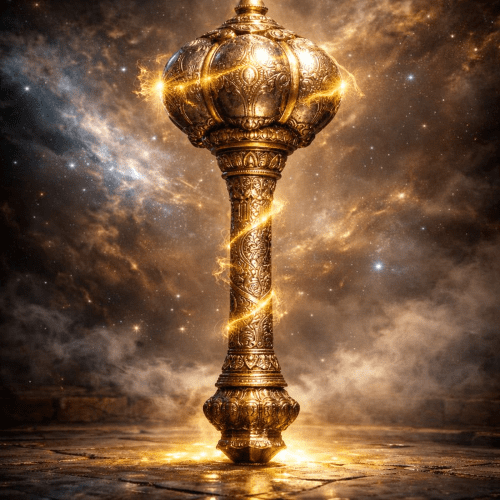
His famous conga-scepter, often described as a magical fly whisk or ceremonial object in English translations, is closely associated with his identity and power. His adventures also involve his relationship with supernatural forces and the challenges of confronting enemies whose abilities extend beyond ordinary human limits.
The difference between the two heroes is significant. Momotaro’s familiar story emphasizes courage, practical cooperation, and the successful completion of a dangerous mission. Mwindo’s epic places greater emphasis on supernatural power, extraordinary endurance, and the difficult relationship between individual capability and the wider order of the world.
In a hypothetical contest based on supernatural abilities, Mwindo would have the advantage because his epic gives him a broader range of extraordinary powers and encounters. However, the two stories were not created to establish a universal ranking of heroes. Their abilities serve different narrative and cultural purposes.
Momotaro vs Mwindo : Enemies, Battles, and Challenges
Momotaro’s principal enemies are the oni, commonly translated as ogres or demons, who inhabit Onigashima. In the familiar version, these beings threaten people through violence, theft, and captivity. Momotaro decides to confront them, and his journey becomes a mission to end their attacks and recover their stolen treasures.
The adventure follows a clear progression. Momotaro leaves home, recruits his animal companions, crosses the sea, and confronts the ogres at their stronghold. The group fights together and ultimately returns with treasure, allowing the story to conclude with a triumphant restoration of order.
This relatively direct conflict gives the tale its appeal as a story of bravery and teamwork. The hero identifies a threat, gathers allies, defeats his opponents, and returns home. His victory reinforces the familiar folktale pattern in which courage and cooperation overcome apparently overwhelming danger.
Mwindo’s conflicts are more extensive and psychologically complicated. His struggle begins with his father’s attempt to destroy him, but the resulting adventures extend into encounters with other family members, powerful adversaries, and supernatural beings. His journey involves escape, pursuit, combat, and repeated demonstrations of his exceptional abilities.
Yet Mwindo’s story is not simply a succession of victories. His extraordinary power can become a source of danger when it is exercised without sufficient restraint. The epic’s movement toward reconciliation and a more responsible relationship with others gives its conflicts a depth that goes beyond defeating an external enemy.
This contrast matters when comparing the heroes. Momotaro’s best-known adventure focuses on protecting a community from a threatening outside force. Mwindo’s epic examines conflicts within the family and society, asking how an exceptionally powerful individual should behave toward those around him.
Momotaro vs Mwindo : Companions, Family, and Responsibility
Companionship is fundamental to Momotaro’s success. His dog, monkey, and pheasant are not merely decorative characters who accompany him on his adventure. Each contributes to the group, and their loyalty helps Momotaro achieve a goal that would be harder to accomplish alone.
The millet dumplings that Momotaro shares with his companions represent the practical and reciprocal nature of their alliance. He offers food, and they agree to help him. Their relationship is presented through a straightforward exchange that develops into collective action. The story consequently offers a memorable lesson about generosity, cooperation, and leadership.
Family also matters in Momotaro’s tale, particularly through the elderly couple who raise him. Although he eventually leaves home to undertake his mission, their care establishes the emotional foundation of his journey. His departure represents an extension of the values he has learned rather than a rejection of his family.
Mwindo’s relationship with family is much more turbulent. His father, Shemwindo, fears the possibility that his son will challenge his authority, creating a conflict that shapes the epic from its beginning. Mwindo’s extraordinary survival and growing power force him into repeated confrontations with the established order.
However, the epic does not reduce its central character to a simple champion of rebellion. Mwindo must eventually confront the implications of his own power and the importance of reconciliation. His development suggests that exceptional abilities do not automatically confer wisdom, and that strength becomes more meaningful when accompanied by an understanding of social responsibility.
Momotaro demonstrates the value of building a team to achieve a shared objective, while Mwindo’s story explores the harder task of repairing relationships damaged by fear, pride, and the misuse of authority. Both narratives connect heroism to relationships, but they approach that connection from very different directions.
Momotaro vs Mwindo : Cultural Significance and Lessons
Momotaro occupies an important place in Japanese popular culture and storytelling. His tale has been retold through children’s books, illustrations, theatre, animation, and other forms of media. Its familiar themes of courage, loyalty, gratitude, and collective effort have helped it remain recognizable across generations.
Nevertheless, the story’s cultural history also demonstrates why traditional narratives deserve careful interpretation. In modern Japanese history, Momotaro was adapted for nationalistic purposes, including wartime propaganda. Other writers challenged these interpretations by retelling the tale from the perspective of the ogres, complicating the assumption that the hero’s violence was automatically justified. His story therefore offers opportunities to examine not only traditional heroism but also how societies redefine heroes to serve changing political and cultural purposes.
The Mwindo epic holds a different kind of significance. Preserved through Nyanga oral tradition, it combines narration, poetry, song, proverbs, and supernatural adventure. Its literary structure offers insight into Nyanga social relationships, cultural values, and understandings of the relationship between human beings and the spirit world.
Mwindo’s story addresses authority, kinship, courage, and the responsibilities that accompany extraordinary power. His struggle with his father exposes the dangers of authoritarian control, while his later experiences reveal that strength alone cannot guarantee a harmonious life. The epic’s broader movement toward reconciliation emphasizes the importance of restoring relationships and finding a sustainable place within the community.
The two traditions should not be treated as interchangeable examples of a universal mythology. Momotaro belongs to a Japanese folktale tradition shaped by its own historical and cultural circumstances, while Mwindo’s adventures emerge from the distinctive oral literature of the Nyanga people. Their comparison becomes meaningful when their differences are respected rather than erased.
Momotaro vs Mwindo : Who Is the Greater Hero?
The answer depends on what qualities define a great hero. Momotaro is an appealing model of purposeful courage, cooperation, and loyalty. His ability to bring together companions and complete a dangerous mission makes him a memorable figure in Japanese folklore. His familiar adventure rewards bravery directed toward a clear communal goal.
Mwindo, meanwhile, represents a more complicated form of heroism. His supernatural abilities, extraordinary survival, and numerous confrontations make him a formidable figure, but his story also considers the dangers of power without restraint. His development gives his epic a broader exploration of family conflict, authority, and reconciliation.
If the comparison focuses on the breadth of supernatural abilities and the scale of extraordinary adventures, Mwindo has the stronger claim. If the emphasis is on a concise heroic mission accomplished through courage, teamwork, and loyalty, Momotaro offers the clearer example.
Ultimately, Momotaro vs Mwindo is not simply a contest between two powerful heroes; it is a comparison of two cultural visions of heroism. One celebrates the courage to confront an external threat with the help of trusted companions, while the other explores the difficult journey from extraordinary power toward responsibility and reconciliation. Both remain valuable because they reveal how different storytelling traditions use remarkable heroes to examine the challenges of living with others.
No posts were found.
