

Curse of Eternal Vengeance: Taira no Masakado and Japan’s Restless Spirit
At a glance
| Description | |
|---|---|
| Mythology | Japanese Mythology |
| Cursed Individual(s) | Taira Clan |
| Cursed By | Taira no Masakado |
| Primary Consequence | Misfortune, Disasters, Decline |
| Symbolism | Vengeance, Rebellion, Resistance spirit |
Mythlok Perspective
In Mythlok’s Perspective, Taira no Masakado is fascinating because he evolved beyond the role of a simple ghost. He occupies a rare space where history, politics, and spirituality merge into a single legend. What began as the story of a failed rebellion became a narrative about memory itself, showing how communities reinterpret controversial figures across generations. Masakado’s transformation from feared onryō to protective guardian mirrors similar traditions worldwide. His journey resembles that of heroes and spirits who were once viewed as dangerous outsiders before becoming local protectors. Comparable examples can be found in the legends of the Celtic hero Cú Chulainn and the Chinese general Guan Yu, both of whom transcended history to become larger-than-life cultural symbols. Like them, Masakado demonstrates how societies often remember powerful rebels not for how they died, but for what they came to represent.
Curse of Taira Clan
Introduction
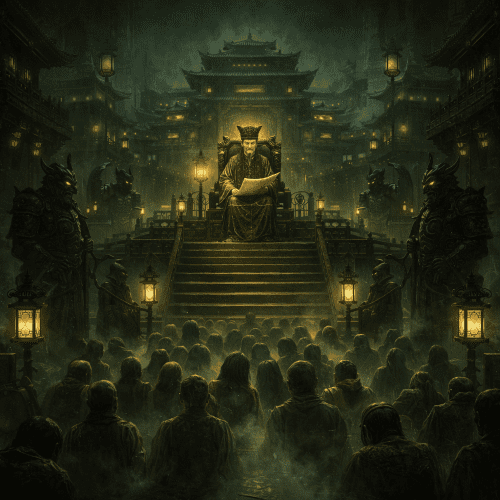
Few legends in Japanese folklore have endured as powerfully as the curse associated with the Taira Clan and its rebellious warrior, Taira no Masakado. More than a thousand years after his death, Masakado remains one of Japan’s most feared and respected supernatural figures. A historical samurai who challenged imperial authority during the Heian period, he was transformed by folklore into a wrathful spirit whose influence allegedly extended far beyond the grave.
The story of Masakado is unusual because it sits at the crossroads of history, religion, and myth. Historical records confirm his rebellion and death in 940 CE, while centuries of oral tradition elevated him into an onryō, a vengeful ghost capable of bringing disaster upon those who offended him. Today, his legend remains deeply connected to the history of the Taira Clan and continues to shape cultural attitudes in Tokyo, where his tomb is still treated with remarkable respect.
Mythological Background
The legend of Masakado is rooted in the Japanese belief that powerful emotions can survive death. Within traditional Japanese spirituality, individuals who die unjustly or without proper rites may become onryō. These spirits are believed to possess the ability to influence the physical world through misfortune, disease, and natural disasters.
Masakado belonged to the Taira Clan, one of the most influential warrior families of early medieval Japan. Descended from Emperor Kanmu, the clan held significant regional authority. During a period of political tension and weak central control, Masakado emerged as a powerful leader in eastern Japan.
Folklore gradually expanded his story beyond historical fact. Some traditions claim his mother was connected to a dragon deity, granting him supernatural protection from birth. Other legends describe divine messages encouraging his rise to power. These stories helped transform him from a regional warlord into a semi-mythical figure whose destiny appeared guided by supernatural forces.
As centuries passed, local communities began to view him in two seemingly contradictory ways. He was feared as a dangerous spirit but also admired as a symbol of resistance against distant authority. This dual identity became central to his lasting legacy.
Origin of the Curse
The origins of the curse are linked to the circumstances surrounding Masakado’s death. In 940 CE, his rebellion against the imperial court came to an end when he was defeated by forces led by his cousin, Taira no Sadamori, and the warrior Fujiwara no Hidesato.
After the battle, Masakado was beheaded and his head was transported to Kyoto as proof of victory. Historical records confirm that his severed head was displayed publicly. In folklore, however, the story took a far darker turn. Legends claim the head remained unnaturally preserved, glaring at spectators and crying out for its body. According to popular tradition, the head eventually rose into the sky and flew eastward toward the Kanto region. It finally landed in what is now Tokyo, where a burial mound was established.
The belief that Masakado was denied peace after death became the foundation of the curse. In Japanese tradition, proper funerary rites are essential for ensuring a smooth transition into the afterlife. The humiliation of public display and the violent nature of his death were believed to have created a spirit consumed by resentment and vengeance.
Nature of the Curse
Unlike many supernatural curses that focus on individual victims, Masakado’s curse became associated with entire communities and institutions. Stories connected his spirit to earthquakes, fires, epidemics, political instability, and unexplained accidents.
The center of these beliefs became Masakado-zuka, the burial mound associated with his head. Located in modern Tokyo’s Otemachi district, the site developed a reputation as one of the most spiritually sensitive locations in Japan.
Many accounts describe unusual events occurring whenever attempts were made to relocate, damage, or build over the tomb. These incidents strengthened public belief that Masakado’s spirit remained active. Over time, his reputation grew to such an extent that he was counted among Japan’s most feared supernatural figures, alongside Emperor Sutoku and Sugawara no Michizane.
The curse also evolved beyond simple vengeance. Some traditions portray Masakado as a guardian of eastern Japan who protects the region while punishing disrespect. This transformation gave the legend greater complexity and helped explain why many people sought his favor rather than merely fearing him.
Victims and Key Figures
Several figures became closely linked to the legend. Taira no Sadamori, who participated in Masakado’s defeat, appears frequently in stories about the aftermath of the rebellion. Folklore suggests that those involved in his death experienced strange misfortunes, reinforcing the idea that his spirit sought revenge.
Another notable figure is Fujiwara no Hidesato, the military leader who assisted in suppressing the rebellion. Though celebrated historically, later traditions occasionally associated him with the consequences of opposing Masakado.
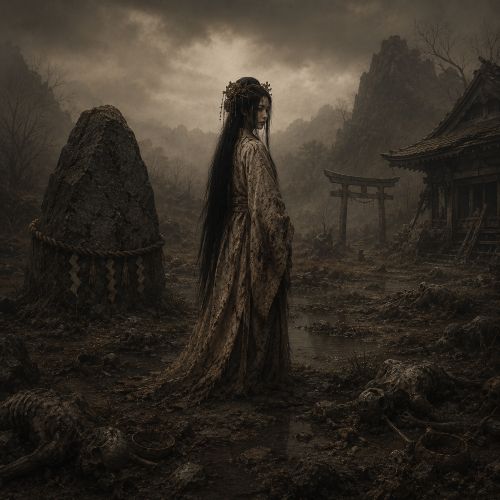
The legend also expanded through the character of Takiyasha-hime, Masakado’s daughter. Popular folklore portrays her as a powerful sorceress capable of commanding supernatural forces. Although largely absent from historical records, she became an important figure in Japanese art, literature, and Kabuki theater.
Modern stories surrounding the curse often focus on incidents linked to the tomb. Following the Great Kanto Earthquake of 1923, construction projects around the site were allegedly followed by accidents, illnesses, and unexplained deaths. While historians view these claims with caution, they played a major role in strengthening the curse’s reputation during the twentieth century.
Consequences and Resolution
Over time, authorities recognized that fear of Masakado’s spirit could not simply be dismissed. Instead, efforts were made to appease and honor him through religious ceremonies. A significant turning point came when Masakado began to be worshipped as a protective deity rather than feared solely as a vengeful ghost. This shift reflected a broader pattern within Japanese religion, where dangerous spirits could be pacified through reverence and ritual.
His association with Kanda Myojin Shrine helped solidify this transformation. By incorporating Masakado into local religious traditions, communities sought to convert destructive spiritual power into protective influence.
The government and local organizations have repeatedly restored and maintained the tomb. Annual ceremonies continue to be held, ensuring that the site remains respected. Rather than attempting to erase the legend, successive generations embraced it as part of Tokyo’s cultural identity.
Symbolism and Moral Lessons
The story of Masakado carries several symbolic meanings. At its core, it highlights the importance of honoring the dead and respecting spiritual traditions. The belief that improper treatment of the deceased can create dangerous consequences remains a recurring theme in Japanese folklore.
The legend also reflects tensions between regional autonomy and centralized authority. Masakado’s rebellion transformed him into a symbol of resistance, particularly in eastern Japan. His eventual elevation from outlaw to guardian spirit demonstrates how cultural memory can reshape historical figures over time.
Another lesson concerns the enduring consequences of pride and ambition. While Masakado’s courage earned admiration, his challenge to imperial authority ultimately led to his downfall. The story balances heroism and tragedy, presenting him as both a rebel and a cautionary example.
Cultural Impact and Legacy
Few legendary figures have left a mark on Japanese culture comparable to Masakado. His story has inspired novels, theatrical productions, television dramas, manga, and video games. The character appears prominently in the Shin Megami Tensei franchise, where he is often depicted as a powerful supernatural being.
His influence extends beyond entertainment. The burial mound associated with his spirit remains one of Tokyo’s most famous historical sites. Located in the heart of the city’s financial district, it stands as a reminder that ancient legends continue to coexist with modern urban life.
For many residents, Masakado represents more than a ghost story. He embodies the complex relationship between rebellion and loyalty, fear and reverence, history and myth. Whether viewed as a cursed spirit, a local protector, or a misunderstood hero, his legend continues to captivate audiences more than a millennium after his death. The enduring connection between Masakado and the Taira Clan ensures that his story remains one of Japan’s most fascinating examples of how history can evolve into living folklore.

Source
Friday, K. F. (2008). The first samurai: The life and legend of the warrior rebel Taira Masakado. John Wiley & Sons.
Hearn, L. (1904). Kwaidan: Stories and studies of strange things. Houghton Mifflin & Co.
Amateras Media. (2024, February 23). The curse of Taira no Masakado? Taira no Masakado’s tomb and… https://www.en.amateras-media.com/culture/431/
Jigsaw Japan. (2017, April 9). A lesson in the importance of not disturbing spirits. https://jigsaw-japan.com/2017/04/09/a-lesson-in-the-importance-of-not-disturbing-spirits/
Japaniche. (2026, March 30). Kanda Shrine | Tokyo. https://japaniche.org/places/kanda-shrine
National Diet Library. (2025, September 28). Kanda Myojin Shrine | Exploring Japanese landmarks in Nishiki-e. https://www.ndl.go.jp/en/landmarks/sights/kandamyojin
Rabinovitch, J. N. (Ed.). (1986). Shōmonki: The story of Masakado’s rebellion. Monumenta Nipponica, Sophia University.
Wikipedia. (n.d.). Taira no Masakado. https://en.wikipedia.org/wiki/Taira_no_Masakado
Frequently Asked Questions
Who was Taira no Masakado?
Taira no Masakado was a Heian-period warrior of the Taira Clan who rebelled against the imperial court in 940 CE and later became a legendary vengeful spirit.
Why is Taira no Masakado considered cursed?
Folklore claims his violent death and public humiliation created a powerful onryō whose anger caused disasters and misfortune.
Is Masakado-zuka still visited today?
Yes. The burial mound associated with Masakado remains a respected site in Tokyo and receives regular maintenance and offerings.
Was the Taira Clan destroyed by Masakado’s curse?
No historical evidence supports this. The clan’s decline resulted from political and military conflicts, though folklore sometimes links later misfortunes to the curse.
Why is Masakado important in Japanese folklore?
He represents resistance, vengeance, spiritual power, and the transformation of a historical figure into a revered cultural icon.