


Uab : The Giant Who Formed the Islands of Palau
At a glance
| Description | |
|---|---|
| Origin | Palauan Mythology |
| Classification | Hybrids |
| Family Members | N/A |
| Region | Palau |
| Associated With | Creation of the Palauan islands, Giant size, Insatiable hunger, Greed |
The Mythlok Perspective
From the Mythlok perspective, Uab represents the fine line between creation and excess. Like Ymir in Norse mythology and Pangu in Chinese mythology, his body gives rise to the world after death. Unlike those primordial beings, however, Uab’s transformation is not an act of divine purpose but the consequence of unchecked greed. His legend reminds us that even humanity’s greatest flaws can become the foundation upon which civilizations build their identity and their stories.
Uab
Introduction
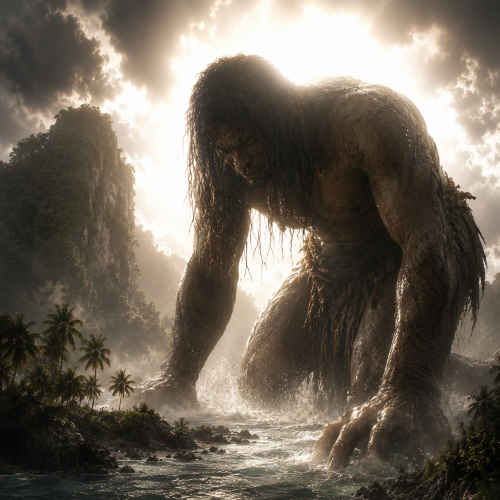
Uab is one of the most important figures in Palauan mythology, remembered as the giant whose body became the islands of Palau. Unlike many mythological characters who rule over nature or wield supernatural powers, Uab’s story is primarily an origin myth that explains the landscape of the archipelago while conveying lessons about greed, balance, and the relationship between people and their environment.
According to Palauan oral tradition, Uab was born on the island of Angaur as an ordinary child. However, his growth quickly became extraordinary. His appetite was impossible to satisfy, forcing the people around him to gather increasing amounts of food just to keep him alive. As he continued to grow, his immense weight caused the land itself to sink beneath the sea, threatening the survival of the community.
Unable to endure the destruction any longer, the villagers devised a plan to kill the giant. After his death, his enormous body was divided, and each part became a different island within the Palauan archipelago. Through this transformation, Uab became both a destructive force and the very foundation of the land itself. His legend remains one of Palau’s best-known creation stories and continues to connect modern Palauans with their ancestral traditions and the natural world.
Physical Traits
Uab is usually portrayed as a gigantic human-like being whose most defining characteristic is his extraordinary growth. Although he was born as a normal child, he rapidly grew into a colossal giant whose size surpassed anything human. His expanding body reflected his equally limitless appetite, making his physical presence inseparable from the central theme of the myth.
Rather than focusing on detailed physical features, Palauan traditions emphasize his overwhelming scale. His enormous body eventually became so heavy that it threatened to sink the island where he lived. This immense size ultimately explains why different parts of his body could transform into entire islands after his death.
Most versions describe Uab as male, although a few regional traditions portray the figure as female. These differences do not significantly change the narrative, which consistently presents Uab as an enormous being whose body shaped the geography of Palau. The myth therefore focuses less on appearance and more on the symbolic connection between the giant and the landscape.
Family
Unlike many legendary figures, Uab’s family background is not consistently preserved across Palauan oral traditions. Most versions focus almost entirely on his extraordinary life and the transformation of his body into the islands rather than his ancestry or descendants.
Some traditions identify Uab as the child of Latmikaik, an important creator goddess in Palauan mythology. In these accounts, Uab belongs to the earliest generation of mythological beings whose actions shaped the world before the later age associated with the goddess Milad. Other versions simply describe him as a child born on Angaur without naming his parents.
There are also less common traditions suggesting that Uab originated from a supernatural being connected to the sea. Because Palauan mythology was preserved through oral storytelling rather than written texts, these differing accounts naturally developed among various communities. Despite these variations, no consistent tradition identifies siblings, a spouse, or children, making Uab a largely solitary figure whose importance lies in his role as a creator through transformation.
Other names
The name Uab is the most widely accepted and commonly used form found in Palauan mythology. Pronunciation varies slightly between communities, reflecting regional dialects within Palau’s oral storytelling traditions.
Some academic sources record alternative spellings such as Uwab, while a few versions identify a female counterpart or variation named Chuab. These differences appear to reflect local traditions rather than entirely separate mythological characters.
Uab is also frequently described as the Greedy Giant, a descriptive title rather than an official name. This nickname highlights the defining characteristic of the legend—his endless hunger, which consumed the resources of his community and ultimately led to his downfall.
Powers and Abilities
Uab is not traditionally worshipped as a god, nor is he portrayed as possessing magical abilities in the conventional sense. Instead, his extraordinary characteristics serve symbolic purposes within the creation myth.
His most remarkable ability is his supernatural rate of growth. As his appetite increased, his body expanded to impossible proportions until his sheer weight threatened the stability of the island itself. His endless hunger represents uncontrolled consumption, making him both a physical and moral force within the story.
The greatest transformation occurs after his death. According to Palauan tradition, different parts of Uab’s body became the islands that make up modern Palau. While individual versions differ on which body parts correspond to specific islands, the central belief remains consistent: the geography of Palau originated from the giant’s body.
Rather than demonstrating magical powers through combat or miracles, Uab’s significance lies in his role as a primordial being whose existence literally became the land. This transformation makes him one of the most distinctive creation figures in Oceanian mythology.
Modern Day Influence
The legend of Uab continues to play an important role in Palauan culture, where it serves as both an explanation of the country’s landscape and a reminder of traditional values. The story is still shared through oral storytelling, schools, cultural programmes, and community events, helping preserve one of Palau’s oldest creation traditions.
Traditional bai, or Palauan meeting houses, often feature artwork depicting scenes from important myths, including stories associated with Uab. These visual representations help pass cultural knowledge from one generation to the next while reinforcing the connection between mythology and community identity.
The legend also carries an enduring moral message. Uab’s insatiable hunger symbolizes the dangers of greed, excess, and unsustainable consumption. As Palau continues to champion marine conservation and environmental stewardship, many educators and cultural organisations reference traditional stories like Uab’s to illustrate the importance of living in balance with nature.
Today, Uab remains more than a legendary giant. He represents the intimate relationship between people, land, and heritage that defines Palauan culture, reminding modern audiences that the islands themselves are inseparable from the stories that gave them meaning.
Related Images


Source
Eldredge, L. G. (Ed.). (2011). The religion of Palau. In Summoning the powers beyond: Traditional religion in Micronesia (pp. 149–170). University of Hawaiʻi Press. https://doi.org/10.21313/hawaii/9780824832032.003.0008
Island Times News. (2022, April 4). UAB and MILAD story of Palau. https://islandtimes.org/uab-and-milad-story-of-palau/
Language & Culture of Palau. (n.d.). Interactive map. https://ldtc-palauan.weebly.com/
OneReef. (2020, February 12). The return of the Palau giants. https://onereef.org/the-return-of-the-palau-giants/
UNESCO ICHCAP. (n.d.). Preserving traditional place names in Palau. https://archive.unesco-ichcap.org/kor/ek/sub10/pdf_down/01-3.%20Preserving%20Traditional%20Place%20Names%20in%20Palau.pdf
The concept of space and time in Palauan mythology. (n.d.). Izumi Syuppan. https://www.izumi-syuppan.co.jp/LLO_PDF/vol_14/14-02.pdf
Comparing religious narratives to the Palau creation story. (n.d.). Nape Lecture Center, BYU–Hawaii. https://napelacenter.byuh.edu/00000189-28db-df8d-a9a9-6dff0c870000/06-the-doctrine-and-legend-pdf
Barnett, H. G. (1949). Palauan Society: A Study of Contemporary Micronesian Culture. Eugene: University of Oregon Press.
Force, R. M., & Force, M. D. (1981). The Full Circle of Palau: A Culture of Respect. Pacific Anthropological Records.
Hijikata, H. (1993). Myths and Legends of Palau. Tokyo: Sasakawa Peace Foundation.
Johannes, R. E. (1981). Words of the Lagoon: Fishing and Marine Lore in the Palau District of Micronesia. Berkeley: University of California Press.
Frequently Asked Questions
Who is Uab in Palauan mythology?
Uab is a legendary giant in Palauan mythology whose enormous body is believed to have transformed into the islands of Palau after his death, making him a central figure in the nation’s creation stories.
Is Uab a god or a giant?
Uab is generally regarded as a mythic giant rather than a god. His importance comes from his role in the creation of the Palauan islands rather than divine authority or worship.
What does Uab symbolize?
Uab symbolizes the consequences of unchecked greed and excessive consumption while also representing creation, transformation, and the deep connection between people and the natural landscape.
How were the islands of Palau created according to the Uab legend?
According to Palauan tradition, after Uab was killed, different parts of his enormous body became the islands of the Palauan archipelago, explaining the origin of the nation’s geography.
Is the story of Uab still important today?
Yes. The legend remains an important part of Palauan cultural identity, preserving traditional history while teaching lessons about environmental stewardship, community responsibility, and respect for natural resources.


