


Xiangliu : The Nine-Headed Serpent of Chinese Folklore
At a glance
| Description | |
|---|---|
| Origin | Chinese Mythology |
| Classification | Hybrids |
| Family Members | N/A |
| Region | China |
| Associated With | Poisonous wetlands, Destructive floods, Serpent |
The Mythlok Perspective
In Mythlok’s Perspective, Xiangliu represents something more disturbing than a conventional monster: destruction that continues long after its source has disappeared. Unlike the Greek Hydra, whose defining threat lies in its regenerative heads, Xiangliu’s mythology emphasises environmental devastation and poisoned landscapes. His story reflects an ancient understanding that defeating a destructive force is only the beginning of restoring what it has damaged.
Xiangliu
Introduction
Xiangliu (相柳), also known as Xiangyao (相繇), is a monstrous nine-headed serpent from ancient Chinese mythology. Described in the Shanhaijing (山海經), commonly translated as the Classic of Mountains and Seas, Xiangliu is associated with destructive floods, poisoned wetlands and the devastation of natural landscapes. He is identified as a minister of Gonggong, a powerful water deity connected with catastrophic floods and disorder.
Unlike many Chinese mythological creatures whose stories revolve around supernatural powers or divine rivalries, Xiangliu represents the destructive consequences of uncontrolled natural forces. His presence transforms fertile landscapes into marshes and ravines, leaving regions unsuitable for human habitation. His story is closely connected with Yu the Great, the legendary ruler celebrated for controlling the Great Flood and restoring order to the land.
The surviving accounts of Xiangliu appear primarily in two sections of the Classic of Mountains and Seas: the Classic of Regions Beyond the Seas: North and the Classic of the Great Wilderness: North. Although the creature’s name differs between these passages, their descriptions share several characteristics, including nine heads, a serpent’s body and an association with Gonggong.
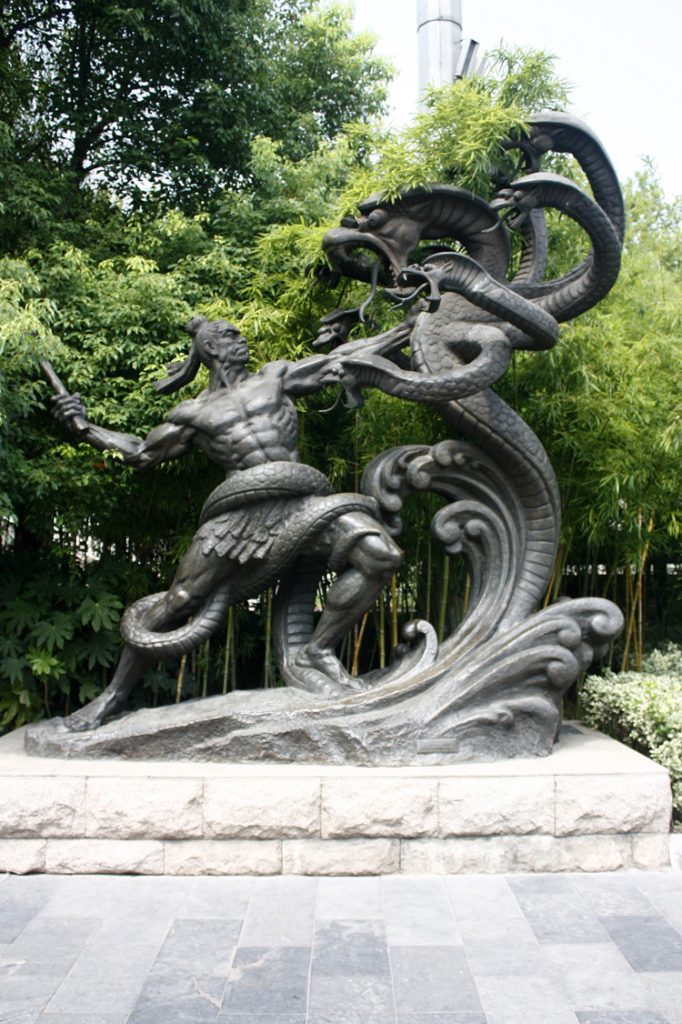
Xiangliu’s eventual defeat by Yu the Great forms an important part of this mythological narrative. However, killing the creature does not immediately restore the damaged environment. Its poisonous blood continues to contaminate the land, demonstrating how the consequences of destruction can survive even after the destructive force itself has been defeated.
Physical Traits
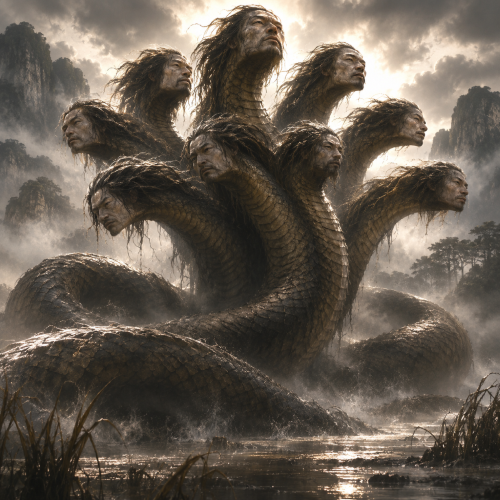
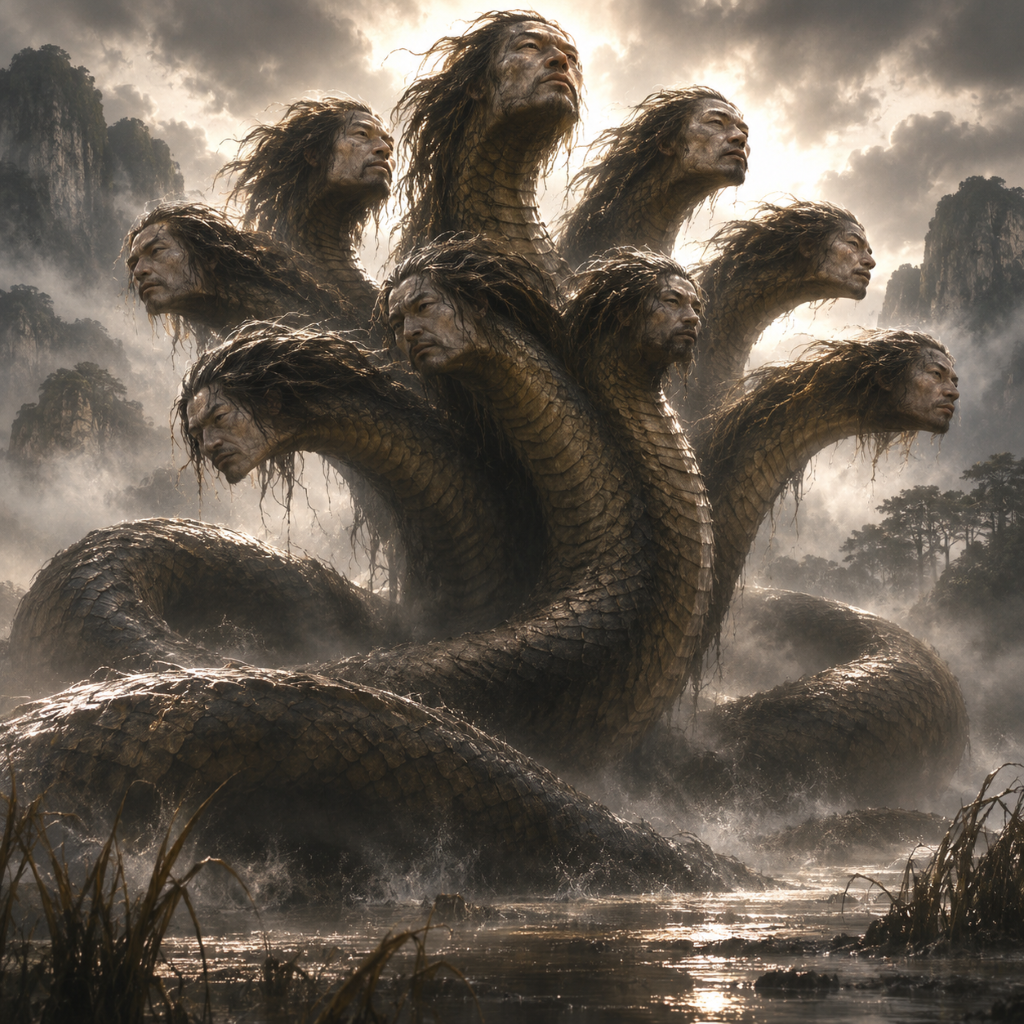
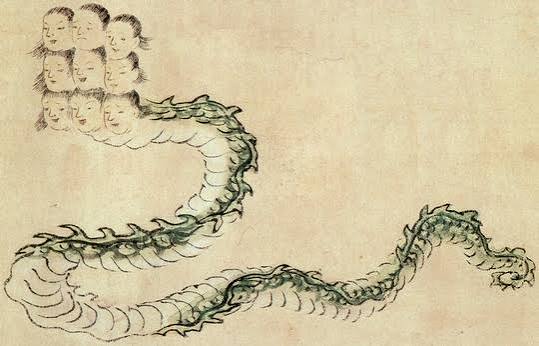
Xiangliu is traditionally depicted as an enormous serpent with nine heads, each possessing a human face. The Classic of Mountains and Seas describes his body as blue-green, giving the creature a distinctive appearance that separates him from ordinary serpents in Chinese folklore. The Classic of the Great Wilderness: North provides additional details about his anatomy. It describes Xiangliu as having a serpent’s body that coils around itself, emphasising his immense size and unusual physical structure. His nine heads are particularly significant because they allow him to feed across multiple territories simultaneously.
The ancient descriptions do not establish precise measurements or provide an extensive account of his anatomy. Consequently, modern illustrations showing nine independent snake necks, elaborate scales or additional monstrous features should be understood as artistic interpretations rather than confirmed details from the earliest texts. His appearance combines human and animal characteristics, creating a creature that exists outside the boundaries of ordinary nature. The human faces attached to a serpentine body also give Xiangliu an unsettling quality, reflecting his position within the supernatural world of ancient Chinese mythology.
Family
Xiangliu’s surviving mythological accounts do not identify his parents, siblings, spouse or offspring. There is no established genealogy that connects him to a particular divine family or lineage. His most important relationship is with Gonggong (共工), the water deity whom he serves as a minister or subordinate. This association places Xiangliu within Gonggong’s supernatural retinue and connects his destructive behaviour with the wider mythology of floods and cosmic disorder.
Gonggong himself appears in several Chinese mythological traditions as a powerful figure associated with water and catastrophic upheaval. His conflicts with other divine and legendary figures form part of the broader collection of stories explaining the relationship between natural forces and cosmic order. Xiangliu’s relationship with Gonggong is therefore based on allegiance and service rather than documented blood relations. Although later adaptations sometimes introduce more elaborate personal histories, the ancient sources do not establish any additional family connections.
Other names
Xiangliu is also known as Xiangyao (相繇), an alternative name recorded in the Classic of the Great Wilderness: North. The name Xiangliu (相柳) appears in the Classic of Regions Beyond the Seas: North. Both passages describe a nine-headed serpent associated with Gonggong and the destructive transformation of the landscape. Their shared characteristics have led translators and modern references to identify Xiangyao and Xiangliu as alternative names for the same mythological being.
The two names should not be confused with entirely separate creatures. Their appearance in different sections of the same ancient work reflects variations in the textual traditions through which Chinese mythology was preserved. In contemporary Chinese popular culture, the name is also written as Xiang Liu, particularly in modern literary and television adaptations.
One notable example is Lost You Forever (Chang Xiang Si), a fantasy romance novel by Tong Hua. Its television adaptation features a character named Xiang Liu, portrayed by Tan Jianci. Although inspired by the ancient serpent, this interpretation introduces a considerably more developed personality and storyline than the original mythological figure.
Powers and Abilities
Xiangliu’s defining abilities revolve around environmental destruction, poisonous contamination and his association with water. His enormous body and nine heads allow him to feed from nine mountains or territories. The Classic of Mountains and Seas describes how the places touched by his body became marshes and ravines. This transformation suggests that his destructive influence extended beyond physical damage, fundamentally changing the surrounding landscape.
His presence also produces poisonous wetlands. In the Classic of the Great Wilderness: North, the waters formed wherever Xiangliu vomited or rested are described as bitter and unsuitable for wildlife. The surrounding environment becomes incapable of supporting ordinary animal life. His poisonous nature remains significant even after death. According to the ancient narrative, Yu the Great eventually kills Xiangliu while controlling the Great Flood. However, the creature’s foul blood contaminates the soil, preventing the cultivation of the five traditional grains.
Yu attempts to restore the damaged ground by filling and raising the earth, but the land repeatedly collapses. Eventually, the affected area becomes a pool and is transformed into a ceremonial terrace associated with the ancient rulers or divine sovereigns. This episode highlights an important aspect of Xiangliu’s destructive influence: defeating the creature does not automatically reverse the environmental damage it has caused. Although modern interpretations sometimes attribute additional supernatural abilities to Xiangliu, the earliest surviving descriptions primarily establish his nine-headed anatomy, destructive environmental influence and poisonous nature.
Modern Day Influence
Xiangliu continues to attract interest through contemporary interpretations of Chinese mythology, particularly in literature, television and fantasy storytelling. One of the most prominent modern appearances is in Lost You Forever, the fantasy novel by Tong Hua and its television adaptations released in 2023 and 2024. The series features Xiang Liu, portrayed by Tan Jianci, as a significant character. His identity draws inspiration from the ancient nine-headed serpent, although the adaptation transforms the original monster into a complex character with personal loyalties, relationships and emotional conflicts.
This interpretation differs considerably from the Classic of Mountains and Seas. The ancient Xiangliu is primarily remembered for his destructive nature and association with Gonggong, whereas the television character develops an independent narrative that explores devotion, sacrifice and personal identity. Beyond television, Xiangliu remains an interesting subject for comparative mythology and research into ancient Chinese cosmology. His nine-headed appearance also invites comparisons with creatures such as the Greek Hydra, although the two belong to different cultural traditions and mythological contexts.
His story offers a fascinating example of how ancient Chinese literature connected supernatural creatures with the physical environment. Rather than presenting destruction as an isolated act of violence, the Xiangliu narrative explores its lasting consequences for the natural world. Through his association with Gonggong and his eventual defeat by Yu the Great, Xiangliu remains an enduring figure in Chinese mythology, representing the dangerous relationship between uncontrolled natural forces and the human struggle to restore balance.
Related Images

Source
Birrell, A. (1999). Chinese mythology: An introduction. Johns Hopkins University Press.
Strassberg, R. E. (2002). A Chinese bestiary: Strange creatures from the Guideways through mountains and seas. University of California Press.
Yang, L., An, D., & Turner, J. A. (2005). Handbook of Chinese mythology. ABC-CLIO.
Major, J. S. (1993). Heaven and earth in early Han thought: Chapters three, four, and five of the Huainanzi. State University of New York Press.
Classic of Mountains and Seas. (n.d.). Classic of regions beyond the seas: North. Wikisource. https://en.wikisource.org/wiki/Classic_of_Mountains_and_Seas
Xiangliu. (2026, March 26). The Crazy Alchemist. https://www.crazyalchemist.com/bestiary/xiangliu/
Xiang Liu. (2024, April 21). Baidu Baike. https://baike.baidu.com/en/item/Xiang%20Liu/1417987
Xiang Liu. (n.d.). MyDramaList. https://mydramalist.com/757669-lost-you-forever-season-2
Frequently Asked Questions
Who is Xiangliu in Chinese mythology?
Xiangliu is a nine-headed serpent from Chinese mythology who served Gonggong. He is associated with destructive floods, poisonous wetlands and the environmental devastation described in the Classic of Mountains and Seas.
Why does Xiangliu have nine heads?
Xiangliu’s nine heads are a defining feature of his mythological identity. According to the Classic of Mountains and Seas, he could feed from nine mountains or territories simultaneously.
Who killed Xiangliu in Chinese mythology?
Yu the Great killed Xiangliu while controlling the Great Flood. However, the serpent’s poisonous blood contaminated the surrounding land, preventing crops from growing.
Is Xiangliu related to Gonggong?
Xiangliu is described as a minister or subordinate of Gonggong, the Chinese water deity. Ancient sources do not establish a biological family relationship between them.
What is the difference between Xiangliu and Xiangyao?
Xiangliu and Xiangyao are alternative names for the same nine-headed serpent in different sections of the Classic of Mountains and Seas.


