


Buitani : The Nauruan Spirit Island of the Dead
| Description | |
|---|---|
| Mythology | Nauruan Mythology |
| Description | Island of spirits |
| Ruler/Guardian | Ancestral spirits |
| Inhabitants | Noble souls, Frigate bird |
| Nature | Neutral |
Mythlok Perspective
In Mythlok’s Perspective, Buitani stands apart from the better-known underworlds of Tartarus and Helheim because it feels less like a prison for the dead and more like an ancestral homeland beyond the horizon. Its frigate bird gives the mythology an especially powerful Oceanic character, transforming a familiar island bird into a bridge between worlds. Buitani ultimately reflects a worldview in which death changes a person’s place of existence without completely severing the relationship between ancestors, community and landscape.
Buitani
Introduction
Buitani is one of the most distinctive concepts in Nauruan mythology: a spirit island associated with the dead and the continuation of existence beyond death. In traditional Nauruan belief, a person became an eani, or spirit, after death and began a journey toward the realm of the dead. Buitani was not simply imagined as a dark or terrifying underworld. Accounts describe it as an island where spirits continued to exist, making the afterlife resemble the familiar social and natural world of Nauru.
The tradition is part of a wider Nauruan indigenous religious system in which ancestors, spirits, natural places and supernatural beings were closely connected. Some dead spirits were believed to reach Buitani, while others could remain associated with places in Nauru such as the ocean, stones or vegetation.
Because much of Nauruan mythology was transmitted orally and recorded by ethnographers at different periods, details vary between sources. The strongest evidence presents Buitani as a spirit land and destination of the dead, rather than as a fully mapped realm with a permanent ruler, elaborate architecture or a conventional system of punishment.
Description
Buitani is described as an island of spirits and, in some accounts, as a spiritual manifestation of the Earth itself. It was understood as the destination of deceased Nauruans whose spirits successfully completed the journey after death. One important feature of the tradition is that the afterlife was not necessarily portrayed as radically different from earthly existence. Buitani could be imagined as an island resembling Nauru, but existing beyond the ordinary human world.
The Nauruan spiritual landscape also extended beyond Buitani. Spirits could inhabit elements of the natural environment, including the sea, stones and vegetation. Household spirits were likewise part of traditional religious practice, with offerings made to protective spirits associated with families and homes. This makes Buitani important not merely as a destination after death, but as part of a worldview in which the boundary between people, ancestors and landscape remained permeable.
Ruler/Guardian
Unlike Hades in Greek mythology or Hel in Norse tradition, Buitani has no securely documented single ruler who governs the realm of the dead. Earlier summaries sometimes connect Buitani with major figures in Nauruan mythology, including Eijebong and Areop-Enap, but the available evidence does not establish either figure as the sovereign or guardian of Buitani.
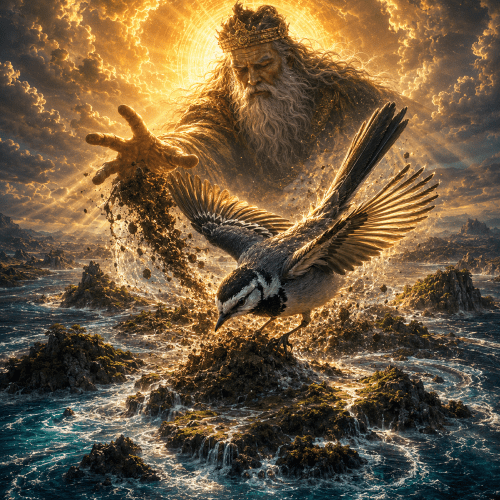
The more clearly attested supernatural intermediary is the frigate bird. Ethnographic accounts describe the bird as closely associated with ancestral spirits and with the passage between the spirit world and the human world. In one recorded account of the journey after death, the deceased spirit travels onward in an outrigger canoe guided by a frigate bird. The bird therefore occupies a more defensible role as a spiritual intermediary than as a literal ruler of Buitani.
Inhabitants
The principal inhabitants of Buitani are the spirits of the dead, known in Nauruan tradition as eani. Historical accounts describe the deceased as becoming spirits immediately after death and beginning a journey toward the land of the dead. Not every spirit necessarily remained in Buitani. Traditional accounts also describe spirits associated with natural features of Nauru, including stones, the ocean and vegetation. These beliefs helped connect ancestral presence to the physical landscape.
The frigate bird was especially significant because it was understood as an intermediary connected with ancestral spirits. Some ethnographic interpretations describe spirits as descending into or appearing through frigate birds, reinforcing the bird’s role as a living link between the human and spiritual worlds.
Access
The journey to Buitani was more than a simple passage from life into an afterlife. One ethnographic account describes the newly deceased spirit travelling toward ebwiyeye, a sharp-edged pinnacle associated with judgment. The spirit had to pass beneath it without being harmed. The episode functioned as a test of the person’s conduct in life, with wrongdoing associated particularly with shame and exposure before other spirits.
After this passage, the spirit travelled toward the horizon, described as the place “where the sea and the sky meet,” and continued toward the land of the dead in an outrigger canoe guided by a frigate bird. Traditional accounts also locate the earthly entrance to Buitani at Anibare Bay. A banana tree has been associated with the location of this legendary gateway. This should be understood as a sacred geographical tradition rather than evidence of a literal physical portal.
Instances of Visit
Unlike the Greek story of Orpheus entering Hades or other traditions built around heroic journeys to the underworld, Nauruan mythology does not preserve a large body of stories about living heroes travelling to Buitani and returning.
The better-documented form of contact involved communication with the dead. Historical accounts state that spirits residing in Buitani could be invoked through trance by a medium. This suggests that the relationship between the living and Buitani was maintained through ritual and spiritual communication rather than through physical exploration of the realm. This distinction is important. Buitani was not primarily an adventure setting in Nauruan mythology. It was a sacred destination of the dead and a continuing source of ancestral presence.
Symbolism
Buitani represents the continuity of existence beyond death. Its island form is especially meaningful because Nauru itself is an island society; imagining the afterlife as another island creates a familiar geographical image for an otherwise invisible spiritual destination.
The frigate bird symbolizes movement between worlds. Its ability to travel far over the ocean made it an especially powerful natural image for a spirit messenger and intermediary. Historical Nauruan and wider Pacific traditions also demonstrate the practical importance of trained frigate birds as carriers and messengers, strengthening the bird’s cultural association with communication and movement.
The Anibare gateway connects mythology with the physical landscape, while the journey through ebwiyeye introduces an element of moral accountability. Together, these motifs express a worldview in which death, ancestry, morality and the natural environment remain interconnected.
Comparative Analysis
Buitani differs from many famous underworlds because it is not primarily defined by eternal punishment. Greek Hades, Norse Hel and other underworld traditions contain rulers, territories and distinctive systems governing the dead, whereas Buitani is less elaborately structured in the surviving Nauruan evidence.
Its closest comparison is perhaps with other Pacific concepts of ancestral destinations, where the dead remain connected to the living world and the landscape. Yet Buitani has its own distinctive features, particularly the island setting, the frigate bird as intermediary and the journey through ebwiyeye.
The comparison also highlights an important difference in emphasis. Rather than presenting death as a descent into a frightening subterranean realm, Nauruan tradition can portray it as a movement toward another island beyond the horizon. Buitani is therefore better understood as a spirit homeland than as a purely punitive underworld.
Modern Influence
Traditional belief in Buitani declined substantially following Christianization and the wider transformation of Nauruan society during the colonial period. Much of what is known today comes from ethnographic records and collections of Nauruan traditions, particularly material recorded in the early twentieth century.
The mythology nevertheless remains important for understanding Nauru’s indigenous worldview. Buitani preserves ideas about ancestral spirits, sacred geography and the relationship between human communities and the natural environment. The frigate bird, Anibare and the traditions surrounding the dead provide particularly strong links between mythology and Nauru’s cultural memory.
Rather than treating Buitani simply as a forgotten “Nauruan underworld,” it is more accurate to view it as part of a broader spiritual system in which death did not necessarily sever a person from the community or landscape. Its continued presence in cultural and scholarly discussions demonstrates how oral traditions can survive even after the religious systems that produced them have undergone profound change.


Sources
Wikipedia (DE). “Buitani.” https://de.wikipedia.org/wiki/Buitani
Wikipedia (EN). “Nauruan indigenous religion.” https://en.wikipedia.org/wiki/Nauruan_indigenous_religion
Hambruch, Paul. Nauru. Ergebnisse der Südsee-Expedition, 1908–1910. Vol. 1, parts 1–2. Hamburg: Friederichsen, 1914–1915.
Detudamo, Timothy (ed.). Legends, Traditions and Tales of Nauru. Suva: IPS Publications, University of the South Pacific, 2008.
Dixon, Roland Burrage. Oceanic Mythology. Vol. 9, The Mythology of All Races. Boston: Marshall Jones Company, 1916.
Sellmann (review of Dobbin). “Summoning the Powers Beyond: Traditional Religions in the Caroline Islands.” Pacific Arts Institute (PAI) Journal, vol. 5, University of Guam. https://www.uog.edu/resources/files/schools-and-colleges/college-of-liberal-arts-and-social-sciences/pai/pai5-sellmann-book-review-dobbin.pdf
Frequently Asked Questions
What is Buitani in Nauruan mythology?
Buitani is the spirit island or land of the dead in traditional Nauruan mythology. It was believed to be the destination of deceased spirits, or eani, after death.
Where is Buitani located?
Buitani is a supernatural realm rather than a physical island that can be reached by ordinary travel. Traditional accounts associate its earthly entrance with Anibare Bay on Nauru, where a banana tree has been identified with the legendary gateway.
Who rules Buitani?
There is no securely documented single ruler of Buitani. Unlike Greek Hades or Norse Hel, Nauruan traditions do not clearly identify a monarch governing the realm. The frigate bird has a more clearly documented role as an intermediary connected with the spirits of the dead.
How do the dead reach Buitani?
Recorded Nauruan traditions describe the dead becoming eani and travelling toward ebwiyeye, a sharp pinnacle associated with judgment. After passing this stage, the spirit travels toward the horizon and onward to the land of the dead, with a frigate bird guiding an outrigger canoe.
Why is the frigate bird important in Nauruan mythology?
The frigate bird is closely associated with ancestral spirits and communication between the living world and Buitani. It functions as a spiritual intermediary and, in accounts of the afterlife journey, guides the deceased toward the land of the dead.
