


Ainu Creation Story : Kamui and the Bird That Created the Land
| Description | |
|---|---|
| Origin | Ainu Mythology |
| Country | Japan |
| Deities Involved | Kamui, Wagtail bird |
| Symbolism | Tides, Transformation, Chaos |
| Process | World built on fish, Wagtail fluttered/stomped, Islands formed |
Mythlok Perspective
In Mythlok’s Perspective, the Ainu Creation Story stands out because it gives a humble bird the responsibility of shaping the world. While many creation myths celebrate the power of gods, this narrative emphasizes patience, cooperation, and respect for nature. The wagtail succeeds not through force but through steady effort, reflecting a worldview in which every living being has value. The story also presents a deeply ecological vision of creation. Rather than separating humans from nature, it places them within a sacred network of spirits, animals, and landscapes. This idea resembles certain Native American earth-diver traditions and aspects of Siberian indigenous cosmologies, where animals act as creators and mediators between worlds. The Ainu myth reminds us that creation is not always about domination; sometimes it is about partnership with the natural world.
Ainu Creation Story
Introduction
The Ainu Creation Story is one of the most fascinating origin myths from northern Japan. Passed down through generations of the Ainu people, this tale explains how the world transformed from a shapeless mass of mud and water into a land where humans, animals, and spirits could thrive. Unlike many creation myths that focus on powerful gods acting alone, the Ainu story highlights cooperation between divine beings and animals. At its center are Kamui, the supreme creator, and a small wagtail bird whose simple actions shaped the earth itself.
For the Ainu, creation was not a single dramatic event but a gradual process that reflected the close relationship between the natural and spiritual worlds. The myth reinforces the belief that every creature has a purpose and that even the smallest being can play a role in shaping existence.
Cosmic Origins
According to traditional Ainu beliefs, the world began as a vast expanse of mud and water. There were no forests, mountains, rivers, or living creatures. Everything existed in a state of disorder, with the earth resembling a swampy sea stretching endlessly in every direction.
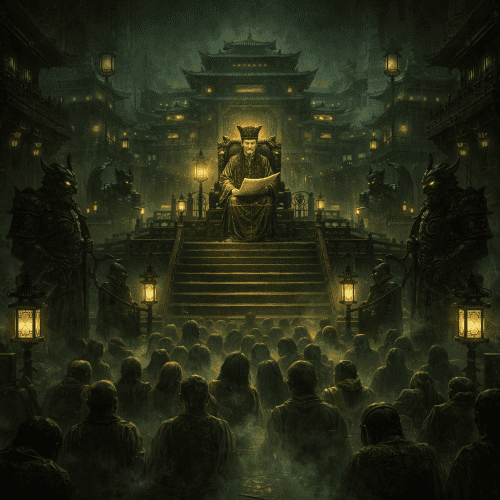
Above this primordial world stood multiple heavenly realms inhabited by divine beings. The highest of these heavens was the dwelling place of Kamui, the supreme creator spirit. Some versions of the story describe his celestial home as lying beyond a great iron gate, emphasizing the distance between the divine realm and the unfinished world below.
Ainu cosmology also describes several layers of existence, including heavenly worlds above and spiritual realms beneath the earth. The human world occupied the middle position within this cosmic structure. Before life could emerge, however, the chaotic waters below had to be transformed into stable land.
Another important feature of the myth is the belief that the earth rested upon the back of a giant fish. The fish’s movements and breathing caused the tides to rise and fall, linking the rhythms of nature to the foundations of creation itself.
Deities and Forces Involved
The central figure in the Ainu Creation Story is Kamui, the supreme creator spirit. In Ainu belief, the word “kamuy” refers to powerful spiritual beings that inhabit natural forces, animals, and important aspects of the world. While many kamuy exist, Kamui is often portrayed as the highest creator responsible for organizing the cosmos.
Kamui observed the formless world below and decided to make it suitable for life. Rather than shaping the earth directly, he entrusted part of the task to another being. That being was the wagtail, sometimes identified as the Water Wagtail or Moshiri-kor-kamuy. Though small in size, the bird possessed a sacred purpose. Kamui selected it to prepare the muddy world for future inhabitants.
The giant fish supporting the earth also plays a significant role. It serves as the foundation of the world and helps regulate the tides through its breathing. Together, Kamui, the wagtail, and the fish represent different aspects of creation, showing how divine and natural forces work together to establish order.
Later Ainu traditions mention other important spirits, including Kamuy-huci, the goddess of fire, and Kotan-kar-kamuy, another creator figure associated with the formation of the world. These variations reflect the diversity of oral traditions that developed across Ainu communities.
Process
The creation process began when Kamui placed the world upon the back of the giant fish. Although this provided a foundation, the surface remained soft, muddy, and unsuitable for life. To solve this problem, Kamui sent the wagtail down from the heavens. When the bird arrived, it found nothing but water and mud. Unsure of what to do, it began fluttering its wings over the surface. It splashed water aside and landed repeatedly on patches of soft earth.
As the wagtail moved about, it stamped the mud with its feet and struck it with its tail. Through these actions, the wet ground gradually became firm. The bird continued this work tirelessly, transforming unstable areas into solid land.
Over time, islands emerged from the watery chaos. These islands eventually became the homeland of the Ainu people and the habitat of countless plants and animals. The creation of land marked the beginning of a world capable of sustaining life. What makes the story remarkable is its emphasis on humble effort rather than overwhelming power. A small bird, acting with persistence and determination, accomplishes a task that shapes the future of the world.
Symbolism
The Ainu Creation Story contains rich symbolic meanings that reflect the worldview of the Ainu people. The giant fish symbolizes stability beneath apparent uncertainty. Although hidden beneath the earth, it supports the world and creates the natural rhythms of the tides. This reflects the idea that unseen forces sustain life.
The wagtail represents transformation and perseverance. Despite its modest size, it becomes the agent through which order emerges from chaos. Its role teaches that greatness is not determined by strength alone but by dedication and purpose. Mud and water symbolize the raw, unformed state of existence before creation. They represent potential rather than emptiness, suggesting that order can emerge from disorder through effort and guidance.
The bird’s stamping and fluttering symbolize the process of shaping nature rather than conquering it. Creation is portrayed as cooperation with the natural world rather than domination over it. Perhaps most importantly, the myth reflects the Ainu belief that animals and spiritual beings are partners in the maintenance of the cosmos. Nature is not separate from the sacred; it is an expression of it.
Comparative Analysis
The Ainu Creation Story shares similarities with many creation myths around the world while retaining distinctive characteristics. One notable parallel is the “earth-diver” motif found in Native American and Central Asian traditions. In these stories, animals help create land from primordial waters. While the Ainu wagtail does not dive beneath the water to retrieve mud, it performs a comparable role by transforming a watery world into habitable land.
The myth also bears similarities to Japanese Shinto traditions. In the Shinto creation story, the divine couple Izanagi and Izanami create the islands of Japan by stirring the ocean with a sacred spear. Both traditions describe islands emerging from a watery beginning, although the Ainu version places greater emphasis on animal participation.
On a broader level, the story reflects a universal theme found in cultures across the globe: the transformation of chaos into order. Unlike myths that rely on cosmic battles or divine conflict, however, the Ainu narrative presents creation as a peaceful act of cooperation between spiritual and natural forces.
Legacy
For centuries, the Ainu Creation Story was preserved through oral tradition. Storytellers passed it from one generation to the next through songs, narratives, and ceremonial performances. The myth reinforced the Ainu understanding of their relationship with the land. Because the islands were shaped through sacred actions, the natural world was viewed as deserving respect and gratitude. Animals, rivers, forests, and mountains were not merely resources but living expressions of spiritual power.
The story also helped define Ainu identity. By explaining the origins of their homeland and their connection to it, the myth provided a cultural foundation that united communities across generations. Today, it remains one of the most important examples of Ainu spiritual heritage and continues to be studied by scholars interested in indigenous traditions and comparative mythology.
Modern Influence
Interest in the Ainu Creation Story has grown significantly in recent decades. As awareness of Ainu history and culture increases, the myth has become an important symbol of indigenous identity and cultural revival. Researchers and mythologists, including figures such as John Batchelor and David Leeming, have documented and analyzed Ainu traditions, helping introduce them to international audiences.
Contemporary Ainu communities continue to share the story through educational programs, museums, artistic projects, and cultural festivals. The tale serves as a reminder of the enduring relationship between people, nature, and the spiritual world.
Elements of Ainu mythology have also appeared in literature, films, manga, anime, and video games. These modern adaptations have brought greater visibility to Ainu traditions while encouraging new generations to explore the rich heritage behind the stories. As discussions about environmental stewardship and indigenous knowledge become increasingly important, the Ainu Creation Story offers a powerful perspective on living in harmony with the natural world.

Sources
Leeming, D. A. (2010). Creation myths of the world: An encyclopedia (2nd ed., Vol. 1). ABC-CLIO.
Wikipedia. (2010). Ainu creation myth. Wikipedia. https://en.wikipedia.org/wiki/Ainu_creation_myth
Omnika. (2024). Myth summary: Kamui and wagtail genesis. OMNIKA. https://omnika.org/myths/kamui-and-wagtail-genesis
Ainu.info. (2009). Religion. Ainu.info. https://www.ainu.info/Ainu-Indigenous-rights/Religion.html
Wikipedia. (2007). Kamuy. Wikipedia. https://en.wikipedia.org/wiki/Kamuy
Wikiwand. (1998). Kamui. Wikiwand. https://www.wikiwand.com/en/articles/Kamui
Nakashima, R. (2024, December 7). Ainu Creation Myths: The Birth of the World and Its Spirits. Japanese Mythology.
Frequently Asked Questions
What is the Ainu Creation Story?
The Ainu Creation Story explains how Kamui sent a wagtail bird to transform a world of mud and water into habitable land for future life.
Who is Kamui in Ainu mythology?
Kamui is the supreme creator spirit who organized the world and directed other spiritual beings to help shape creation.
Why is the wagtail important in the Ainu Creation Story?
The wagtail created solid land by fluttering, splashing water away, and stamping the mud, making the world suitable for life.
What does the giant fish symbolize in Ainu mythology?
The giant fish supports the earth and creates the tides, symbolizing the hidden forces that sustain the natural world.


